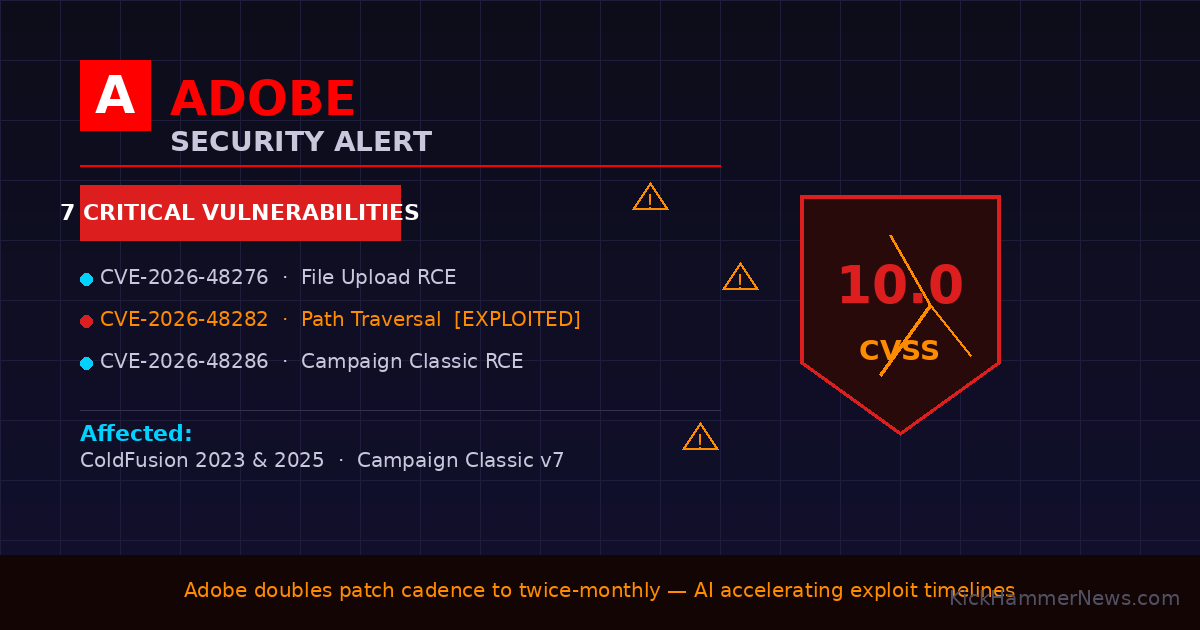
When Adobe released its July security bulletins on July 1, 2026, the numbers were alarming enough to stop any enterprise IT administrator in their tracks: nine vulnerabilities across two products, seven of them carrying a perfect 10.0 CVSS score — the highest possible severity rating in the industry. Within 72 hours of disclosure, one of those flaws was already under active exploitation in the wild.
But buried beneath the urgent patch notices was a larger story that will reshape how organizations think about software security in the age of artificial intelligence: Adobe is fundamentally restructuring its vulnerability response process because AI has compressed the window between patch release and active exploitation from days to mere hours.
The Vulnerabilities: What’s at Stake
The disclosure covers two Adobe products: ColdFusion, the enterprise web application development platform used by thousands of organizations including government agencies and financial institutions, and Adobe Campaign Classic, a widely deployed on-premises marketing automation platform.
For ColdFusion 2023 (versions 2023.20 and earlier) and ColdFusion 2025 (versions 2025.9 and earlier), Adobe patched eight vulnerabilities, six of which earned the maximum CVSS 10.0 rating:
- CVE-2026-48276 and CVE-2026-48283: Unrestricted file upload vulnerabilities with dangerous file type handling, enabling arbitrary code execution. No authentication required.
- CVE-2026-48277, CVE-2026-48281, and CVE-2026-48316: Improper input validation flaws, each allowing remote code execution in low-complexity attacks.
- CVE-2026-48282: A path traversal vulnerability that enables arbitrary code execution — and the one that came under active exploitation within hours of patch release.
- CVE-2026-48313 (CVSS 9.3): A separate path traversal flaw allowing arbitrary file system read.
- CVE-2026-48315 (CVSS 9.3): An improper input validation issue enabling privilege escalation.
Adobe Campaign Classic was separately patched for CVE-2026-48286 (CVSS 10.0), a critical incorrect authorization flaw affecting on-premises deployments of ACC v7 build 9396 and earlier on both Windows and Linux. Successful exploitation allows an attacker to execute arbitrary code. Adobe-hosted instances were silently patched without customer action required; organizations running self-hosted or hybrid Campaign deployments must manually apply version 9397.
Adobe has assigned all of these flaws its highest “Priority 1” designation, recommending administrators apply patches within 72 hours.
From Days to Hours: The Exploitation Timeline
The speed of exploitation for CVE-2026-48282 is striking even by modern standards. Security researcher Ryan Dewhurst, founder of the KEVIntel threat intelligence platform, reported a confirmed exploitation attempt within hours of the patch going public. A single attacker operating from an IP address geolocated to India attempted to read the Windows system file C:\Windows\win.ini — a classic probe technique used to confirm arbitrary file read capability before escalating to more damaging payloads.
Independent research from watchTowr Labs adds further context to the severity. Their analysis revealed that CVE-2026-48282, initially characterized as a path traversal flaw, is more precisely an arbitrary file write vulnerability, while CVE-2026-48313 functions as an arbitrary file read. The patch quietly addressed additional undisclosed issues involving arbitrary file move, delete, directory creation, and directory listing — suggesting the attack surface was even broader than the advisory indicated.
Security researcher Sina Kheirkhah documented the mechanics of CVE-2026-48276 in detail: after the patch, several file extensions including .jspf, .cfmail, and .war were added to a block list, and a new
Adobe’s Strategic Response: Doubling the Cadence
Perhaps the most significant development in Adobe’s disclosure wasn’t in the vulnerability list itself, but in the accompanying announcement from Chief Security Officer Aanchal Gupta: starting July 14, 2026, Adobe is moving from monthly to twice-monthly security bulletins, releasing advisories on the second and fourth Tuesday of each month.
“The frontier AI capabilities we are using are also available to attackers,” Gupta wrote in a blog post. “And the window between public vulnerability disclosure and active exploitation is compressing from days to hours. We are applying AI to find and fix vulnerabilities first, and getting those fixes to customers faster is the natural next step.”
The statement is a rare moment of candor from a major software vendor acknowledging that the traditional monthly patch cycle — long a cornerstone of enterprise IT operations — is structurally inadequate for a threat environment where AI gives both defenders and attackers dramatically accelerated capabilities.
ColdFusion is particularly sensitive terrain here. The platform has a well-documented history of exploitation, with CISA having added 79 Adobe product flaws to its Known Exploited Vulnerabilities catalog over the past five years. Ten of those have been weaponized by ransomware operators. ColdFusion servers are often found at the edge of enterprise networks, processing customer-facing web applications, and a full SYSTEM-level compromise represents a beachhead into internal infrastructure.
What This Means for Enterprise IT
For organizations running ColdFusion, the immediate priority is straightforward: apply ColdFusion 2023 Update 21 or ColdFusion 2025 Update 10 immediately. If your deployment timeline prohibits immediate patching, disable the file upload functionality in ColdFusion’s administrator settings as an interim control — it is off by default, and the most critical exploitation paths require it to be active.
For Campaign Classic administrators, upgrade to ACC v7 build 9397. If you’re unsure whether your deployment is Adobe-hosted or on-premises, contact Adobe support — on-premises instances are unpatched and actively at risk.
Beyond the immediate remediation, Adobe’s cadence change signals something important for enterprise patch management teams. Many organizations have built their vulnerability management workflows around monthly vendor patch releases, scheduling maintenance windows and testing cycles on predictable 30-day cycles. As major software vendors begin shifting to twice-monthly or even more frequent schedules in response to AI-accelerated exploitation, those workflows will need to adapt.
Gartner research published earlier this year found that the median time-to-exploitation for newly disclosed critical vulnerabilities had dropped to under 18 hours in the first quarter of 2026, down from approximately 4.5 days in 2024. That compression is driven almost entirely by threat actors using AI to analyze patches, reverse-engineer the underlying vulnerability, and generate working exploits at machine speed.
Microsoft made a similar operational shift in its Patch Tuesday communications in late 2025, adding explicit exploitation likelihood ratings and prioritizing a subset of “act within 24 hours” patches separately from the monthly rollup. Adobe’s move follows the same logic: when the threat clock is measured in hours, a monthly response cadence is a structural disadvantage.
The Broader Picture
The ColdFusion disclosure arrives against a backdrop of sustained pressure on enterprise software security. Oracle patched a critical E-Business Suite flaw actively exploited in the wild just weeks ago. Linux kernel vulnerabilities have drawn renewed scrutiny as enterprise Linux deployments accelerate following Windows 10’s end of support. The first half of 2026 has been marked by a dramatic increase in the speed and sophistication of vulnerability exploitation across the enterprise software stack.
Adobe’s response — doubling its patch cadence, deploying AI for internal vulnerability discovery, and maintaining an out-of-band emergency response process for zero-days — represents a mature, if belated, acknowledgment that the game has changed. The question for enterprise security teams is whether their own processes can keep pace.
For now, the actionable answer is simple: patch ColdFusion and Campaign Classic today, not at the end of the month.
Sources: The Hacker News, BleepingComputer, watchTowr Labs, Adobe Security Advisories APSB26-68 and APSB26-69, KEVIntel


