SpaceXAI launched Grok 4.5 on July 8, the first major model to emerge from the company’s $60 billion acquisition of Anysphere — and the most credible challenger to Anthropic and OpenAI at the agentic coding workbench.
The model lands fourth on the Artificial Analysis Intelligence Index with a score of 54, trailing Claude Fable 5, GPT-5.5, and Claude Opus 4.8 in overall capability. But zoom into the benchmarks that actually matter for AI developers in 2026 — coding agents, autonomous tool use, and long-horizon software tasks — and the ranking gets considerably more complicated.
The Cursor Connection
Grok 4.5 is not merely another foundation model with a coding flair bolted on top. It is the direct descendant of SpaceX’s landmark acquisition of Anysphere, the startup behind the Cursor AI code editor, which closed earlier this year for roughly $60 billion. That acquisition gave SpaceXAI something no competitor could buy outright: a continuous stream of real-world developer session data at massive scale.
While rivals have trained their coding models on static datasets — GitHub repositories, Stack Overflow threads, synthetic traces — Grok 4.5 was trained on live, annotated sessions from Cursor users: the keystrokes, the debugging cycles, the tool calls, the context switches. The result is a model calibrated not for how developers say they work, but for how they actually work.
Elon Musk described Grok 4.5 at launch as an “Opus-class model,” a claim that prompted immediate scrutiny and, on some benchmarks, some justification. On the provider-harness DeepSWE 1.0 score and Terminal Bench 2.1, Grok 4.5 outpaces Anthropic’s Claude Opus 4.8. On the more contested neutral DeepSWE 1.1 evaluation and SWE Bench Pro, Opus 4.8 retakes the lead — scoring 69.2% versus Grok 4.5’s 64.7%. Claude Fable 5, Anthropic’s highest-capability model, remains the clear bar-setter at 80.4% on SWE Bench Pro.
Where Grok 4.5 Wins: Cost Per Task
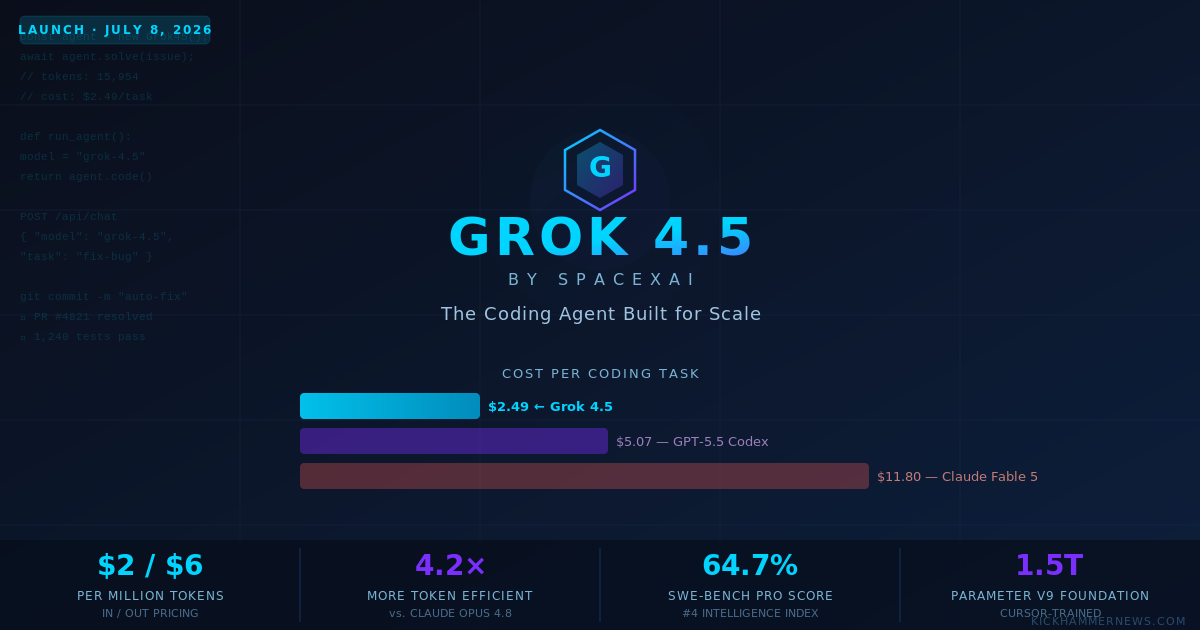
The more significant competitive story may not be the raw benchmark numbers but the economics. Grok 4.5 is priced at $2 per million input tokens and $6 per million output tokens — a dramatic undercut of its rivals. Claude Opus 4.8 runs at $5 input and $25 output. OpenAI’s GPT-5.5 comparable tier runs at similar or higher prices.
That gap compresses dramatically when you factor in token efficiency. Grok 4.5 uses approximately 15,954 output tokens on average to solve SWE-Bench Pro tasks. Claude Opus 4.8 requires around 67,020. That 4.2x difference in verbosity, combined with pricing, translates directly to cost-per-task figures that reshape the math for teams running coding agents at volume.
Independent benchmark estimates put Grok 4.5 at approximately $2.49 per coding task. The same task costs roughly $5.07 with GPT-5.5 in Codex, and $11.80 with Claude Fable 5 in Claude Code. For an enterprise running thousands of automated pull requests, issue resolutions, or refactoring passes per day, that is not a marginal difference — it is an order-of-magnitude shift in operating expense.
The Architecture Behind the Claims
Grok 4.5 runs on xAI’s V9 foundation, a 1.5-trillion-parameter architecture that has not been detailed publicly beyond parameter count. What is notable is how xAI has tuned the model’s behavior in practice. Independent testers have observed that Grok 4.5 tends toward terse, tool-use-first responses: it reaches for bash, reads files, and writes code rather than narrating its reasoning at length. That behavioral profile — prioritizing action over explanation — maps well to agentic pipelines where token count is money.
The tradeoff is real. TechTimes and other independent evaluators have noted that Grok 4.5 shows meaningfully higher hallucination rates than Opus 4.8 on tasks that require deep factual recall or large-context synthesis. For pure coding tasks, hallucination rate matters less than factual Q&A. For hybrid agents that must read documentation, reason over requirements, and write code simultaneously, the gap could be consequential.
Who Benefits and Who Should Wait
The Grok 4.5 value proposition crystallizes most sharply for a specific class of user: teams running high-volume agentic pipelines where cost efficiency matters more than peak capability on any single hard task.
If you are trying to resolve a backlog of open GitHub issues automatically, generate test suites, scaffold boilerplate code, or run nightly refactoring agents, Grok 4.5’s $2.49 per task figure represents a compelling budget argument. At those volumes, a 60% cost reduction versus Opus 4.8 and an 80% reduction versus Fable 5 in Claude Code is operationally significant.
If your workload involves complex, high-stakes software — distributed systems design, cryptographic protocol implementation, mission-critical infrastructure — the benchmarks suggest Fable 5 and Opus 4.8 still hold the edge at the frontier of reasoning depth.
SpaceXAI is also leaning into the Cursor distribution moat. Grok 4.5 is available directly inside Cursor beginning at launch, giving SpaceXAI instant access to Cursor’s multi-million developer user base. A developer who has already integrated Cursor into their workflow does not need to change tools; they simply get a model upgrade. That embedded distribution channel is something neither Anthropic nor OpenAI can replicate without a major acquisition of their own.
The Broader AI Model Race
Grok 4.5’s launch is the latest move in a model race that has dramatically accelerated in 2026. Claude Fable 5 remains the top-ranked model on overall intelligence benchmarks. GPT-5.5 holds second place. Claude Opus 4.8 sits at third. But the frontier is no longer just about who scores highest on a single benchmark. Cost, speed, token efficiency, and distribution have become equally critical competitive axes.
SpaceXAI has been explicit about its strategy: it does not need to beat Fable 5 on every dimension, only on the dimensions that matter most to the agentic developer workflow. On that narrower playing field, Grok 4.5 makes a credible case that it belongs at the table.
EU availability for Grok 4.5 is expected in mid-July. The model is available now via the SpaceXAI console, the Grok Build agent, and inside Cursor.


