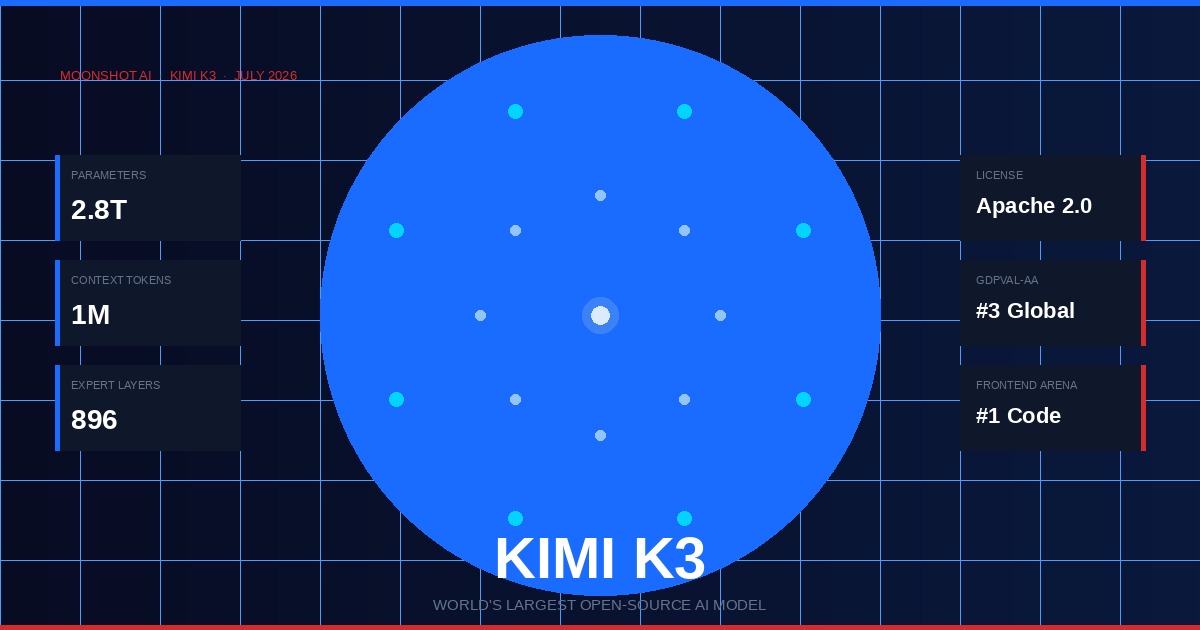
When DeepSeek’s R1 model stunned Silicon Valley in early 2025, many dismissed it as a one-off shock. A year and a half later, that shock has become a pattern. On July 16, 2026, Chinese AI startup Moonshot AI released Kimi K3, a 2.8-trillion-parameter open-weight model that is, by a significant margin, the largest open-source AI model ever released to the public. It is not merely large — on at least one widely respected benchmark, it outperforms Anthropic’s Claude Fable 5, and it is doing it while navigating U.S. chip export restrictions that were supposed to slow China’s AI development to a crawl.
A Scale No Open Model Has Reached Before
The sheer number is staggering. At 2.8 trillion parameters, Kimi K3 is nearly triple the size of its own predecessor, Kimi K2.6, and dwarfs any previously open-sourced model. For reference, Meta’s Llama series — long considered the gold standard of open-weight AI — has not publicly crossed the trillion-parameter threshold. Moonshot has.
The model is built on a Mixture-of-Experts (MoE) architecture, which helps explain how a 2.8-trillion-parameter system can remain practically useful for inference. Of the model’s 896 experts, only 16 are activated for any given token — roughly 1.8% of the total parameter pool. This means that despite the headline number, the compute cost per forward pass is dramatically lower than a dense 2.8T model would require. It is an increasingly common design choice for frontier-scale models, but Moonshot has pushed the total pool size further than anyone before.
Architectural Innovations: KDA and Attention Residuals
Kimi K3 ships with two key architectural changes that Moonshot says account for roughly a 2.5x improvement in scaling efficiency over the K2 series. The first is Kimi Delta Attention (KDA), a hybrid linear attention mechanism designed to handle very long contexts more efficiently than standard quadratic attention. The second is Attention Residuals, a modification to how information propagates between transformer layers.
Together, these changes allow the model to handle a context window of one million tokens — essentially the entire text of several novels — without the performance degradation that typically comes with extended contexts. For enterprise users dealing with long legal documents, research corpora, or massive codebases, this is a meaningful practical advantage.
The model also includes native multimodal understanding, meaning it can process images alongside text without needing a separate vision adapter. And unlike the reasoning-optional setup of many prior models, K3 ships with reasoning always on by default — what Moonshot calls “thinking mode.” The model reasons through problems before responding, a capability that used to require choosing a separate, premium variant.
Benchmark Performance: Third Overall, First in Code
Moonshot is candid that K3 does not top every leaderboard. On GDPval-AA v2, a benchmark evaluating real-world tasks across 44 occupations and 9 major industries, K3 scored 1,687 points — placing third globally, behind only Claude Fable 5 Max (1,815) and GPT-5.6 Sol Max (1,747.8), and ahead of Claude Opus 4.8 (1,600) and GPT-5.5.
Where K3 does claim the top spot is in coding. In the Frontend Code Arena blind evaluation — where developers rate outputs without knowing which model generated them — K3 scored 1,679 points, beating Claude Fable 5. For a model that costs a fraction of closed proprietary alternatives to run, that is a striking result.
The pricing at launch: $3 per million input tokens, $15 per million output tokens, and $0.30 per million cached tokens — flat across the full context window. Compare that to the premium pricing of top-tier closed models, and developers building agentic systems or processing large volumes of text have a strong economic case to consider K3.
The Hardware Question: Building Around Export Controls
Perhaps the most geopolitically significant dimension of K3’s release is how it was built. The United States has spent the past two years tightening semiconductor export controls specifically to limit China’s ability to train frontier AI models. Nvidia’s most powerful data center chips — the H100, H200, and B-series GPUs — are restricted from sale to Chinese entities. The explicit goal has been to maintain a significant computational lead.
Moonshot’s own disclosures tell a different story. The company used export-grade Nvidia silicon alongside what it describes as an unnamed alternative GPU vendor. In other words, Moonshot trained the world’s largest open-source model on hardware that was, by design, supposed to be insufficient for the task.
This does not mean the restrictions have failed entirely. The 2.5x efficiency improvements Moonshot claims for K3 are, in part, a response to compute constraints — the company had to innovate around the bottleneck rather than simply scaling spending. But the outcome challenges the foundational premise of the export control strategy: that limiting access to leading-edge chips would prevent Chinese labs from building leading-edge models.
Open Weights and the Implications for the AI Ecosystem
The full model weights are scheduled to be released by July 27, 2026, under an Apache 2.0 license, meaning developers worldwide will be able to download, fine-tune, and deploy K3 for commercial or research purposes without paying Moonshot a fee. That changes the competitive dynamics considerably.
When a 2.8-trillion-parameter model is available for free download, it does not stay in the hands of large corporations with dedicated infrastructure. It gets quantized, distilled, and repurposed. Researchers at universities fine-tune it on specific domains. Startups build products on top of it. The knowledge embedded in the model — including whatever competitive advantages its architecture represents — propagates rapidly through the global developer community.
This is simultaneously a gift to the open-source AI movement and a significant challenge for closed-model providers. A model that approaches Fable 5 performance on certain benchmarks, available for free and licensed permissively, will attract developers who might otherwise pay for API access to proprietary systems.
What Comes Next
Moonshot has launched K3 in two API variants: K3 Max, optimized for chat and agent tasks, and K3 Swarm Max, designed for large-scale parallel processing workloads. The model is already live on Kimi.com, the Kimi mobile apps, the Kimi Work desktop client, Kimi Code, and available through aggregators including OpenRouter.
Whether K3 represents a genuine narrowing of the gap between Chinese and American AI labs, or a temporary peak before the next generation of U.S. models reasserts dominance, will become clearer over the next several months. What is already clear is that the assumption that frontier AI development requires frontier U.S. hardware is no longer a safe one to make.
The race for open-source AI supremacy — and for the geopolitical leverage that comes with it — just got more interesting.


