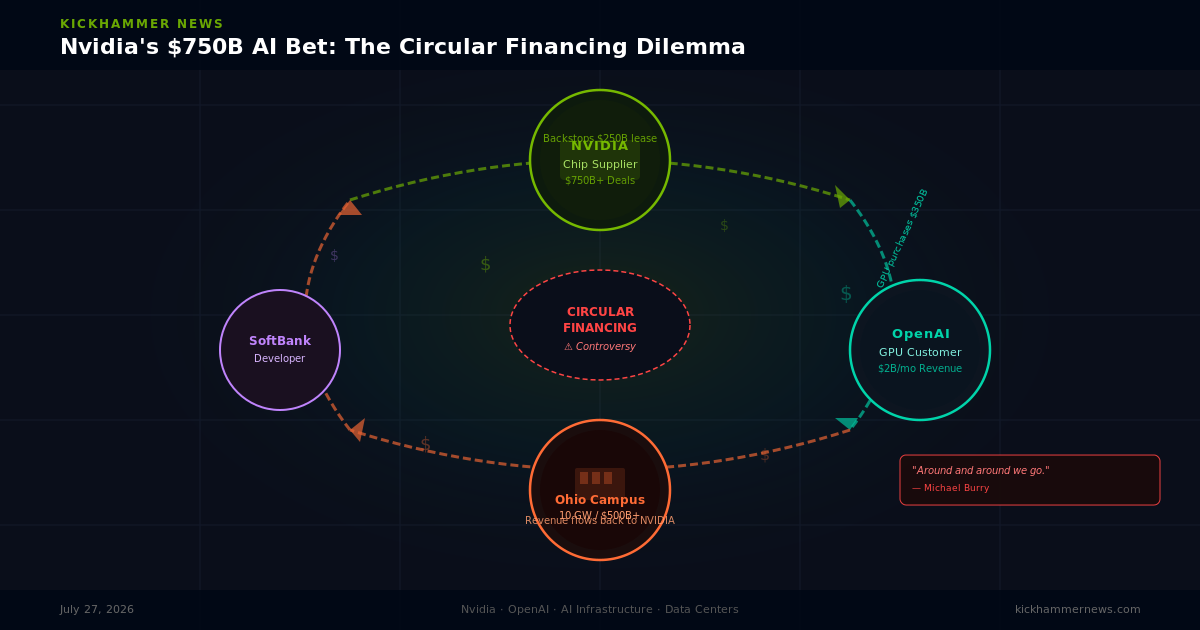
When the Wall Street Journal reported late last week that Nvidia is in talks to backstop up to $600 billion in OpenAI-related financing, it set off alarm bells far beyond Silicon Valley. The proposed deal — $250 billion to guarantee OpenAI’s lease of a massive Ohio data center campus, plus another $350 billion in support for GPU purchases — is staggering in scale. But what has analysts and market skeptics truly rattled is not the dollar figure itself. It is what the structure of the deal reveals about the underlying economics of the AI industry.
At its heart, the arrangement follows a disarmingly simple and troubling logic: Nvidia would guarantee OpenAI’s ability to pay for Nvidia’s own hardware. The chip giant funds the customer, the customer buys the chips, the revenue flows back to Nvidia. Critics have a name for this: circular financing. And Michael Burry, the investor famous for predicting the 2008 housing collapse, was blunt on social media. “Around and around we go,” he posted.
The Ohio Megacampus
The data center at the center of this controversy is a project that makes even the boldest recent AI infrastructure announcements look modest. Located in southern Ohio and being developed by SoftBank’s energy subsidiary SB Energy, the campus is designed to eventually support ten gigawatts of computing capacity — roughly equivalent to the entire electricity consumption of a mid-sized American city. The first phase, targeting 800 megawatts, is expected to come online in 2028.
That kind of infrastructure does not come cheap. The full buildout, including chips and supporting systems, could cost more than $500 billion. For context, that is more than the GDP of Sweden. It is a number so large that conventional debt markets have reportedly struggled to fill the financing gap on their own — which is precisely why Nvidia’s participation is being floated.
The logic for Nvidia as a participant is clear: if OpenAI cannot finance the purchase of hundreds of thousands of GPUs, Nvidia’s own revenue projections look shakier. By stepping in as a financial guarantor, Nvidia helps ensure that demand for its products remains robust. The chip maker has become so central to the AI economy that it is now being asked to help finance the ecosystem that depends on it.
$750 Billion in Deals and Growing Concern
The OpenAI arrangement is not Nvidia’s only such deal on the table. Bloomberg reported on July 27 that Nvidia is working on a fresh round of AI infrastructure deals worth more than $750 billion in total. These include partnerships with data center operators, cloud providers, and AI labs across multiple continents. Each deal follows a similar structural logic: Nvidia provides financial backing that ultimately facilitates purchases of Nvidia hardware.
Investors cheered in the short term — Nvidia shares climbed on the news. But a growing chorus of analysts is raising questions that go beyond any one transaction. If the primary buyer of AI infrastructure is being financed by the primary seller of AI chips, what does that say about the organic demand for AI services? Are the enormous capital expenditure figures being reported across the industry a genuine reflection of business value creation, or are they partly an artifact of this self-reinforcing financial loop?
Nvidia has not yet confirmed the specifics of the OpenAI deal, and sources told reporters that negotiations remain fluid and could change. But the mere fact that such a structure is being seriously contemplated speaks volumes about where the AI industry stands in mid-2026.
OpenAI’s Precarious Economics
To understand why a deal like this is even necessary, it helps to look at OpenAI’s financial position. The company generates approximately $2 billion in monthly revenue — a figure that would have seemed fantastical just three years ago. ChatGPT has become one of the fastest-adopted consumer products in history, and enterprise contracts are multiplying. And yet, OpenAI continues to run massive operating losses. The compute costs required to train and serve frontier models are simply enormous, and they keep growing.
The company has already raised billions from Microsoft, SoftBank, and a constellation of sovereign wealth funds. Its valuation has climbed past $300 billion. But none of that has been enough to close the gap between what OpenAI earns and what it spends. Each new model generation requires more compute than the last, and the Ohio campus — if built as planned — would be one of the largest capital expenditure commitments in corporate history.
This is not unique to OpenAI. Google, Microsoft, Amazon, and Meta have all committed to historic levels of data center spending. The difference is that those companies have established, highly profitable businesses that can absorb the capital outlays. OpenAI is still in a growth phase, burning cash at a rate that requires continuous external financing.
The Circular Financing Debate
The circular financing concern is not new in the technology industry, but the scale of what is being proposed here is unprecedented. Critics point to a structural problem: when the supplier of critical infrastructure becomes a major creditor to its own customers, the market signal of strong demand becomes harder to read. Apparent demand could be, at least in part, a function of the supplier’s willingness to extend financing rather than genuine, self-sustaining economic activity.
Proponents of the arrangement push back. They argue that Nvidia’s involvement as a financial backstop is little different from what major industrial companies — aircraft manufacturers, heavy equipment makers — have done for decades. Boeing finances airline purchases of its planes. John Deere finances farmer purchases of its tractors. If the underlying economics of AI are sound, they argue, then Nvidia’s participation in the financing stack merely removes a bottleneck that would otherwise slow necessary infrastructure development.
The counterargument is that AI remains at an earlier stage of economic maturity than commercial aviation or agricultural equipment. The revenue streams that will ultimately justify ten gigawatts of Ohio computing capacity are still being established. Training frontier models has not yet translated, for most companies, into the kind of reliable returns that justify traditional project finance at this scale.
What Comes Next
Whether or not Nvidia and OpenAI formalize this specific deal, the broader dynamic it represents is already reshaping how investors and regulators think about the AI industry. The Securities and Exchange Commission has reportedly been monitoring the interrelationships between AI infrastructure investors and suppliers. Several members of Congress have raised questions about systemic risk concentration in the AI supply chain.
For now, the Ohio data center remains a construction project in its early stages. Whether it becomes a monument to visionary infrastructure investment or a cautionary tale about financial engineering will depend on whether the AI economy generates the revenues needed to service the enormous obligations being stacked up in its name.
One thing is certain: the numbers involved have grown so large that what happens in the AI infrastructure market no longer stays there. The financial structures being built around artificial intelligence are becoming deeply intertwined with the broader financial system — and with Nvidia at the center of both the supply and the financing of that infrastructure, the stakes for getting it right have never been higher.


