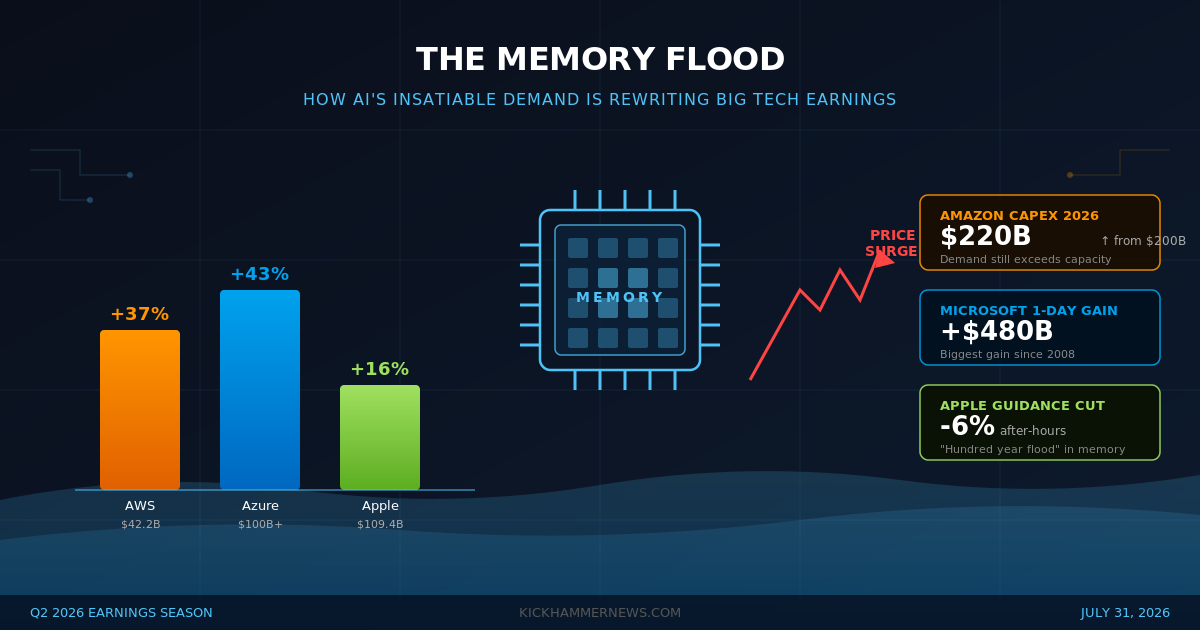
July 31, 2026 — On the same day Amazon revealed it would spend $220 billion on cloud and AI infrastructure in 2026 — and still wouldn’t have enough capacity to meet customer demand — Apple CEO Tim Cook compared his company’s supply chain situation to a natural disaster. “We’re in what I would characterize as a hundred year flood on the memory pricing,” Cook told investors on Thursday, his final earnings call after 15 years as Apple’s chief executive. The phrase — measured, even understated — managed to capture the chaos reshaping the technology industry’s financial landscape with surprising precision.
Big Tech’s Q2 2026 earnings season wrapped up on Thursday, and the results tell a story of jaw-dropping revenue, evaporating cash flow, and a single chokepoint that is squeezing the entire industry from opposite directions: memory chips.
AWS: The Fastest Cloud Growth in Four Years
Amazon delivered the most dramatic numbers of the week. AWS, the company’s cloud computing arm, posted $42.2 billion in revenue for the second quarter — a 37% jump from $30.9 billion a year ago. That figure beat Wall Street’s expectations of roughly 31% growth and represented AWS’s fastest expansion since 2021, five consecutive quarters of accelerating growth. Operating income at the cloud unit hit $16.6 billion, up 64% year over year, on a 39.4% margin. Amazon’s stock surged more than 9% in after-hours trading.
CEO Andy Jassy framed the numbers in terms of sheer scale. “AWS is now a $169 billion annualized revenue run rate business, which, for perspective, would place it 24th on the Fortune 500 list if it was a standalone company,” he said on the earnings call. The unit’s backlog — representing committed future revenue — has grown to $496 billion.
The growth is being driven by a simple dynamic: more companies are moving AI inference workloads to production, and the vast majority of enterprise data already sits in AWS. “As more and more companies are bringing their inference workloads to production, they want it to live near the rest of their workloads and data,” Jassy said. He also noted that 85% of global IT spending is still on-premises, and “that equation is going to flip in the next 10 to 20 years.”
But the headline AWS number was not the most surprising figure Jassy disclosed. That distinction belongs to Amazon’s revised capital expenditure forecast: $220 billion for 2026, up from the already-staggering $200 billion projection the company issued earlier this year. The $20 billion increase was attributed largely to higher memory costs. And even at that elevated spend level, Jassy told investors, Amazon will not have enough data center capacity to meet all the demand it is seeing in 2026. He expects the gap to persist into 2027.
The company’s free cash flow flipped to negative $7.6 billion, compared with a positive $18.2 billion inflow a year earlier. The reversal reflects $66.1 billion in increased equipment purchases as Amazon races to build the infrastructure to feed AI demand.
Microsoft’s $480 Billion Day
While Amazon’s earnings dominated cloud coverage, Microsoft had its own historic moment. The company’s fiscal fourth quarter results triggered the biggest single-day stock gain for Microsoft since 2008 — adding approximately $480 billion in market value in a single session.
The engine was Azure, Microsoft’s cloud platform, which grew 43% year over year, well ahead of the 40% analysts had projected. More symbolically, Azure crossed the $100 billion annual revenue mark for the first time, a threshold that until recently seemed distant. Microsoft’s total quarterly revenue came in at $90 billion, up 18% year over year, with operating income of $40.6 billion — also up 18%.
The result silenced, at least temporarily, a strain of investor anxiety that had been building through the summer: that hyperscalers were spending recklessly on AI infrastructure with little evidence of proportionate revenue returns. For Microsoft, the Azure numbers provided that evidence. The cloud is genuinely accelerating, and the AI workloads embedded within it are generating real revenue, not just promise.
Microsoft’s results also highlighted how its deep integration of AI tools — across Office 365, Teams, GitHub Copilot, and Azure — is beginning to compound. Enterprise customers are adopting AI features at scale, and those subscriptions carry significantly higher average selling prices than traditional software licensing.
Tim Cook’s Exit and the Memory Oligopoly
Apple’s quarter played out differently. Revenue of $109.4 billion for the three months ended June 30, up 16% year over year, was solid enough. Net income of $29.8 billion, or $2.02 per diluted share, beat analyst estimates. iPhone sales grew 22%.
But those figures were backward-looking. The forward-looking guidance rattled investors. iPhone sales will grow at only a “mid-teens” rate in the current quarter, Apple said, a significant deceleration. Total revenue growth in the coming quarter will land between 9% and 10%, below the 12% analysts had expected. Apple’s stock dropped roughly 6% in after-hours trading.
The culprit is memory. Apple is not building giant data centers or chasing AI inference workloads. It isn’t spending $200 billion a year on capex. But the insatiable appetite for HBM and DRAM memory chips among companies that are doing exactly that has created a structural shortage with cascading effects. Memory chip prices have surged to the point where Apple was forced in June to raise prices on Macs and iPads — a remarkable admission from a company that has long treated pricing discipline as core to its brand identity.
“There’s a limited number of suppliers,” Cook said Thursday. “It’s essentially owned by three companies: Micron, SK Hynix, and Samsung. If there were more suppliers, that would be good.” He added cryptically that Apple is “evaluating all options.”
Cook framed the current supply environment as unprecedented in his 15 years leading the company. A hundred-year flood. The phrase is striking because it implies that the current memory pricing shock is not a normal cycle to be waited out but something qualitatively different — driven not by temporary supply disruptions but by a structural shift in global demand that data center construction is outpacing the memory industry’s ability to supply.
The earnings call had an additional layer of significance: it was Cook’s last. He announced in April that he would hand the CEO role to hardware chief John Ternus in September, closing a tenure that saw Apple grow from a $300 billion company into the world’s most valuable at a $4.9 trillion market cap.
The Unifying Thread
It would be easy to read this week’s earnings reports as a tale of two tech economies — cloud companies booming on AI demand, device makers getting squeezed by the same infrastructure buildout. But the more accurate framing may be that all of these companies are feeling the effects of the same underlying reality: the world is attempting to build AI infrastructure at a scale and speed that the physical supply chain was not designed to support.
Amazon is spending $220 billion and still falling short. Microsoft is investing aggressively and seeing its cloud revenue accelerate, but free cash flow is under pressure industry-wide. Alphabet raised its capex forecast above $200 billion last week and saw its stock fall 7%. Meta took a similar hit on its capital spending disclosures. Apple isn’t in the arms race at all, and it’s still getting hurt — because the memory oligopoly that serves both AI data centers and consumer devices is running hot in a way that may not cool quickly.
For the technology industry, the memory chip supply chain is emerging as the single most important constraint on near-term AI deployment. And with the market essentially controlled by three manufacturers, the path to loosening that constraint runs through geopolitics, trade policy, and long-lead capital investment as much as engineering.
Cook’s hundred-year-flood metaphor may prove prescient. Floods recede. But they also reshape the terrain they move through — and the memory market is reshaping Big Tech’s finances in ways that will take years to fully absorb.


