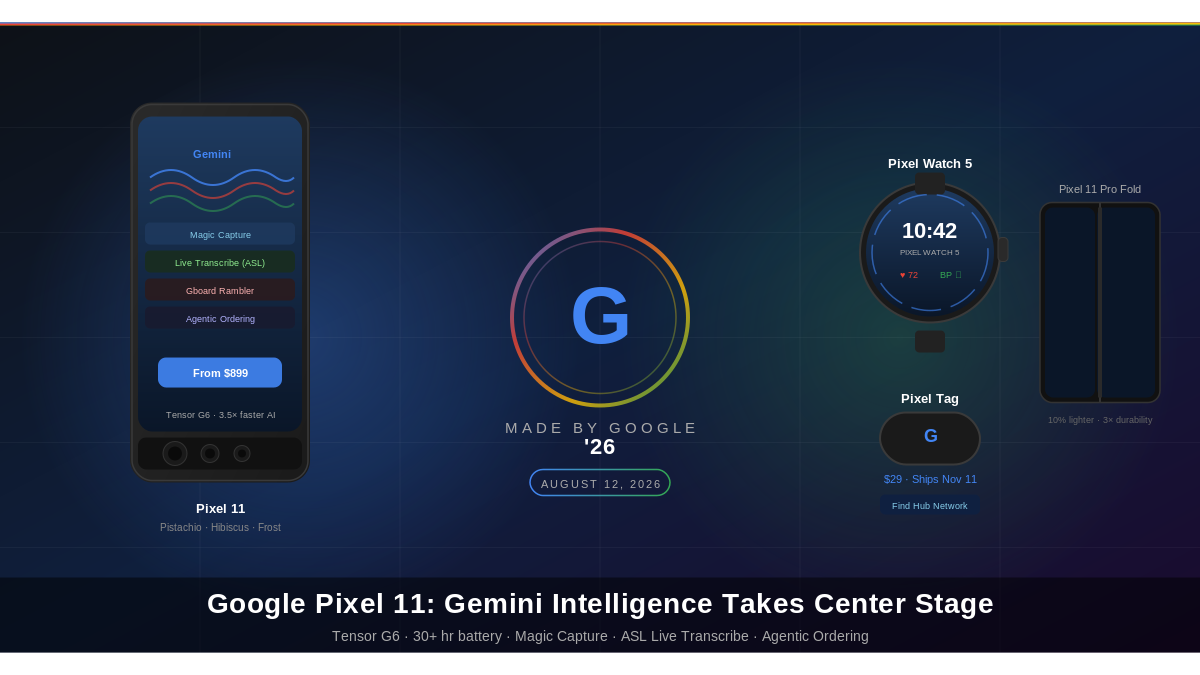
August 12, 2026 — Google held its annual hardware showcase in New York today, and the company did not disappoint. The Made by Google 2026 event brought the full Pixel 11 family to the world, alongside the Pixel Watch 5, and a surprise new product — the Pixel Tag — signaling that Google is ready to compete directly with Apple in the personal tracking device market. Woven through every announcement was a single thread: Gemini Intelligence, Google’s AI suite, is now deeply embedded in every piece of hardware the company ships.
The Pixel 11 Family: Fewer Hardware Leaps, More AI Muscle
Google unveiled four phones today: the Pixel 11, Pixel 11 Pro, Pixel 11 Pro XL, and the Pixel 11 Pro Fold. The headline-grabbing spec this year is less about raw camera megapixels and more about the intelligence running under the hood.
At the center of the lineup is the new Tensor G6 chip, which features 50% more TPU compute than its predecessor and pairs with the latest Gemini Nano model running entirely on-device. Google says this allows AI tasks to run up to 3.5 times faster while consuming up to 3.5 times less energy — a remarkable efficiency jump that should meaningfully improve battery life during AI-heavy workloads.
Camera improvements are still present, of course. The standard Pixel 11 ships with a 48MP main sensor boasting 56% better light sensitivity, a 13MP ultra-wide, and a 10.8MP 5x telephoto that extends to 30x Super Zoom. The camera bar itself gets a design refresh — now more than 40% thinner with a full-glass surface that gives the device a cleaner, more premium look. Pro models push further with a 50MP main sensor, a 48MP telephoto with 30% more light sensitivity, and a jaw-dropping 120x Pro Zoom capability.
Battery life receives a real-world boost as well. Google is promising 30-plus hours of use across the lineup, supported by Qi 2.2 wireless charging at 25W — 25% faster than the previous generation.
Pricing is as follows: the Pixel 11 starts at $899, with shipping beginning August 20. The Pixel 11 Pro starts at $1,099, and the Pro XL opens at $1,299. Colors for the standard model include Pistachio, Hibiscus, Frost, and Obsidian.
Gemini Intelligence: The Real Story
If there’s one takeaway from today’s event, it’s that Google’s competitive strategy against Apple isn’t just better silicon or better cameras — it’s Gemini everywhere. The AI feature suite announced today represents the most ambitious software rollout Google has tied to a hardware launch.
The first standout feature is Magic Capture, which records hundreds of frames between when a user presses start and stop, then automatically selects, crops, and unblurs the best shot. For anyone who has fumbled to capture a fast-moving moment, this promises to change what smartphone photography feels like in practice.
Gboard Rambler tackles a persistent frustration with voice-to-text: filler words. Rather than transcribing speech literally, Rambler filters out “umm,” “ah,” and run-on sentence constructions, producing cleaner, more polished output automatically.
Google also announced a meaningful accessibility breakthrough: Live Transcribe now supports American Sign Language. Using the Pixel Camera, the phone can recognize ASL in real time and convert it to on-screen text, opening communication for Deaf and hard-of-hearing users in contexts that previously required interpretation.
Perhaps the most ambitious feature is what Google is calling agentic ordering — available initially to U.S.-based users. Gemini on the Pixel 11 can now order groceries, book rides, or arrange coffee pickups on a user’s behalf. More notably, it can place phone calls to businesses to make reservations or schedule appointments, acting as a persistent AI assistant that operates across apps and real-world services. This is the “AI phone” pitch made concrete.
Pixel 11 Pro Fold: Thinner, Tougher, Smarter
The Pixel 11 Pro Fold continues Google’s refinement of its foldable form factor. The new model is approximately 10% lighter, nearly 1mm thinner, and features slimmer bezels on both displays. Google is also touting triple the durability compared to the Pixel 10 Pro Fold — a direct response to the criticism that foldables feel fragile relative to their price tags. Tensor G6 and Gemini Intelligence are included here as well, making the Pro Fold the most powerful device in the lineup.
Pixel Watch 5: Health AI Gets Serious
The Pixel Watch 5 is not a visual departure from last year’s model — it retains the same domed Actua 360 display with 320 PPI AMOLED LTPO technology and up to 3,000 nits of brightness, and remains available in 41mm and 45mm sizes. But Google upgraded the internals with double the storage and larger batteries, and the health tracking capabilities represent a meaningful step forward.
Gemini-powered health features now include improved strength and HIIT workout tracking, Bedtime Automations, and Breathing Emergency Detection — a safety-oriented feature that can recognize irregular breathing patterns during sleep. More notably, the Pixel Watch 5 adds blood pressure monitoring and insulin resistance trend tracking, pushing the device further into genuinely clinical territory. These are not novelty health features; they represent the kind of longitudinal health data that physicians may begin to find useful.
Pixel Tag: Google Enters the Tracker Market
The day’s most unexpected announcement was the Pixel Tag, a pill-shaped Find Hub tracker featuring a prominent ‘G’ logo and a removable coin cell battery. The device will sell for $29 individually or $99 for a four-pack, putting it in direct competition with Apple’s AirTag. Pixel Tag leverages Google’s Find Hub network, which covers Android devices globally — a network that, at this point, dwarfs Apple’s Find My ecosystem in sheer device count.
One caveat: the Pixel Tag won’t ship until November 11, suggesting Google is positioning it for the holiday season rather than launching it alongside the phones.
What Today’s Event Means for the Industry
Google’s Made by Google 2026 event makes a coherent argument: the AI-phone race is shifting from “AI as a feature” to “AI as the operating model.” Gemini no longer sits in a drawer waiting to be called — it watches, predicts, books reservations, and listens for emergencies. The Tensor G6 chip provides the on-device horsepower to run these workloads without leaning on the cloud, which matters for latency, privacy, and battery life simultaneously.
Apple’s response will arrive in September. But for now, with the Pixel 11 shipping August 20, Google has the floor — and Gemini has the stage.
Sources: TechCrunch, Android Central, 9to5Google, CNBC, Android Authority, Google Blog