Oracle is preparing yet another round of layoffs before September 1, even as it borrows tens of billions of dollars to build the AI data centers it says will define its future. The arithmetic is bleak, and the workers bearing the cost are running out of places to hide.
The database giant has asked managers to identify employees for elimination, with some teams facing cuts in the double-digit percentage range, according to reporting from Business Insider citing people familiar with the plans and an internal document. The goal: trim payroll before September 1, the start of Oracle’s fiscal second quarter. Oracle declined to comment.
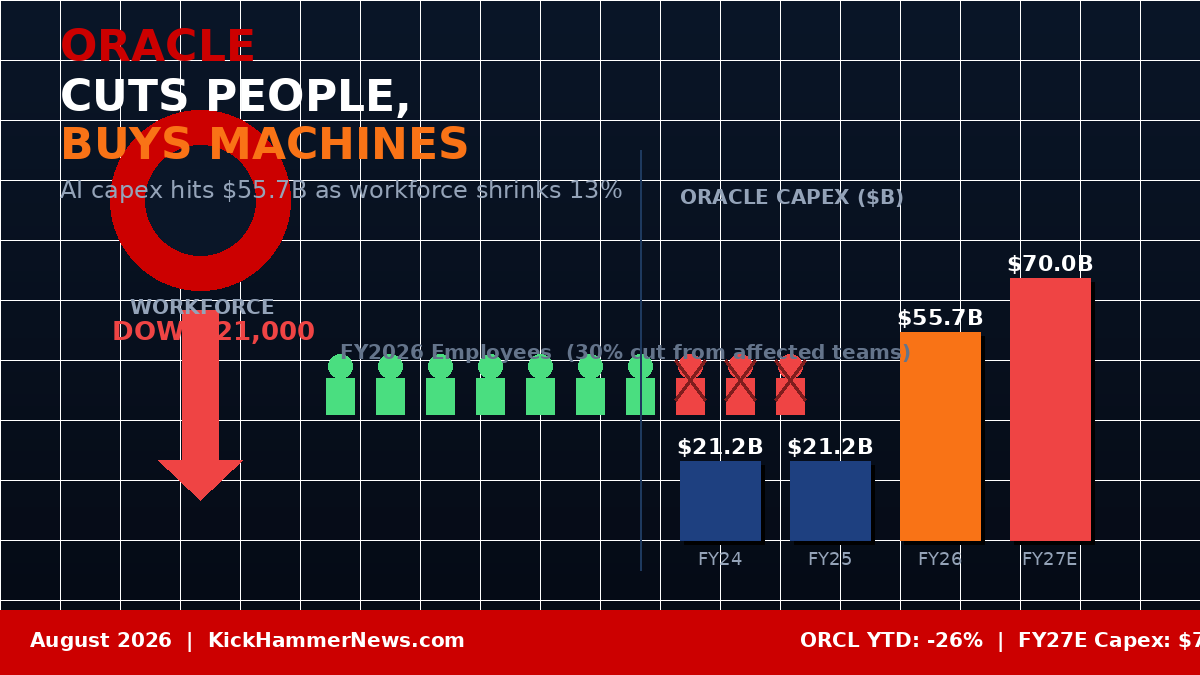
The move would accelerate one of the most dramatic workforce contractions in enterprise tech history. In the fiscal year ending May 31, 2026, Oracle shed approximately 21,000 employees — a 13% decline — taking headcount from roughly 162,000 to about 141,000. The company booked $1.8 billion in restructuring charges over that period, with total anticipated charges under its “2026 Restructuring Plan” reaching as much as $2.1 billion.
That is an enormous number. And Oracle’s own explanation for it makes the situation even more uncomfortable: the company has stated in regulatory filings that the headcount decline was partly attributable to “the adoption and deployment of AI technologies.” In other words, the technology Oracle is betting its future on is also the reason it is sending thousands of people home.
The Capex Math That Explains Everything
To understand why Oracle keeps cutting, follow the capital expenditure figures.
In fiscal 2026, Oracle’s capex bill reached $55.7 billion — up from $21.2 billion just a year earlier. That extraordinary sum reflects a frantic build-out of data center capacity to serve the AI workloads that are Oracle Cloud Infrastructure’s (OCI) primary growth engine. The problem is that the company generated far less in operating cash than it spent, leaving a shortfall of roughly $23.7 billion.
Covering that gap required aggressive financial engineering. Oracle raised approximately $43 billion in debt markets during the year and sold $5 billion in additional equity. Looking ahead, the company expects to secure another $40 billion or so through further borrowing and stock issuance. That is a staggering level of financial leverage for a company of Oracle’s size, and it is the structural reason that headcount has become a cost lever the company keeps pulling.
The logic, when you lay it out plainly, is this: Oracle cannot simultaneously fund one of the largest private infrastructure build-outs in history and maintain its pre-AI workforce. Something has to give, and it is people.
The Business Case — and Its Limits
Oracle’s defenders will point to genuine growth. Revenue rose 17% in fiscal 2026. OCI, the cloud infrastructure arm that competes with Amazon Web Services, Microsoft Azure, and Google Cloud, expanded 77%, driven by surging demand for the computing capacity required to train and run AI workloads. Oracle has secured high-profile deals with OpenAI, and Chairman Larry Ellison has argued that AI will supercharge Oracle’s core enterprise software business rather than cannibalize it.
On an earnings call earlier this year, Ellison told analysts he believes the threat that AI poses to conventional enterprise software would affect other vendors — but not Oracle. His reasoning: Oracle’s databases and ERP applications are so deeply embedded in enterprise operations that they will become more valuable, not less, as AI systems learn to interact with them.
That may yet prove true. The 77% growth rate at OCI suggests real traction, and the $638 billion remaining performance obligation Oracle has disclosed — essentially contracted future revenue — dwarfs comparable figures from a year ago.
But the market is not convinced. Oracle shares have lost approximately 26% of their value so far in 2026. The stock has been caught in two overlapping anxieties: the sector-wide unease about whether AI infrastructure spending will ever produce the returns that justify it, and the specific concern that AI agents capable of handling complex knowledge tasks will erode demand for the traditional software products that have been Oracle’s core business for four decades.
When a company cuts a quarter of its share price while simultaneously arguing the strategy is working, investors are asking to see proof — and the proof is not yet there.
The Human Cost of the Bet
Strip away the earnings-call optimism and the balance sheet abstraction, and what you find is a workforce that has spent the past two years in a state of rolling uncertainty.
The 21,000 people who left Oracle in fiscal 2026 were not a single event. They were the product of a “2026 Restructuring Plan” that has been unfolding across quarters, touching different teams and geographies at different moments. The workers facing cuts this month — ahead of a September 1 payroll deadline set by the calendar and the balance sheet — are the latest installment.
Across the industry, the same dynamic is playing out at different speeds. Meta, Microsoft, and other large technology employers have been converting payroll into AI capital expenditure, treating salaries as a cost to redirect toward silicon and server halls. Oracle stands out not because the trade-off is unusual but because its numbers make the logic so nakedly visible. A 13% headcount reduction financing a $55.7 billion capex bill is a precise illustration of what “investing in AI” actually looks like for the people who work at these companies.
What Comes Next
Oracle’s fiscal year began June 1, and management has framed fiscal 2027 as a year in which the investment thesis is supposed to start paying off. Capex is projected to approach $70 billion, which means the financial pressure on operating costs — including payroll — is not going away.
The question for the people receiving manager calls this month is whether the next quarterly earnings report will show returns sufficient to slow the cuts. Based on the trajectory of the past year, optimism requires significant faith in the AI demand story Oracle has been telling Wall Street — and Wall Street has been voting against.
For Oracle’s enterprise customers watching this from the outside, the situation raises a different set of questions: about whether the company they rely on for core ERP, database, and cloud infrastructure has the organizational stability to support them through a multi-year transition. A company that shed 13% of its workforce in a year and is preparing more cuts is a company in structural flux, regardless of how strong the revenue growth looks on paper.
Oracle is making a massive, debt-fueled bet on AI infrastructure. Whether the bet pays off will be clear in a few years. What is clear today is who is covering the cost in the meantime.
*Sources: The Next Web, Quartz/Yahoo Finance, Business Insider, Oracle FY2026 financial filings*


