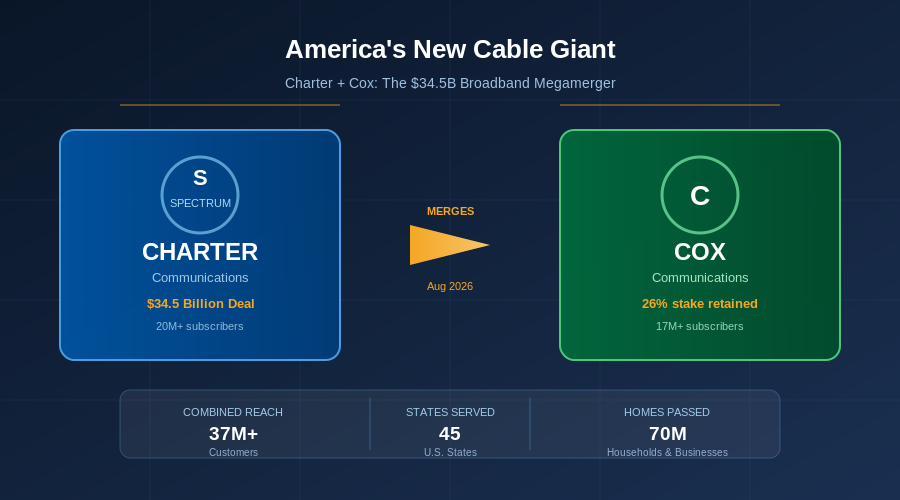
Charter Communications officially closed its $34.5 billion acquisition of Cox Communications on August 20, 2026, completing one of the largest media and telecommunications mergers in American history. The transaction creates the biggest cable operator in the United States by geographic footprint, combining two of the country’s longest-standing broadband and video providers into a single entity that will ultimately carry the Cox Communications corporate name while continuing to sell services under the Spectrum brand.
A Merger Years in the Making
The road to this moment began in May 2025, when Charter, Charter Holdings, and Cox Enterprises formally entered into a transaction agreement. Under the deal’s structure, Cox Enterprises agreed to sell its commercial fiber and managed IT and cloud services businesses to Charter and contribute its residential cable business to Charter Holdings — a complex arrangement designed to unlock value across both companies’ portfolios.
For Charter, the rationale was straightforward: scale. Regional cable operators have found themselves increasingly squeezed between national internet providers, wireless carriers offering home broadband alternatives, and tech giants controlling the streaming entertainment landscape. Acquiring Cox allowed Charter to dramatically expand its Spectrum footprint beyond its existing territory, deepening its competitive position across dozens of new markets.
The final regulatory hurdle fell on August 14, 2026, when the California Public Utilities Commission approved the deal with conditions — the last remaining state-level regulator to weigh in. Federal regulators, including the FCC’s Wireline Competition Bureau, had already cleared the transaction back in February 2026.
The Numbers Behind the Colossus
The combined entity serves approximately 37 to 38 million customers across 45 states, with roughly 70 million homes and businesses now within reach of its infrastructure — a footprint with few peers in American telecommunications.
Cox Enterprises and its subsidiaries received approximately 26 percent of the combined company’s fully diluted shares as part of the deal. Around $12 billion of Cox debt and finance leases remain outstanding at Charter subsidiaries following the close. Charter also simultaneously completed its acquisition of Liberty Broadband, folding in the John Malone-backed entity’s 26 percent stake in Charter. Liberty Broadband had previously spun off Alaska cable operator GCI in July 2025, leaving it outside the Charter transaction.
“The combination of Charter and Cox creates a stronger, more competitive company to further invest and innovate,” said John Malone, Chairman of Liberty Broadband, in a statement.
Leadership and Corporate Identity
Charter President and CEO Chris Winfrey will lead the combined company and serve on its board. Alex Taylor, Chairman and CEO of Cox Enterprises, has been named Chairman of the new entity. Eric Zinterhofer, who previously chaired Charter’s board, will serve as lead independent director.
Cox Enterprises appointed Dallas Clement, its President and Chief Operating Officer, and Mark Greatrex, former President of Cox Communications, to the 13-member board. Advance/Newhouse will retain its two seats, held by Steve Miron and Michael Newhouse.
Despite adopting the Cox Communications corporate name within the next 12 months, the combined company will keep Stamford, Connecticut as its headquarters while maintaining a significant presence in Atlanta — Cox’s longtime operational home. The dual-city structure reflects both the heritage of each organization and the practical reality of merging thousands of employees across multiple campuses.
What Changes for Customers
For the roughly 6 to 7 million Cox residential subscribers, the transition to Spectrum’s ecosystem begins almost immediately. Charter plans to bring its pricing and packaging to former Cox markets by mid-September 2026 — less than a month after deal close.
As a migration incentive, Cox home internet customers who do not already subscribe to Cox Mobile will receive one free year of wireless service. The company is also rolling out access to Charter-developed video products: the Xumo Stream Box, the Spectrum TV app, and a pay-TV bundle that includes several ad-supported streaming services at no additional cost. The package includes Disney Plus, Hulu, discovery Plus, HBO Max, Fox One, Paramount Plus, and Peacock — a notable all-in offer that could help Spectrum compete with virtual MVPD services and the growing number of streaming-only subscribers.
Charter also announced that Cox customer service operations currently handled offshore will transition to U.S.-based teams within 18 months. The company pledged outage credits for service interruptions lasting longer than two hours, an extension of a policy that Charter has deployed across its existing Spectrum footprint.
“The addition of Cox to the Spectrum footprint is one that can be celebrated by customers, employees and investors alike,” Winfrey said.
A Reshaped Broadband Landscape
The merger arrives at a turbulent moment for the cable industry. While broadband remains a resilient revenue source — Americans need fast, reliable internet more than ever — cord-cutting continues to hollow out traditional pay-TV subscriber bases. At the same time, fixed wireless access from T-Mobile and Verizon has intensified competition in markets that cable operators once treated as effectively captive.
Charter and Cox each faced those pressures in isolation. Combined, the new entity can leverage a far larger subscriber base to negotiate content deals, invest in infrastructure upgrades, and absorb the capital costs of network densification without the same per-subscriber burden that weighed on each company separately.
The deal also consolidates control over significant portions of American broadband infrastructure at a time when policymakers and regulators are paying close attention to internet access affordability and competition. Consumer advocacy groups had raised concerns during the regulatory review process about the potential for higher prices in markets where cable remains the dominant high-speed option.
The End of an Independent Cox Era
For Cox Communications, the close of this deal marks the end of a nearly century-old independent run. The company traces its roots to 1898, when James M. Cox founded a newspaper in Dayton, Ohio — eventually building a media empire that expanded into cable television in the 1960s. Unlike its peers Comcast and Charter, Cox remained privately held for generations, giving the Cox family unusual control over its trajectory long after the rest of the cable industry went public.
That independence is now history. But by retaining the Cox Communications name at the corporate level, the combined company signals something important: the Cox brand carries weight, particularly in markets like Atlanta, Phoenix, Las Vegas, and San Diego, where it has operated for decades. Keeping it isn’t just nostalgia — it’s strategy.
Whether that strategy pays off will depend largely on execution. The next 18 months will test whether Charter can integrate Cox’s operations, migrate customers onto Spectrum’s platform, and deliver on the service-quality promises that regulators and consumers will be watching closely.
For now, America has a new cable giant — and the broadband competition it faces has never been more intense.


