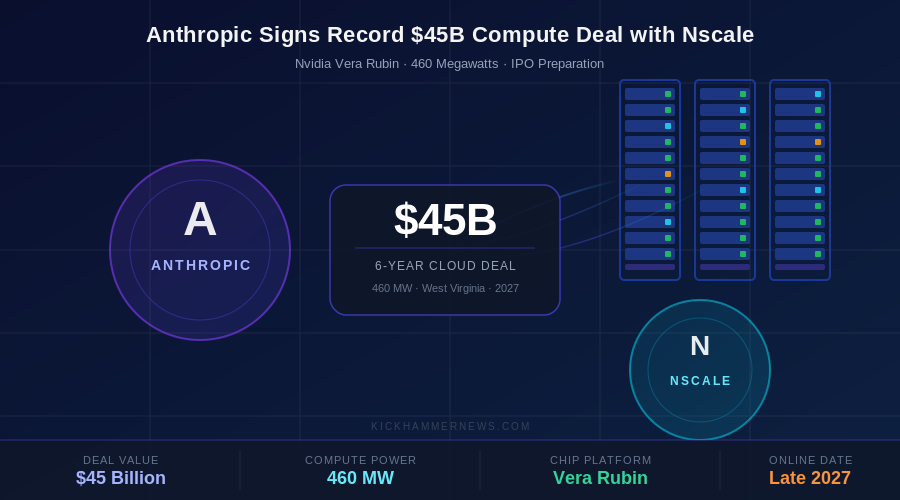
When Anthropic announced a $45 billion cloud computing agreement with Nscale on August 26, 2026, it didn’t just set a new record — it signaled a fundamental shift in how AI companies compete. The era of model quality as the primary battleground is giving way to an era of infrastructure scale, and Anthropic just placed the largest single bet in that war.
What the Deal Entails
The agreement, confirmed by multiple sources including Bloomberg and CNBC, commits Anthropic to renting AI computing power from Nscale over a six-year period. In exchange, Anthropic will gain access to approximately 460 megawatts of compute capacity — enough electricity to power around 345,000 average American homes at any given moment.
The physical heart of this deal is a Nscale flagship data center development in West Virginia. That facility is expected to come online by late 2027, and it will be equipped with Nvidia’s next-generation Vera Rubin chip systems — the most powerful AI training and inference hardware available at that time. Vera Rubin, Nvidia’s successor to the Blackwell architecture, represents a significant leap in performance-per-watt ratios and is specifically designed to handle the memory-intensive demands of frontier AI training runs.
Nscale, despite being founded as recently as 2024, has rapidly positioned itself as a critical player in the AI infrastructure race. Prior to the Anthropic agreement, the company had already secured partnerships with Microsoft, establishing credibility at enterprise scale. The Anthropic contract now represents the single largest entry in Nscale’s contracted revenue backlog, which reportedly stands at $51 billion. The startup is also planning its own initial public offering, targeting a raise of up to $3 billion at a valuation of approximately $14.6 billion.
A Pattern of Aggressive Compute Accumulation
The Nscale deal does not stand alone. Anthropic has been on a relentless compute acquisition campaign throughout 2026. According to Bloomberg reporting, the company has signed deals totaling tens of billions of dollars across multiple infrastructure partners in just the past eight months.
Earlier agreements include a $50 billion arrangement with Fluidstack, a $10 billion deal with Volta Infra Holdings, and a previously reported $45 billion agreement with SpaceX for compute capacity. When combined with the Nscale agreement, Anthropic’s committed infrastructure spending reaches a figure that few companies in history have ever deployed on any single technology initiative.
This scale of commitment raises an obvious question: why so much, so fast?
The IPO Imperative
The answer is almost certainly Anthropic’s planned public offering. The company, which closed a $65 billion Series H round at a valuation of approximately $965 billion in May 2026, is now targeting a public debut as early as October 2026. Investors in the company are reportedly pushing for an IPO valuation of $2 trillion or more.
Going public at that kind of valuation requires more than impressive model benchmarks — it requires demonstrating the capacity to serve massive customer demand at scale. Enterprise buyers don’t want best-in-class AI models they can’t reliably access; they want guaranteed compute headroom. The Nscale deal, and others like it, are Anthropic’s way of proving to institutional investors that supply constraints won’t become a growth ceiling.
There’s also a competitive dimension. OpenAI, Anthropic’s primary rival, has been aggressively scaling its own infrastructure. The race to lock up compute capacity has become a strategic priority across the industry, with leading AI companies essentially entering long-term contracts for resources that don’t yet exist, betting that demand will materialize by the time the data centers come online.
Nscale’s Remarkable Ascent
It’s worth pausing on just how unusual Nscale’s trajectory is. Founded in 2024, the company has gone from a standing start to operating one of the most significant AI infrastructure businesses in the world in under two years. Its ability to win contracts from both Microsoft and Anthropic — two of the most sophisticated buyers of compute in the world — validates both its technical capabilities and its execution credibility.
The company’s West Virginia site benefits from the state’s aggressive push to attract AI data center investment, including favorable energy pricing and regulatory support. West Virginia, long dependent on coal mining and chemical manufacturing, has positioned data centers as a pillar of its economic diversification strategy, and deals like this one are exactly what state economic development officials have been pursuing.
The choice of Nvidia’s Vera Rubin hardware is also telling. Securing allocation of the newest Nvidia chips is increasingly difficult — demand far outstrips supply for every successive generation of Nvidia’s AI accelerators. That Nscale has locked in Vera Rubin capacity suggests the company has built a strong relationship with Nvidia’s supply chain, which itself is a strategic asset of considerable value.
What This Means for the Industry
The Anthropic-Nscale deal is significant not just for its size, but for what it reveals about the structure of the AI industry in 2026.
First, it confirms that AI model companies are now infrastructure companies whether they want to be or not. The cost of staying competitive at the frontier requires multi-decade commitments to physical infrastructure at a scale previously associated only with hyperscale cloud providers like Amazon, Google, and Microsoft.
Second, it accelerates the bifurcation of the AI market. Companies with access to this kind of capital can secure compute that smaller competitors simply cannot. This creates durable structural advantages — not necessarily in model quality, but in reliability, latency, and capacity to serve large enterprise contracts.
Third, it raises real questions about concentration risk. An industry where the leading players are locked into six-year, multi-billion dollar agreements with a small number of infrastructure providers is an industry that is becoming harder to disrupt. New entrants face not just a model training challenge but an infrastructure access problem.
Looking Ahead
By the time Nscale’s West Virginia facility comes online in late 2027, the AI landscape will look different than it does today. Models will be more capable, inference will be cheaper, and applications that are still speculative will have become standard enterprise tools. Whether the demand that Anthropic is betting on will materialize at the scale required to justify $45 billion in spend remains to be seen.
But the direction of travel is clear. Anthropic has decided that the risk of under-investing in compute is greater than the risk of over-committing to it. In a market where compute access is becoming the determining factor in which AI companies can compete at the frontier, that bet may well prove prescient.
Sources: Bloomberg, CNBC, TechCrunch, PYMNTS, Data Center Dynamics


