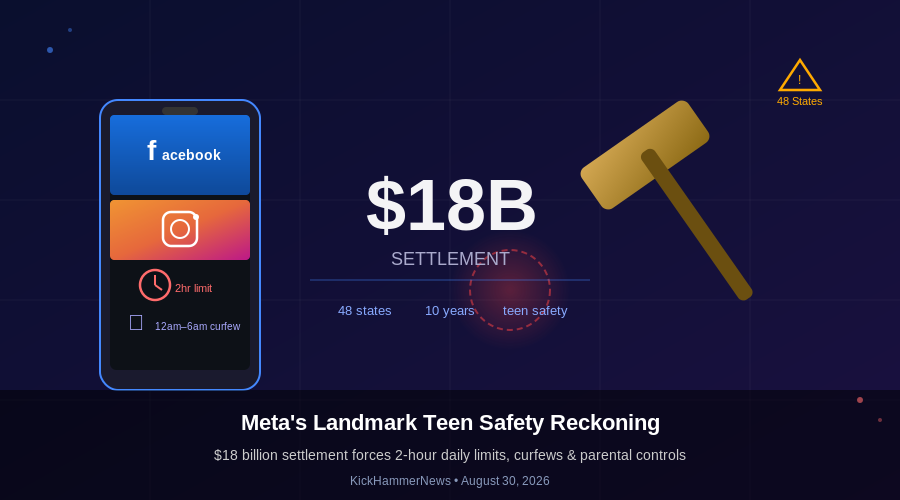
Meta has agreed to one of the largest technology-sector legal settlements in US history, pledging up to $18 billion to resolve claims that it deliberately engineered Facebook and Instagram to be addictive to children — and, crucially, agreed to a sweeping package of platform reforms that will fundamentally change how teenagers experience social media in America.
The agreement, reached on August 26, 2026 with attorneys general from 48 US states plus Washington, DC, Puerto Rico, and several US territories, marks a turning point in the years-long legal reckoning between Big Tech and governments determined to hold platforms accountable for harms to young users.
What the Lawsuit Alleged
The roots of the case stretch back to a 2023 federal lawsuit filed by California, Kentucky, Colorado, and New Jersey, which accused Meta of designing its platforms in ways that “encourage addictive behaviour, fail to verify users’ ages, encourage adolescents to bypass parental controls, and inadequately safeguard against harmful content.” More states quickly joined. By the time the case went to trial in Oakland, California, in August 2026, 29 states had active claims alleging Meta knowingly deployed dopamine-manipulating algorithms, cosmetic filters that distorted body image, and persistent push notifications engineered to keep teens scrolling.
The lawsuit also alleged systematic violations of the Children’s Online Privacy Protection Act (COPPA), including collecting and retaining personal data from children under 13 without proper parental consent.
This trial was not the first time Meta had faced the music. In February 2026, a Los Angeles jury found Meta and YouTube liable for harm caused to a young woman referred to as KGM in court proceedings. In March, Meta was ordered to pay $375 million in a case brought by New Mexico. And just weeks before this settlement, a New Mexico judge tacked on another $567 million in a second phase of that trial. The legal momentum had become impossible to ignore.
Terms of the Settlement
Meta denied wrongdoing — a familiar posture in settlements of this scale — but the evidence heard at trial clearly moved the needle. With more costly verdicts likely on the horizon, the company chose to settle rather than fight on all fronts.
The total payout will reach up to $16.7 billion distributed to 47 states, DC, and US territories, paid in annual installments over 10 years. California stands to receive between $1.5 billion and $2.2 billion over the decade; New York is in line for up to $1.1 billion. Texas, which negotiated separately, secured a deal worth more than $1 billion. Many states plan to direct the funds toward children’s mental health services.
There is a significant conditional clause: Meta has committed to paying only 70 percent of the total settlement — roughly $12.7 billion — outright. The remaining 30 percent, around $5 billion, will only be paid if rival platforms including Snapchat, TikTok, and Alphabet’s YouTube adopt equivalent safety measures and contribute comparable sums. Meta also committed to tightening daily usage limits from two hours to one hour per day if competitors follow suit.
How Facebook and Instagram Will Change for Teens
The behavioral and design changes embedded in the settlement may ultimately prove more consequential than the financial penalty. For users under 18 in the United States, the following defaults will be imposed once a court approves the deal:
Two-hour daily usage cap. Teen accounts on Facebook and Instagram will be limited to a combined two hours of use per day. Parents must actively consent to any override of this limit.
Overnight curfew. Both platforms will enforce a midnight-to-6am blackout for teen accounts, blocking access during hours that researchers have linked to disrupted sleep patterns.
Hidden social metrics. Likes and reactions to teens’ posts will be hidden by default — targeting one of the most psychologically charged features of social media, the quantified validation loop that critics say drives anxiety and compulsive use.
Cosmetic filter restrictions. “Extreme makeup” and other cosmetic procedure filters that alter physical appearance will be disabled for teen accounts by default, a direct response to research linking such filters to body image disorders.
School-hours notification block. The majority of push notifications from both platforms will be silenced between 8am and 3pm on weekdays, reducing classroom distraction.
Parental monitoring tools. Parents and guardians will gain significantly expanded oversight capabilities. They will be able to review a teen’s time spent on the platform, see usernames of social connections, receive daily alerts when a teen first messages an adult account, and get notifications when a teen searches for keywords related to suicide, self-harm, or eating disorders.
Age verification. Meta agreed to invest in improved age-checking technology, using both in-house and third-party tools, subject to regular independent audits. This is particularly pointed given Australia’s experience: after banning under-16s from social media in December 2025, the country’s internet regulator found in August 2026 that more than 80 percent of young Australian teens were still accessing platforms — largely because age verification mechanisms were too easy to circumvent.
The implementation timeline is phased. Non-personalized feed options would arrive within four months of court approval; broader compliance measures within six months; and major age-assurance systems within a year.
Notably absent from the settlement: any requirement to end personalized recommendations or targeted advertising, the revenue engine that underpins Meta’s $201 billion annual business.
A Global Ripple Effect
While the settlement’s formal jurisdiction ends at US borders, its reach is likely to travel. South Korea’s media regulator has already called for Meta’s new protections to be applied worldwide. The European Commission, which has separately accused Meta of designing Facebook and Instagram to be “addictive” under the Digital Services Act, responded to the news by telling Meta that “the ball is in their court” to offer equivalent commitments to EU regulators. The UK is considering its own overnight curfews and a social media ban for under-16s. Brazil’s courts are simultaneously processing a $525 million claim from consumer rights groups.
The patchwork of global regulation is coalescing into something larger — a worldwide reckoning with the business model that prioritizes engagement above all else.
What Critics Are Still Saying
Child safety advocates welcomed the settlement while flagging what it leaves on the table. Sacha Haworth of the Tech Oversight Project called it “a historic settlement that will have a lasting impact,” but cautioned that lasting protection for all children requires congressional action to apply consistent rules across every platform. The NSPCC’s Ella Bradshaw pointed to features that the settlement does not address: disappearing messages, infinite scroll, live-streaming gifting, and the growing risks posed by Meta’s own AI chatbots.
The central critique is structural. By focusing on screen-time limits and parental controls rather than requiring a fundamental redesign of recommendation algorithms, the settlement stops short of attacking the root cause. Meta’s algorithms — which are optimized for engagement, and which studies have shown can route teenagers toward progressively more extreme content — remain largely untouched.
The Bigger Picture
Meta’s $18 billion settlement is not an admission that social media broke a generation. But it is the clearest signal yet that the era of regulatory immunity for social platforms is over. The combination of financial penalties, court-imposed platform changes, and coordinated international pressure has created conditions where building for engagement at any cost is becoming genuinely expensive.
The real test now is whether rivals blink first — and whether the pressure on Meta’s algorithms will outlast the next quarterly earnings call.
Published August 30, 2026


