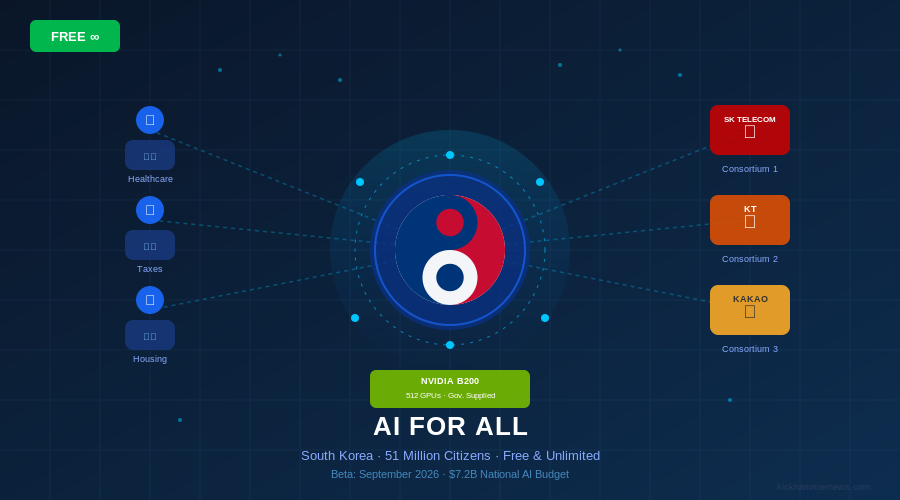
August 31, 2026 — In a move that has no precedent among major industrialized nations, South Korea announced this week that it will provide every one of its 51 million residents with free, unlimited access to generative AI services — with no token limits, no subscription fees, and direct integration into government systems. The program, called “AI for All,” is being rolled out by three domestic technology consortia and backed by a $7.2 billion government AI budget for 2026.
The rollout is not a proof-of-concept or a modest pilot program. It is a national commitment — one that signals South Korea’s ambition to lead the world not just in AI adoption, but in how governments can fundamentally reshape the relationship between citizens and artificial intelligence.
What “AI for All” Actually Means
At its core, the program is designed to be genuinely useful, not just symbolic. Unlike many government tech initiatives that produce clunky portals nobody uses, South Korea’s Ministry of Science and ICT has structured “AI for All” around practical, daily-life use cases: booking medical appointments, navigating the housing market, filing taxes, finding government benefits you didn’t know you qualified for, and getting tailored educational content for children.
The services will connect directly to government systems rather than function as standalone chatbots. That integration is the key differentiator. A citizen asking about their tax situation won’t get a generic AI response — they’ll get guidance informed by their actual records. A small business owner checking eligibility for government support won’t have to wade through bureaucratic websites; the AI will surface relevant programs and act on their behalf.
Parents will receive personalized recommendations for educational material. Small businesses will be able to calculate taxes and check subsidy eligibility. Residents will be able to search for apartments and book doctor appointments without phone queues or government office visits.
The beta version launches in September, with a broader national rollout planned before the end of 2026.
Three Consortia, One Platform
Seoul named three technology groups — collectively called “Friday” — to build and operate the services. They are led by SK Telecom, KT (Korea Telecom), and Kakao, which operates one of South Korea’s most widely used consumer platforms.
Each consortium will launch its own AI application while also embedding generative AI features into their existing products. SK Telecom and KT are South Korea’s two dominant telecom operators, giving the program an immediate distribution advantage: these companies already have billing relationships and app ecosystems covering the overwhelming majority of the South Korean population.
Kakao brings something different — a deeply entrenched consumer platform used for messaging, payments, navigation, and news. Integrating AI into Kakao’s apps means AI-powered services will appear where people already spend their time, rather than asking them to adopt something new.
The government isn’t just providing the mandate — it’s also providing computing power. Seoul plans to distribute up to 512 Nvidia B200 GPUs among the three consortia and will help cover operating costs. The Ministry of Science and ICT has not disclosed the program’s total cost, but the broader AI budget context makes the scale clear.
The Numbers Behind the Decision
South Korea has made a strategic bet on AI that goes well beyond this single program. President Lee Jae-myung’s administration has allocated approximately 10 trillion won — roughly $7.2 billion — for AI-related spending in 2026 alone. That figure is three times what was allocated the previous year, suggesting this is not a temporary election-cycle promise but a sustained national strategy.
The domestic market conditions also help explain why Seoul is moving so boldly. A government survey conducted this year found that about 25% of South Koreans already pay for AI services. For comparison, a PNC Bank survey found that only about 2% of Americans pay for AI subscriptions. Seoul estimates that more than 20 million South Koreans already use free generative AI tools.
In other words, South Korea isn’t trying to convince a skeptical public that AI is useful. The public is already convinced — and already paying foreign companies like OpenAI and Anthropic for the privilege. “AI for All” is designed to redirect that demand toward domestic platforms.
The Strategic Subtext: AI Sovereignty
The geopolitical angle is hard to miss. The initiative is explicitly framed as part of South Korea’s effort to build a stronger domestic AI industry and reduce dependence on systems developed in the United States and China.
This is AI sovereignty — a concept that has been discussed in European policy circles for years but rarely translated into concrete programs at this scale. South Korea is essentially saying: our citizens are already using AI at high rates, they’re paying for it, and the money is flowing to foreign platforms. We can change that by providing a compelling domestic alternative at zero cost.
There is also a data dimension. AI systems improve with use. Every interaction with a domestic platform is training data that stays within South Korea’s regulatory and national-security perimeter. Every interaction on a foreign platform potentially is not. The government’s desire to play a “larger role in how AI is used” is partly about policy control, but it’s also about keeping the feedback loop — the data that makes AI better — domestic.
What Could Go Wrong
The ambition is real, but so are the risks.
Government IT projects at this scale have a poor historical track record. Integrating AI with live government systems — medical records, tax databases, housing registries — introduces serious data privacy and security challenges. A single breach affecting millions of citizens’ sensitive government data could set the program back years.
There’s also a question of quality. The three consortia are not OpenAI or Anthropic. South Korea’s domestic AI industry has made significant strides, but it is not yet operating at the frontier. If the “AI for All” services feel noticeably inferior to ChatGPT or Claude, the government subsidy may not be enough to shift behavior, and the platforms may find themselves in an awkward position: providing a free service that people use grudgingly rather than enthusiastically.
The government has acknowledged some of these uncertainties. It has not set an adoption target for the service, and the program’s total cost remains undisclosed. Details about how government-system integrations will work in practice — how medical appointment booking or tax advice will actually function — have not been fully outlined ahead of the September beta.
A Model for Others?
The most significant question isn’t whether South Korea will succeed — it’s whether other governments are watching and drawing lessons.
Europe has talked endlessly about AI sovereignty but has struggled to produce domestic AI models that compete at scale. India has experimented with government-backed digital infrastructure (Aadhaar, UPI) with remarkable success, but hasn’t yet applied that approach to AI. The United States has taken the opposite philosophical position: let private markets lead, regulate minimally, and trust that American companies will maintain the frontier.
South Korea is testing a different hypothesis: that government can be a platform, not just a regulator. That the question isn’t whether to have an AI industry, but who builds it and for whom.
The beta launches in September. By the end of 2026, one of the world’s most tech-forward populations will be using AI services provided by its own government, for free, integrated into the fabric of daily life. Whether that looks like a success or a cautionary tale will say a great deal about the next phase of the global AI race.
Sources: Wall Street Journal, TechSpot, gHacks Tech News


