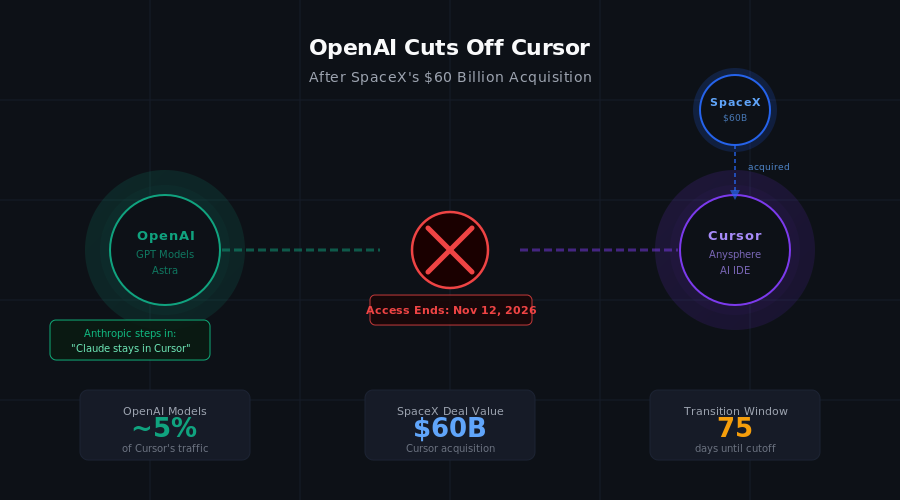
The AI industry’s most bitter corporate rivalry just claimed an unexpected casualty: Cursor, the beloved AI coding tool used by millions of developers worldwide. OpenAI announced it will terminate Cursor’s direct access to its models on November 12, 2026 — a move triggered not by anything Cursor did, but by who now owns it.
When SpaceX completed its $60 billion acquisition of Anysphere, Cursor’s parent company, in mid-August, it set off a chain of events that illustrates just how fragile the AI ecosystem’s supply chain really is.
The Deal That Changed Everything
SpaceX’s acquisition of Cursor was, on its face, a bold strategic bet. Cursor had grown into one of the most popular AI-powered development environments, with a loyal user base that had embraced its seamless integration of multiple language models. The $60 billion price tag reflected both its staggering growth and SpaceX’s ambition to build out a comprehensive AI toolkit through what is increasingly being called SpaceXAI.
But within days of the deal closing, OpenAI moved to invoke a termination clause buried in its licensing agreement — a clause that allows the company to end partnerships following a change of ownership. On August 28, OpenAI notified SpaceX of its intent to wind down the Cursor contract, setting November 12 as the final date for model access.
“We are making this choice because we cannot be confident that SpaceX will use our technology within our terms of service,” OpenAI stated in a public post. The explanation was pointed and deliberate.
A History of Broken Contracts
OpenAI’s decision wasn’t made in a vacuum. The company cited a specific and documented pattern of contract violations by Musk-affiliated entities.
When Musk acquired Twitter in 2022 — now folded into SpaceX — he canceled a data licensing agreement that had given OpenAI access to the full Twitter firehose for approximately $2 million per year. Musk determined the price was too low and simply cut off access, breaking the contract terms. OpenAI had been using that data to train ChatGPT.
More recently, during Musk’s legal battle with OpenAI, he admitted under oath that xAI — also now part of SpaceX — had used outputs from other AI companies’ models, including Claude, to train its own Grok models. This practice, known as “distillation,” violates OpenAI’s terms of service. It also violated Anthropic’s, which led Anthropic to cut off xAI’s API access.
OpenAI also flagged its upcoming Astra model as a factor. Astra reportedly reaches the highest cybersecurity risk classification the company has ever assigned to a product. Given that context, OpenAI said there is “a new level of accountability” required for partners to demonstrate terms-of-service compliance before receiving access.
“It boils down to trust,” said OpenAI’s Thibault Sottiaux, who was careful to frame the move as targeting Musk specifically, not the developer community Cursor serves.
Elon Musk responded on X with characteristic restraint: “I couldn’t care less. Scam Altman and Greg Stockman are utterly untrustworthy assholes who stole an open-source nonprofit.”
Cursor’s Surprisingly Calm Response
Cursor co-founder Michael Truell moved quickly to reassure users. In a post on X, he revealed that OpenAI models account for only about 5% of Cursor’s total AI traffic — a figure that many in the developer community found difficult to believe, given OpenAI’s long-standing centrality to the platform.
“Cursor was one of the very first users of OpenAI, we’ve worked closely with their team for years, and we’ve trusted their platform to be neutral infrastructure for our business,” Truell wrote.
Whether that 5% figure is accurate or optimistic spin, the practical reality is more nuanced. Cursor offers access to a wide range of models, including Claude Fable, Claude Opus, and Claude Sonnet from Anthropic; Gemini 3.1 Pro and Gemini 3.7 Flash from Google; and SpaceXAI’s own Grok family. For users who have already migrated to these alternatives, the OpenAI cutoff may be barely noticeable. For those who rely on specific GPT model behaviors or have built workflows around particular OpenAI capabilities, the November deadline represents a real disruption.
Developers can still access OpenAI models through Cursor by supplying their own API keys — OpenAI confirmed it will maintain that path — but this requires each user to manage their own billing relationship with OpenAI rather than going through Cursor’s unified interface.
Anthropic Seizes the Moment
Anthropic moved fast to position itself as the reliable alternative. Tom Brown, Anthropic’s co-founder and Chief Compute Officer, posted on X that Cursor “has been a trusted partner of Anthropic since Sonnet 3.5” and pledged to increase compute capacity to support Claude models in Cursor.
There’s a certain irony to Anthropic playing the loyal partner card. The company has its own history of cutting off API access when business interests conflicted: it blocked Windsurf from Claude access in June 2025 when reports emerged that OpenAI planned to acquire the competing coding tool. Windsurf’s deal with OpenAI ultimately fell apart, but the precedent was set — and OpenAI is now using that same playbook.
Anthropic also revoked OpenAI’s API access in August 2025, after discovering that OpenAI teams had apparently used Claude for internal benchmarks ahead of the GPT-5 launch. The AI industry, it turns out, is not above using access to models as a competitive weapon.
The Bigger Picture: Model Access as Leverage
The Cursor situation reveals something important about the current structure of the AI industry. Developers and companies have increasingly built their products on top of foundation model APIs, treating them as neutral infrastructure — much like cloud computing or internet connectivity. The assumption was that access would be reliable as long as you paid your bills and followed the rules.
That assumption is now under serious pressure. When AI companies disagree on who counts as an acceptable partner, the developers building on top of their models get caught in the crossfire.
The challenge is structural. Major AI coding tools require custom enterprise contracts rather than standard API access. These agreements include terms-of-service compliance obligations at scale, safety provisions, and — as we’ve now seen — change-of-ownership clauses that give suppliers the right to exit when a company changes hands. As AI coding tools become more capable, handling increasingly sensitive tasks with access to proprietary codebases, the accountability requirements embedded in these contracts will only become more stringent.
This creates an uncomfortable dynamic for the companies building on top of foundation models. Their product quality depends on model access, their model access depends on their ownership structure, and their ownership structure can change in ways they don’t fully control. Cursor didn’t change its practices or violate any terms. It was acquired — and that was enough.
What Comes Next
For Cursor’s user base, the immediate outlook is manageable. The platform’s model diversity means most developers can continue working with minimal disruption by shifting to Claude or Gemini-based workflows. The November 12 deadline gives teams roughly two and a half months to audit which features depend on OpenAI models and adjust accordingly.
For the broader developer tools market, the implications are more significant. The episode demonstrates that model neutrality — the idea that an AI tool is an independent layer that can plug into any foundation model — is more fragile than it appears. When a major supplier decides that a new owner is an unacceptable rival, the tool’s carefully constructed model agnosticism becomes irrelevant.
OpenAI acknowledged that the decision is “incredibly tough” and that developers who rely on its models through Cursor will be most directly affected. That acknowledgment doesn’t make the November deadline less real. What it does make clear is that the era of AI companies treating model API access as neutral infrastructure is over.
The Musk-Altman feud has been running for years, playing out in lawsuits, public insults, and competing AI labs. Cursor is just the latest casualty — but it’s the first time that a corporate conflict between AI heavyweights has disrupted the daily workflow of millions of working developers. It will not be the last.


