Oracle is set to report its first quarter fiscal year 2027 results on September 10, 2026, after the close of the market — and the stakes have rarely felt higher. Coming off a record-breaking fourth quarter that sent revenue past $19 billion for the first time, the company faces a paradox that has dogged it for the better part of a year: the bigger its cloud infrastructure business grows, the more Wall Street frets about the cost of building it.
With a conference call and live webcast scheduled for 4:00 p.m. Central Time on earnings day, investors, enterprise customers, and cloud-industry watchers will be scrutinizing every line of the report for signals about whether Oracle’s colossal AI infrastructure bet is beginning to pay off in earnest — or whether the spending treadmill is about to accelerate again.
What Oracle Guided, and What Analysts Expect
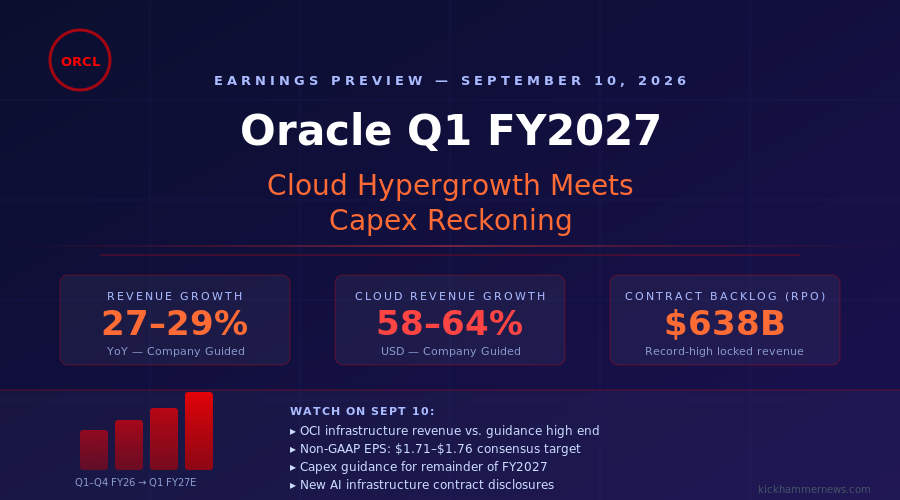
When Oracle closed the books on fiscal year 2026, management offered unusually precise guidance for Q1 FY2027. Total revenues are expected to grow between 27 and 29 percent in both constant currency and U.S. dollars — a significant step up from prior quarters and a reflection of the cloud backlog that has been compounding for several years. Cloud revenue specifically is guided to grow between 57 and 63 percent in constant currency, or between 58 and 64 percent in U.S. dollars. Non-GAAP earnings per share is expected to land between $1.71 and $1.76 in constant currency terms, representing 16 to 20 percent year-over-year growth.
The consensus view on the Street is broadly aligned with the high end of that guidance. Analysts surveyed by multiple financial platforms are projecting total revenue of approximately $19.13 billion and GAAP EPS of $1.30 for the quarter. The slight divergence between GAAP and non-GAAP figures reflects Oracle’s ongoing capital expenditure cycle, which is running at levels that would have seemed implausible just two years ago.
A Record Backlog That Demands Delivery
Perhaps no single data point has defined Oracle’s recent investor narrative more than its remaining performance obligation — the forward-looking backlog of contracted revenue. As of its last major reporting period, Oracle’s RPO surpassed $638 billion, a figure that dwarfs its immediate cloud competitors on a proportional basis and represents years of locked-in enterprise spend on Oracle Cloud Infrastructure.
That backlog is a double-edged sword. On one hand, it signals extraordinary enterprise trust and demand for OCI as a platform for AI workloads. On the other, it commits Oracle to delivering data center capacity at a rate that requires enormous ongoing capital investment. Management has repeatedly framed this as a good problem to have — demand is outpacing supply — but the market has not always been forgiving when capex timelines slip or margin expansion stalls.
The July 2026 stock sell-off, which saw Oracle shares post their worst weekly performance since 2001, was a reminder of how quickly sentiment can turn. Investors who had bid up the stock on AI infrastructure euphoria quickly reassessed when questions arose about the pace of monetization relative to the scale of capital being deployed. The September 10 report will be the first concrete data point since that turbulence.
The AI Infrastructure Arms Race
Oracle’s cloud story is inseparable from the broader AI infrastructure arms race. OCI has positioned itself as a preferred destination for AI training and inference workloads, in part because of its competitive GPU cluster pricing and the architectural advantages of its second-generation cloud regions. Several of the largest AI model developers have publicly disclosed OCI contracts, and Oracle’s partnership with Microsoft — which routes Azure customers to OCI capacity through a deep interconnect agreement — continues to generate meaningful cross-sell demand.
The Q1 results will offer an important test of whether Oracle can translate that demand into recognized revenue at the pace implied by its guidance. Cloud infrastructure revenue has been growing faster than Oracle’s legacy applications business for several quarters, and the company’s agentic AI platform — which embeds AI agents directly into Fusion ERP, NetSuite, and other enterprise applications — is beginning to show up in renewal conversations as a premium upsell driver.
For enterprise customers on long-term Oracle Fusion contracts, the pitch has evolved from “cloud migration” to “agentic workflow transformation.” Oracle’s AI agents can now autonomously handle procurement approvals, financial close processes, and supply chain exception management — capabilities that are increasingly cited in analyst reports as differentiators against SAP and Workday. How well Oracle can monetize those capabilities without triggering customer sticker shock will be a key theme on the earnings call.
Margin Expansion: The Unresolved Question
Investors who want to believe the Oracle story are broadly willing to accept elevated capex as a necessary evil of infrastructure buildout. What they are less willing to accept indefinitely is margin compression. Oracle’s non-GAAP operating margin has been under pressure as the mix shifts toward lower-margin infrastructure revenue relative to higher-margin legacy database and application support contracts.
Management has argued that as OCI utilization rates improve and the fixed-cost base of newly built data centers gets leveraged over more customers, margins will recover and eventually expand. The Q1 FY2027 report will be an early data point on whether that thesis is materializing. Analysts will be watching gross margin on cloud services specifically, as well as the trajectory of capital expenditure commitments, which tend to show up in supplemental disclosures and cash flow statements rather than headline revenue figures.
One factor that could positively surprise: Oracle’s layoffs announced earlier this year, affecting portions of its non-engineering workforce, were widely interpreted as a signal that management intends to hold the line on operating expenses even as revenue investment accelerates. If those cuts flow through to the income statement in Q1, they could provide a meaningful tailwind to operating margin in the period.
What to Watch on September 10
Several specific metrics will command attention when results drop after the bell. Cloud infrastructure revenue growth — the OCI line — is the headline number; anything at or above the high end of guidance will likely be received positively. Cloud application revenue, which includes Fusion and NetSuite, is the margin story; sustained growth here signals that Oracle’s AI monetization is progressing rather than stalling.
Total RPO and new contract wins will be the clearest signal about demand momentum heading into the second quarter and beyond. Oracle’s management team has historically been more forthcoming about backlog growth than about near-term pipeline, so any commentary on large AI infrastructure commitments signed in the August quarter will be closely parsed.
Finally, capital expenditure guidance for the remainder of fiscal 2027 will be scrutinized for any acceleration or deceleration relative to market expectations. Oracle has previously signaled plans to significantly ramp data center construction into 2027, and any revision to that trajectory — up or down — will move the stock.
The Broader Enterprise Software Context
Oracle’s September 10 report arrives in a competitive environment that has grown measurably more intense over the past twelve months. Microsoft’s Azure continues to gain enterprise cloud share, SAP’s cloud ERP transition has reaccelerated, and a wave of AI-native ERP startups is beginning to win deals at the mid-market level. Oracle’s response has been to lean harder into its data advantage — the vast stores of structured business data that enterprise customers have accumulated in Oracle databases over decades — as the foundation for AI models that competitors cannot easily replicate.
Whether that strategy translates into durable revenue growth at the scale Oracle’s valuation requires is the question that September 10 will begin to answer. Markets are expecting Oracle to deliver on its boldest guidance in years. The company’s recent history suggests it is capable of doing so — but the capex overhang, margin dynamics, and intensifying competition mean that execution will need to be near-perfect.
The conference call transcript and supplemental data package will almost certainly generate more questions than they answer. For enterprise technology observers, that is precisely what makes this one of the most anticipated earnings reports of the fall season.
Oracle will release Q1 FY2027 results on September 10, 2026, after market close, followed by a conference call and webcast at 4:00 p.m. Central Time. The live webcast will be available at oracle.com/investor.


