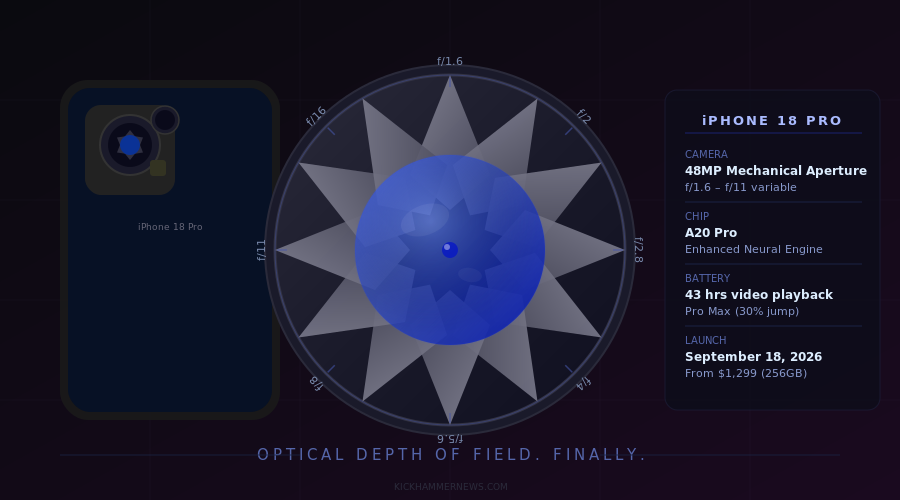
Tomorrow, September 18, Apple’s iPhone 18 Pro and Pro Max ship to the first wave of pre-order customers — and the camera system inside them represents something the industry has never seen before on a phone: real, moving aperture blades built directly into the lens assembly. It sounds like a detail only a photography nerd would care about. It isn’t. The mechanical aperture changes what a smartphone camera can fundamentally do, and the ripple effects will be felt across mobile photography, videography, and the professional camera market for years.
What “Mechanical Aperture” Actually Means
Every serious camera — every DSLR, every mirrorless, every cinema lens — uses a diaphragm of overlapping blades that can open wide to let in light or pinch down to keep it out. This mechanism, called an aperture, gives photographers control over two things simultaneously: how much light hits the sensor, and how much of the scene is in sharp focus versus artistically blurred (the “depth of field”).
Smartphones have been faking it for years. Apple’s portrait mode, Google’s computational photography, Samsung’s “Pro” modes — they all use software to simulate the look of a wide or narrow aperture after the image has already been captured. The results are impressive, but not the same. Bokeh generated by software lacks the organic, continuous quality of optical blur. Backgrounds can have telltale artifacts around hair, glasses frames, and objects that transition from foreground to background.
The iPhone 18 Pro changes this with a 48MP main camera that houses actual mechanical blades. When you dial down the aperture in the native Camera app, tiny actuators physically move those blades, narrowing the opening just as they would in a professional lens. The result is real optical depth of field — not simulated.
Why This Has Taken So Long
The engineering challenge isn’t conceptual; it’s physical. Smartphone lenses are extraordinarily small — a few millimeters in diameter. Fitting a functional diaphragm mechanism into that space while keeping the module thin enough to sit flush against the phone’s body (or close to it) is a precision manufacturing problem that has stumped every major manufacturer for over a decade.
Apple has been working on this in earnest since at least 2023, according to supply chain reports, collaborating with optics specialists in Japan and Taiwan to develop actuators small enough and reliable enough to survive the 200,000-plus open/close cycles that a heavily-used phone camera might accumulate over three years.
The company also had to build new software pipelines. A mechanical aperture creates physically accurate light falloff, lens diffraction at small apertures, and real vignetting — phenomena that software bokeh modes don’t have to deal with. Apple’s image signal processor in the A20 Pro chip had to be tuned to handle this correctly, including auto-exposure algorithms that understand the physical relationship between aperture, shutter speed, and ISO rather than just making post-hoc adjustments.
The A20 Pro: More Than a Spec Bump
The A20 Pro chipset powering the iPhone 18 Pro and Pro Max deserves its own moment. Apple claims a meaningful jump in both CPU and GPU performance over the A19 Pro, but the more interesting claims are around on-device machine learning.
The neural engine in the A20 Pro has been substantially revised, with Apple citing major gains in the kinds of sustained inference workloads that power features like Live Text, real-time translation, and the new on-device health analysis capabilities in watchOS 13. For the camera, this means computational processes that previously required a second or two of processing can now run in real time, allowing features like enhanced night mode and computational RAW capture to happen as you’re shooting, not after.
Battery life on the Pro Max has taken a significant leap: Apple is quoting 43 hours of video playback, up from 33 hours on last year’s 17 Pro Max. That’s a 30-percent improvement in a single generation. Some of this comes from chipset efficiency, some from larger battery cells, and some from software-level power management improvements. Whatever the combination, 43 hours of continuous video is staggering for a device that also runs full desktop-class apps, connects to cellular networks, and is expected to stay pocket-warm.
The Aperture Control Interface
Apple could have buried the mechanical aperture in a submenu somewhere, accessible only to power users. It didn’t. The redesigned Camera app for iOS 27 puts aperture control alongside the existing zoom, exposure, and timer controls in the main viewfinder — tap the new aperture dial, slide to your preferred f-stop, and watch the live preview update in real time as the blades physically adjust.
The range runs from f/1.6 (wide open, maximum background blur, best for low light) to f/11 (everything in focus, sharpest edge-to-edge rendering for landscapes or architecture). For users who’ve never thought about aperture before, Apple has built in a visual depth-of-field preview that shows, in plain language, how much of the scene will be sharp at the selected setting. For users who know exactly what f/2.8 means, that guidance is one tap away from being hidden.
Video gets the same treatment. For the first time on an iPhone, you can shoot at a specific aperture for an entire video clip, adjust it mid-clip, or set the Camera app to maintain a fixed aperture while it adjusts shutter and ISO automatically. Cinematographers and content creators will find this immediately useful for maintaining visual consistency between cuts.
Competitive Implications
It would be surprising if Google, Samsung, and the rest of the Android ecosystem were caught flat-footed here. Samsung has been experimenting with variable aperture since the Galaxy S9 in 2018, using a simpler two-position iris (f/1.5 or f/2.4) rather than a continuously variable mechanism. That was quietly dropped from subsequent Galaxy models due to mixed reviews of its real-world impact.
Apple’s implementation looks meaningfully more sophisticated: continuous adjustment, deeper integration with the ISP, and a hardware/software co-design approach that Samsung’s earlier effort lacked. Pixel cameras at Google have always leaned heavily on computational photography and will likely continue to do so — but Google has shown in recent generations that it understands the value of physical hardware improvements and may accelerate its own aperture roadmap.
For the professional camera market, the long-term implications are harder to predict. Action cameras, vlogging cameras, and mirrorless entry-level bodies already compete with smartphones for casual and semi-professional use. A phone that can meaningfully control depth of field optically narrows the gap further, particularly for travel photography and documentary work where carrying a dedicated camera body is impractical.
The Price of Progress
The iPhone 18 Pro starts at $1,299 in the United States for the 256GB configuration, a $100 increase over the iPhone 17 Pro. The 1TB model tops out at $1,699. For Australians, pricing starts at $2,099 for 256GB — also up $100 from last year, with the 1TB model reaching $2,599.
Apple’s explanation for the increase is vague, as it always is. The mechanical aperture system adds complexity to manufacturing, and component costs across the industry have risen with the global memory shortage that has pushed up pricing on everything from consumer laptops to enterprise servers. Demand for advanced packaging and precision actuator components has also tightened supply chains that affect Apple’s supply base directly.
Whether the price increase is worth it depends on how much you value what the camera can now do. For photographers who have been waiting for a phone that can genuinely compete with a dedicated mirrorless body for certain types of shooting, the answer may be yes. For someone upgrading from an iPhone 16 or 17, the jump in camera capability is substantial.
What Comes Next
Variable aperture is the most dramatic iPhone camera change in recent memory, but it almost certainly isn’t the last significant optical innovation that smartphones will absorb. Periscope telephoto lenses — already present on several Android flagships and on the iPhone 15 and 16 Pro — may gain their own variable aperture systems in future generations. Larger sensors, improved lens coatings, and new spectral sensing capabilities (already present in medical-grade devices) are plausible near-term additions.
For today, though, the iPhone 18 Pro and Pro Max represent a genuine step change. Mechanical aperture blades in a smartphone camera lens aren’t a marketing claim. They’re a physics upgrade — and that’s rare enough to pay attention to.
The iPhone 18 Pro and Pro Max launch September 18, 2026. The iPhone Duo, Apple’s first foldable, follows October 23.


