Oracle is closing out September 2026 with a sweeping expansion of its artificial intelligence platform — one that touches everything from cutting-edge multimodal models to U.S. government defense clouds, and from Rust-powered database drivers to enterprise-grade transactional workflows. The breadth of announcements underscores how aggressively the Austin, Texas-based giant is racing to cement its position as the dominant AI infrastructure provider for large enterprises.
Kimi K3 Lands in OCI: Oracle Doubles Down on Multimodal AI
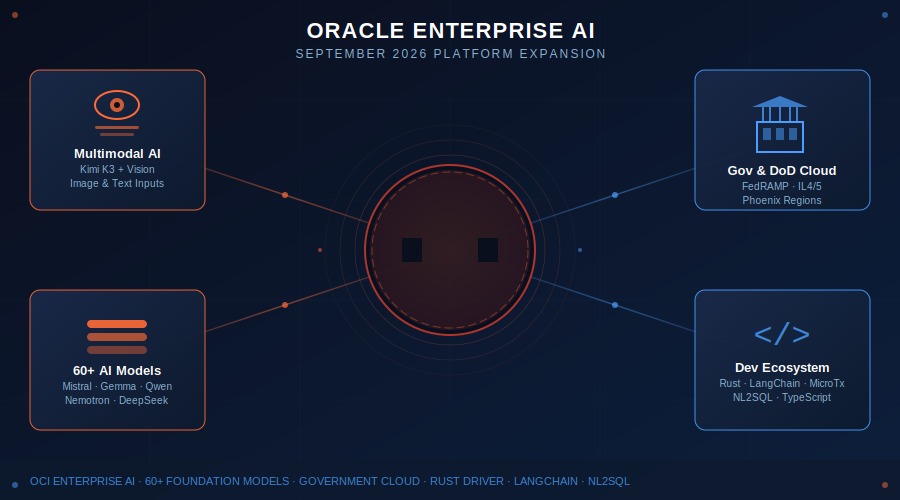
The marquee addition to Oracle Cloud Infrastructure’s Enterprise AI platform this month is Kimi K3, developed by Chinese AI lab Moonshot AI. The model brings genuine multimodal capability to Oracle’s commercial cloud — handling both image and text inputs in a single inference pipeline. For enterprises, that means document understanding workflows, chart interpretation, image-based quality control, and other visual AI applications can now run natively within OCI alongside text-only workloads.
Oracle’s OCI Enterprise AI team was direct about the strategic intent: Kimi K3 enables organizations to “develop applications that process visual and textual information together for multimodal and agentic use cases.” In practice, this positions Oracle to compete more directly with Microsoft Azure’s Phi-4 Multimodal — which Microsoft announced at Ignite Paris just this week — and with Google Cloud’s native Gemini integration.
The timing is not coincidental. Enterprise customers are increasingly demanding AI infrastructure that can handle unstructured media — contracts, inspection images, product photographs, engineering diagrams — alongside the structured data that ERP systems traditionally manage. Oracle’s move to bring Kimi K3 into OCI gives its cloud a credible answer to those multi-format demands.
Sixty-Plus Models and Growing: The OCI Model Catalog Expands
Beyond the Kimi K3 headline, Oracle significantly expanded the breadth of its OCI Enterprise AI model catalog through the Model Import feature. September additions include:
- SEA-LION v4 32B IT from AI Singapore, tailored for Southeast Asian languages and multilingual enterprise scenarios
- Mistral Magistral Small, the compact reasoning model from the French AI company increasingly popular in European enterprises
- Google Gemma 4, the latest open-weights model from Google DeepMind
- Alibaba’s Qwen series of multilingual models
- NVIDIA Nemotron variants, optimized for inference on NVIDIA hardware
- DeepSeek models, which continue to gain enterprise traction despite ongoing geopolitical scrutiny in some markets
The cumulative effect is a model catalog that now spans more than sixty foundation models from at least eight different labs and research institutions. For enterprise buyers who are increasingly wary of single-vendor AI lock-in, this diversity is strategically significant. Oracle’s pitch is that its customers can bring their own preferred model into OCI and run it under the same enterprise governance layer — role-based access controls, content moderation, audit logging — rather than having to adopt Oracle’s own model stack wholesale.
Cleared for Takeoff: Government and Defense Cloud Expansion
Perhaps the most strategically consequential announcement in Oracle’s September AI push is the expansion of its government cloud footprint. OCI Enterprise AI is now available in the US Gov West (Phoenix) region within Oracle US Government Cloud, as well as the US DoD West (Phoenix) region within Oracle US Defense Cloud.
This matters because government cloud accreditation — particularly for workloads that require FedRAMP High or DoD Impact Level 4 and 5 clearances — is notoriously difficult to achieve. With AI capabilities now directly available in these secured regions, federal agencies and defense contractors can run inference workloads without routing data through commercial cloud regions, eliminating a major compliance barrier that had previously forced government users to wait for cloud AI features.
Oracle already holds the Joint Enterprise Defense Infrastructure (JEDI)-successor OCI contract as part of the Defense Enclave Services program, and adding AI inference in dedicated government regions directly supports that footprint. The move also intensifies competition with Microsoft’s Azure Government and Amazon’s AWS GovCloud, both of which have long dominated the defense sector.
NL2SQL Levels Up: Making Data Queries Human
On the developer-facing side, Oracle’s Natural Language to SQL feature inside OCI Enterprise AI received a meaningful upgrade. The enhanced NL2SQL capability now supports model selection — allowing teams to choose which underlying foundation model powers their natural language database queries. It also adds scheduled metadata refreshes, ensuring that as database schemas evolve, the AI’s understanding of available tables and columns stays current without manual intervention. Background SQL generation further reduces latency by pre-computing common query patterns.
For enterprise data teams that have struggled to democratize access to complex relational databases, NL2SQL represents a practical bridge between business analysts’ natural language questions and the SQL expertise traditionally required to answer them. Oracle has been building toward this capability for several quarters; the September refinements suggest the feature is maturing toward production-grade reliability rather than experimental use only.
Database 26ai: The Developer Ecosystem Deepens
Running in parallel with the OCI platform news, Oracle’s September product pulse also highlighted significant expansions to the Oracle AI Database 26ai developer ecosystem:
Rust Comes to Oracle Database: Oracle launched `rust-oracledb`, a pure Rust driver for Oracle Database that requires no Oracle Client libraries. For the growing number of enterprise development teams adopting Rust for its memory safety and performance characteristics, this removes a longstanding friction point — no more dependency on the traditional Oracle Instant Client stack.
TypeScript and LangChain Integration: The `langchain-oracledb` integration enables developers to build AI-powered applications using TypeScript and JavaScript directly against Oracle AI Database capabilities. As LangChain has become one of the most widely adopted frameworks for building agentic AI workflows, native Oracle integration effectively lowers the barrier for existing Node.js and TypeScript development shops to adopt Oracle-backed AI pipelines.
Oracle MicroTx Workflows: A new capability combining durable workflow execution with XA transaction coordination addresses a specific enterprise pain point — long-running business processes that also contain business-critical operations requiring atomic outcomes. Think of multi-step procurement approvals that must either complete entirely or roll back cleanly; MicroTx Workflows brings that reliability to distributed AI agent architectures.
What It All Means: The Enterprise AI Land Grab Continues
Oracle’s September AI push is not happening in isolation. Microsoft announced autonomous Copilot agents going generally available at Ignite Paris this week. SAP’s RISE with SAP platform has been embedding AI deeply into its ERP workflows all year. And AWS continues to expand Amazon Bedrock with new model options monthly.
What distinguishes Oracle’s approach is the dual focus: enterprise database depth on one side, and government/regulated-industry readiness on the other. While competitors court startups and digital-native companies with developer-friendly tooling, Oracle is betting that the highest-value AI workloads of the next decade will run inside regulated enterprises — banks, defense contractors, healthcare systems, utility companies — and that those customers will pay a premium for AI infrastructure that meets their compliance requirements without compromise.
The September announcements, taken together, represent Oracle’s most comprehensive AI platform update of 2026 so far. With fiscal Q2 earnings on the horizon and cloud revenue momentum building after Q1’s 90% growth in AI consumption infrastructure, the pressure on Oracle’s competitors has never been higher. The enterprise AI land grab is fully underway — and Oracle is clearly not content to cede any ground.
—
*Sources: Oracle AI Blog September 2026 Edition, Oracle Monthly Product Pulse September 2026, Oracle OCI Enterprise AI documentation*