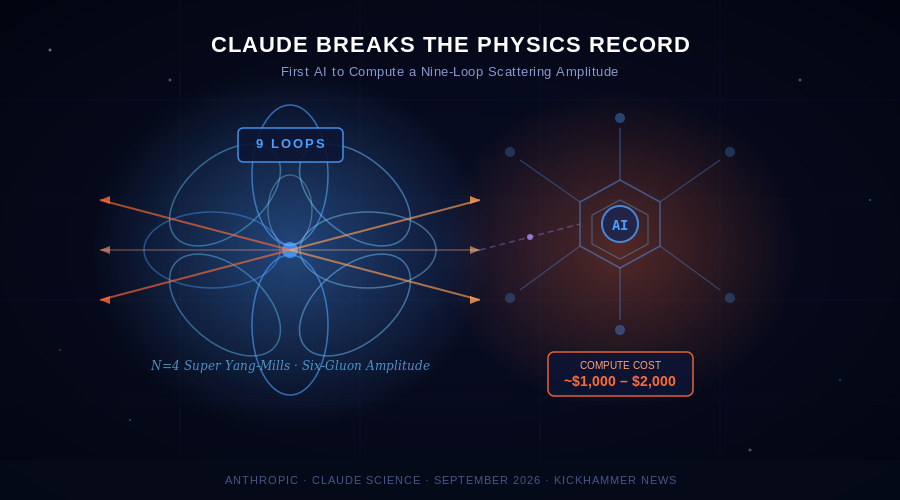
On September 25, 2026, Anthropic published a research report that quietly shook the theoretical physics world. Claude, Anthropic’s AI model, had autonomously computed the nine-loop scattering amplitude in planar N=4 super Yang-Mills theory—a calculation at the absolute frontier of high-energy physics, one that no human team had ever directly completed before. The total cost? Roughly $1,000 to $2,000 in compute credits. The time required? About a week of CPU time. And the result? Independently validated by one of the world’s foremost experts in the field.
This isn’t a story about an AI guessing its way through a physics textbook. This is a story about machine intelligence genuinely advancing the boundaries of human scientific knowledge—at a price point that would have been laughable just three years ago.
What Is N=4 Super Yang-Mills Theory, and Why Should You Care?
To understand why this achievement matters, you need to know a little about the physics behind it. Yang-Mills theory provides the mathematical framework that describes three of the four fundamental forces of nature: electromagnetism, the weak force, and the strong nuclear force. The theory underpins the Standard Model of particle physics—the most successful predictive framework in the history of science.
N=4 super Yang-Mills (often abbreviated N=4 SYM) is a simplified cousin of the real thing. It incorporates supersymmetry—a theoretical symmetry that pairs every known particle with a heavier “superpartner”—in a particularly elegant way that makes calculations dramatically more tractable. As physicist Matt von Hippel of the University of Copenhagen explained in an August 2026 challenge post that sparked the computation: “This unrealistic model becomes paradoxically easier to calculate with, because the particle balance restricts which variable combinations matter.”
Physicists have used N=4 SYM for decades as a testing ground—a sandbox where new mathematical techniques can be developed and refined before being applied to more realistic but computationally brutal theories. It’s where the “amplituhedron” was discovered, where dual conformal symmetry was first observed, and where some of the most beautiful structures in mathematical physics have emerged.
The “amplitude” that Claude computed describes the quantum mechanical probability of six gluons (force-carrying particles) scattering off one another. And “nine loops” refers to how many successive quantum corrections were computed—each loop order representing an additional layer of quantum uncertainty that must be carefully accounted for.
Moving from eight loops to nine isn’t like adding one more row to a spreadsheet. Each loop order multiplies the complexity of the calculation dramatically. The previous record—eight loops—was achieved by Lance Dixon of SLAC/Stanford and Yu-Ting Liu in 2023, and was itself considered a landmark result. Going one loop further required dramatically more computational power and a sustained, error-free execution of intricate mathematical steps.
The Calculation
Two Anthropic researchers, Liam Fitzpatrick and Siddharth Mishra-Sharma, led the project. They worked through Claude Science, a specialized platform Anthropic has built for scientific and research applications, which allows researchers to deploy Claude on extended computational tasks with structured checkpointing and reliability features.
The team approached the nine-loop problem using two independent methods—a crucial decision that allowed them to cross-validate their results.
The first method was the bootstrap technique, a mathematical approach that works somewhat like solving a sudoku puzzle: you impose physical constraints (things the answer must obey, like symmetry properties and consistency with lower-loop results) and iteratively narrow down which solution satisfies all of them simultaneously. This method consumed the bulk of the compute—roughly $100 in Claude Science credits, equivalent to running 96 CPU cores continuously for a week.
The second method used an indirect form-factor approach, computing the amplitude through a different mathematical pathway and checking that the two answers agreed. When they did, confidence in the result rose substantially.
Lance Dixon—whose 2023 eight-loop calculation had stood as the record—reviewed the work and validated the findings. A separate group led by Song He at the Chinese Academy of Sciences, working with GPT-6 assistance, independently converged on similar results around the same time, providing additional external confirmation.
The final result: 107,053 verified numerical coefficients characterizing the nine-loop amplitude, computed autonomously by an AI model with minimal human intervention during the actual calculation process.
Why This Is Different from AI “Playing Physics”
There’s an important distinction between AI systems that can recall physics facts from training data and AI systems that can actually execute the kinds of sustained, complex, error-sensitive mathematical workflows that professional theoretical physicists do. The nine-loop calculation falls firmly in the second category.
Theoretical physics calculations at this level are not about pattern-matching or statistical inference. They require the sequential execution of thousands of algebraic manipulations, with errors at any step potentially invalidating everything that follows. They require checking intermediate results against known constraints, backtracking when inconsistencies appear, and maintaining logical coherence across an enormously complex web of calculations.
As Fitzpatrick and Mishra-Sharma noted in their report, “Claude used all the methods my collaborators and I developed over the years”—referring to established techniques that Claude had to apply correctly, in sequence, without human oversight during execution. The AI was not discovering new mathematical methods; it was executing existing methods at a scale and persistence that exceeds typical human capacity.
That distinction matters. The result demonstrates something significant about where AI capability now sits: not at the frontier of mathematical invention, but squarely at the frontier of computational execution in cutting-edge research. For a huge class of problems in theoretical physics, computational chemistry, and formal mathematics, the bottleneck has never been knowing what to calculate—it has been having the patience, precision, and computing resources to actually do it.
Claude just demonstrated that the bottleneck is dissolving.
The Cost Question Changes Everything
Perhaps the most jaw-dropping aspect of this story isn’t the physics—it’s the economics.
Frontier theoretical physics calculations have historically required either years of painstaking human labor by expert postdocs and faculty, or access to supercomputing facilities costing millions of dollars in infrastructure. The nine-loop amplitude, had it been attempted by a human team using conventional methods, might have taken years and would have been limited to the handful of groups worldwide with both the expertise and the compute resources to attempt it.
Claude did it for between $1,000 and $2,000.
This price point doesn’t just make the calculation cheaper. It fundamentally changes who can do frontier theoretical physics. A graduate student at a well-funded university could, in principle, budget for a calculation like this from a research grant. A physicist at an institution in the developing world, who might lack access to expensive supercomputing clusters, now has a path to frontier-level computation that simply didn’t exist before.
The implications extend far beyond particle physics. Any field where the bottleneck is sustained precision computation—quantum chemistry, drug discovery, cryptography, materials science—is now looking at a different landscape. The question for each of these fields is shifting from “can we afford to compute this?” to “what should we compute next?”
The Concurrent Human Achievement
It would be incomplete to tell this story without noting that a human-led team reached similar findings at essentially the same time. Song He, Jiahao Jing, and Jingxuan Li at the Chinese Academy of Sciences, working with AI assistance from GPT-6, also computed results at the nine-loop level independently.
This isn’t a footnote—it’s part of the story. AI systems are not replacing human physicists; they are becoming tools that allow human physicists to reach further. He’s team brought domain expertise, physical intuition, and years of experience with amplitude calculations; the AI provided the computational muscle. The combination is what allowed them to compete at this level at all.
The fact that two independent groups—one primarily AI-led, one human-led with AI assistance—converged on similar results almost simultaneously provides stronger validation than either result alone would. Science advances by replication, and this simultaneous convergence is itself a scientific result.
What Comes Next
The Anthropic paper is careful to note that the nine-loop calculation represents progress in execution, not in conceptual breakthrough. The physics community has long suspected that scattering amplitudes in N=4 SYM might eventually be computable to all loop orders using sufficiently powerful methods. The nine-loop result is consistent with that picture—but it doesn’t, by itself, reveal the all-loop structure.
For that, “new ideas” are still needed—the kind of conceptual leaps that come from human intuition, inspiration, and the messy, inefficient, beautiful process of scientific creativity. Neither Claude nor GPT-6 has yet demonstrated that it can originate the kind of mathematical insight that produced, say, the amplituhedron. That remains a frontier where human creativity still leads.
But the gap between what AI can execute and what AI can discover is narrowing. And as the tools for AI-assisted scientific research continue to mature—with platforms like Claude Science offering structured research environments, spending controls, and reliability features—the pace of computation-bounded discoveries is likely to accelerate dramatically.
The nine-loop amplitude has been computed. The ten-loop calculation is now being planned.
Conclusion
The computation of a nine-loop scattering amplitude by Claude is a landmark moment—not because it proves AI has surpassed human intelligence, but because it demonstrates that AI can now extend human reach into scientific territory that was previously inaccessible. At a cost of a few thousand dollars, in a week of CPU time, Claude executed a frontier calculation that no human team had ever directly completed.
For theoretical physicists, this changes the economics of research in ways that will take years to fully absorb. For anyone watching the development of AI, it’s a concrete data point about where we are: AI systems are now genuine tools for frontier scientific computation, not just clever text generators.
The mathematics of nature is vast. The tools for exploring it just got significantly more powerful.
—
Sources: Anthropic Research Blog (September 25, 2026); Unite.AI; AI Weekly; KingY.ai; Creati.AI


