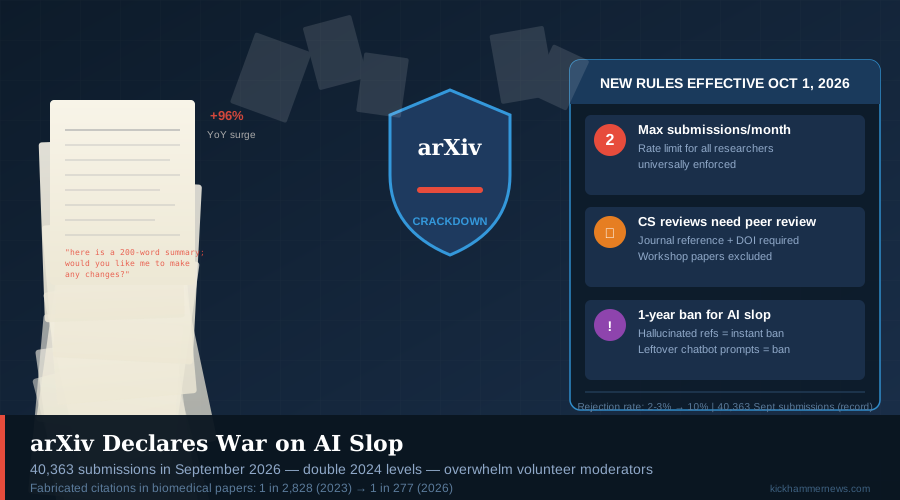
The flood finally broke the dam. On October 1, 2026, arXiv — the preprint server that has served as science’s open publishing backbone for over three decades — announced a sweeping suite of emergency measures aimed at stemming what researchers are calling a tsunami of AI-generated academic garbage. The moves, long debated but politically fraught, mark a turning point in how the scientific community grapples with the double-edged sword of generative AI.
The Numbers Tell a Devastating Story
The scale of the problem is staggering. In September 2026, arXiv received 40,363 submissions — nearly double the 20,569 submissions the platform processed in September 2024. That 96% explosion in just two years mirrors the rise of advanced large language models, and the correlation is anything but coincidental.
Volunteer moderators — the largely invisible workforce that keeps arXiv functional — have been overwhelmed. A relatively small number of prolific submitters, many using AI tools to generate papers at industrial scale, have consumed a disproportionate share of moderation resources. The result: longer review times, degraded quality signals, and an erosion of the trust that has made arXiv indispensable to physicists, mathematicians, computer scientists, and biologists worldwide.
“The platform is being DDoS’d by papers,” said one computer science researcher on social media, borrowing language from cybersecurity to describe the submission flood. “Except instead of bots pinging servers, it’s bots writing papers.”
Three Strikes, You’re Out: arXiv’s New Rules
arXiv responded with a three-pronged enforcement strategy that fundamentally changes how the platform operates.
Rate Limits for All. Starting October 1, all submitters are capped at a maximum of two submissions per calendar month, with no more than three active submissions at any time. This applies universally, regardless of academic status or field. arXiv called it a “stopgap measure” while the organization develops more sophisticated moderation infrastructure.
Computer Science Review Papers Now Require Peer Review. In one of the most significant policy shifts in arXiv’s history, the computer science section will no longer accept review articles or position papers unless they have already cleared peer review at an established journal or conference — complete with documentation including journal references and DOIs. Workshop papers do not qualify. Thomas Dietterich, chair of arXiv’s CS section, described the catalyst: hundreds of AI-generated survey papers flooding the system monthly, many containing “annotated bibliographies without proper analysis” and citations that reference completely unrelated papers.
Rejection rates in computer science have spiked from the historical baseline of 2–3% per year to a troubling 10% in recent months — a figure that would have seemed impossible just three years ago.
One-Year Bans for Obvious AI Slop. The most punitive measure targets the most egregious offenders. Researchers who submit papers containing “incontrovertible evidence” of unvetted AI-generated content — including hallucinated references, leftover chatbot prompts embedded in the text (one notorious example: a paper with the phrase “here is a 200-word summary; would you like me to make any changes?” left in the body), and placeholder data — will face a one-year submission ban. After that ban expires, the offender must have their papers accepted through peer-reviewed venues before returning to arXiv.
A Fabrication Crisis Hidden in Plain Sight
The new policies land against a backdrop of genuinely alarming data on AI-generated scientific fraud. A Columbia University study tracking fabricated citations in biomedical papers found the problem has metastasized at a terrifying rate: in 2023, fabricated references appeared in approximately one in every 2,828 papers. By early 2026, that figure had collapsed to one in 277 papers — a tenfold increase in fraudulent citations in just three years.
Research has also found that 30 to 69 percent of LLM-generated references in biomedical contexts are simply hallucinated — plausible-sounding citations that refer to papers that do not exist, were written by people who never wrote them, or describe findings that were never reported. These fake citations then enter the scientific record, get picked up by other papers, and metastasize through the literature.
“We’re not just talking about bad papers being ignored,” said one data integrity researcher. “We’re talking about fabricated facts becoming the scaffolding for real science.”
The Community Is Divided
Not everyone applauds arXiv’s crackdown. The rate limit and peer-review requirements have drawn significant criticism from researchers who argue the policies disproportionately harm exactly the people arXiv was built to help.
Stephen Casper, an AI safety researcher at MIT, warned that the restrictions on review papers would fall hardest on “young people, people without access to lots of compute, and people who are not at institutions with lots of publishing experience.” Review and survey papers are often entry points for early-career researchers — a way to contribute meaningfully before they have original experimental results of their own.
Others have raised concerns about the reliability of AI detection tools, which power some moderation decisions. Detection software has documented high false-positive rates that risk flagging legitimate work. A graduate student using AI to help format references or improve prose could theoretically trigger the same alarms as someone submitting a paper they never read.
Richard Sever of openRxiv — the biomedical preprint platform — offered a counterpoint: “Biomedical preprint servers have maintained similar policies since their inception, and they function well. arXiv is simply catching up to standards that other fields established long ago.”
The Bigger Picture: Science at a Crossroads
What’s happening at arXiv is a microcosm of a much larger struggle. The same AI tools that have accelerated legitimate scientific discovery — from protein structure prediction to materials science simulation to drug candidate generation — have also democratized the ability to produce scientific-looking text at near-zero cost. The bottleneck that once enforced quality — the time and expertise required to write a coherent paper — has been largely eliminated.
The consequences extend beyond reputation. Contaminated preprint literature feeds AI training datasets, meaning today’s AI slop could become tomorrow’s AI baseline. The scientific community is staring down a feedback loop with potentially serious epistemic consequences.
arXiv’s executive director acknowledged the organization is “actively contemplating more measures” beyond those announced this week. What those might look like — AI-specific credentialing requirements, mandatory disclosure of AI tool use, algorithmic triage — remains unclear.
What is clear is that the era of frictionless scientific publishing is over. Whether the new friction will restore integrity or simply shift the flood to less-moderated corners of the internet is the question the research community is now urgently debating.
The dam broke. The question is whether anyone can build a better one fast enough.
Sources: arXiv Blog, Decrypt, The Next Web, The Outpost AI, The Scientist, Columbia University Citation Integrity Study


