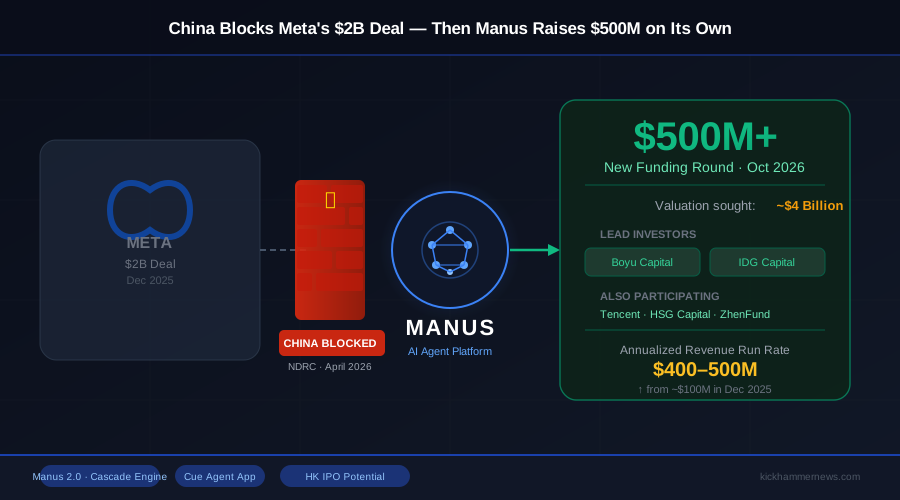
In one of the most dramatic reversals in recent tech history, Chinese AI agent startup Manus has raised more than $500 million in new funding — just months after Beijing forced Meta to unwind a $2 billion acquisition of the company. The round, led by Boyu Capital and IDG Capital, reportedly values Manus at approximately $4 billion, roughly double what Meta had agreed to pay.
The story of Manus is equal parts geopolitical thriller and Silicon Valley success saga, laying bare the fault lines between American tech giants and China’s determination to keep its most promising AI assets at home.
From Viral Moment to Acquisition Target
Manus — operated through its parent company, Butterfly Effect — burst onto the global AI scene in early 2025. Where most AI tools of the era functioned as sophisticated chatbots, Manus was something different: a true autonomous agent capable of conducting deep research, writing long-form reports, building functional websites, and completing complex multi-step tasks with minimal human supervision. The product went viral almost immediately, drawing comparisons to what ChatGPT had been in late 2022 — a technology that felt genuinely, unsettlingly capable.
Founded in China and later relocating its headquarters and engineering teams to Singapore, Manus attracted backing from U.S. venture firm Benchmark alongside a roster of Chinese investors including Tencent. By the second half of 2025, it had become one of the most closely watched AI startups on earth.
Meta saw the acquisition as a strategic shortcut — a way to acquire both the talent and the technology needed to accelerate its own agentic AI ambitions at a time when the company was struggling to keep pace with OpenAI and Anthropic. In December 2025, Meta announced the roughly $2 billion deal and began integrating Manus’s engineers and systems into its own infrastructure.
Beijing Steps In
The integration never fully happened. In April 2026, China’s National Development and Reform Commission issued an extraordinary directive: it prohibited foreign investment in the Manus project. Meta, which had already made considerable progress embedding Manus’s technology, was forced to reverse course. Manus’s original investors stepped in to buy back Meta’s stake, and the two companies separated.
The NDRC’s decision was widely read as a statement of principle. Manus had become a symbol of China’s emerging edge in agentic AI — a field that Beijing increasingly views as strategically critical. Allowing a company with that kind of capability to transfer into American hands, at a moment of rising tech competition between the two superpowers, was apparently a line China was not prepared to cross.
The episode also illustrated just how much the landscape had shifted since the early 2020s, when Chinese AI companies had largely operated under the radar of national security regulators. Manus’s case set a precedent: China’s most capable AI assets, wherever they happened to be headquartered, could be subject to state intervention if their acquisition by foreign buyers was deemed contrary to national interests.
$500 Million and a New Chapter
Rather than limping along in the wake of the deal’s collapse, Manus emerged from the episode with extraordinary momentum. Today’s funding round — more than $500 million, led by Boyu Capital and IDG Capital, with participation from existing backers Tencent, HSG Capital, and ZhenFund — reflects a company that is growing at a speed that few startups reach at any stage.
According to reporting by The Information in June, Manus’s annualized revenue run rate had reached between $400 million and $500 million, up from approximately $100 million in December 2025. That is a four- to five-times increase in a matter of months, and it explains why investors were willing to fund the company at a valuation twice as high as what Meta was prepared to pay.
The company has not disclosed a formal valuation for this round, but Bloomberg had reported it was seeking approximately $4 billion heading into the fundraise. Manus declined to comment on those figures.
A Product Built for the Agentic Era
Manus has not been standing still while the boardroom drama played out. The company has shipped Manus 2.0, an upgraded platform built around its proprietary Cascade execution system. Where earlier versions of the agent could handle individual tasks in sequence, Cascade is designed to manage complex, branching workflows — coordinating multiple sub-agents, handling failures gracefully, and maintaining coherent context across very long task chains.
Alongside the core platform, Manus released Cue, a standalone personal agent application that represents perhaps the most consumer-forward product the company has launched to date. Cue gives AI agents their own dedicated email addresses, phone numbers, and mobile wallets, allowing them to act as persistent, semi-autonomous representatives on behalf of their users. In practical terms, this means an agent can receive emails, make calls, initiate payments, and maintain a continuous presence across services — without requiring constant supervision from the human it represents.
The implications are significant. While much of the agentic AI landscape in 2026 remains focused on enterprise workflows and developer tooling, Cue is a clear bet that consumer-grade autonomous agents are ready for the mainstream. Whether users are prepared to hand that kind of independent authority to an AI system remains an open question — one that regulators in Europe, the United States, and elsewhere are beginning to grapple with seriously.
The Geopolitical Backstory Isn’t Going Away
For investors and analysts watching the broader AI landscape, the Manus story is a reminder that the competition between the U.S. and China in artificial intelligence is no longer confined to chip access or model benchmarks. It now extends to corporate ownership, talent mobility, and the question of which governments get to decide where frontier AI capabilities ultimately reside.
Manus’s case may not be the last of its kind. As the capabilities of AI agents continue to grow, and as the commercial value of the most advanced systems becomes increasingly tied to national competitiveness, deals that might once have sailed through regulatory review will face new scrutiny on both sides of the Pacific.
For now, Manus has emerged from a period of extraordinary uncertainty with more money, more independence, and more momentum than many would have predicted when Beijing first intervened in April. A potential Hong Kong IPO is now being discussed internally, according to people familiar with the company’s plans — a path that would keep Manus on the right side of Chinese regulators while giving it access to global capital markets.
Whether that public listing comes to pass, and whether Manus can sustain the growth rates that have made its revenue figures so striking, are questions for the months ahead. For today, the company has answered the most immediate question of all: after losing the backing of one of the world’s largest technology companies, it was able to raise half a billion dollars from investors who believe its best days are still to come.