The artificial intelligence industry’s infrastructure spending spree may be building toward the largest financial impairment event in tech history, with a new Gartner report warning that over $3.5 trillion in AI data center investment faces write-down risk by the end of 2030.
Released on October 14, 2026, the analysis from the research and advisory firm paints a stark picture: AI providers are collectively investing at a pace that cannot be justified by the revenue their infrastructure will generate. The numbers, while almost incomprehensibly large, reflect a genuine and widening gap between ambition and economics — one that Gartner believes will reshape the AI industry’s power structure within the next four years.
A Trillion Dollars a Year, and Counting
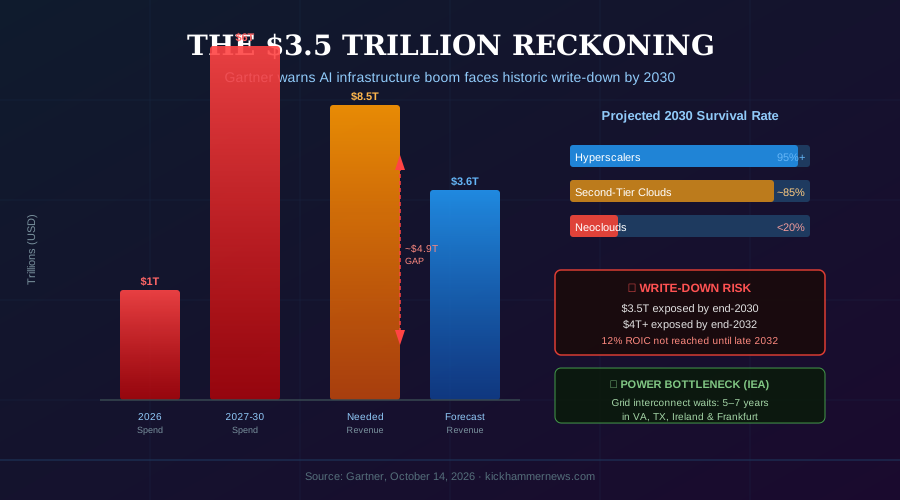
According to Gartner’s projections, AI providers are on track to spend nearly $1 trillion on AI infrastructure in 2026 alone. That figure is expected to grow, with an additional $6 trillion projected to flow into AI data centers, compute clusters, and networking hardware between 2027 and 2030. The cumulative total approaches $7 trillion — a number that would have seemed fantastical just a few years ago.
The problem isn’t the scale of the investment per se. It’s the math on the other side of the ledger. To cover announced capital spending, financing costs, and generate a standard 12% return on invested capital (ROIC), AI data center owners would need approximately $8.5 trillion in cumulative revenue through 2030. Gartner’s forecast for actual enterprise and consumer AI revenue attributable to these facilities tops out at roughly $3.6 trillion over the same period — less than half of what’s needed.
The shortfall is staggering: nearly $5 trillion. And Gartner does not expect the industry to reach even the 12% ROIC threshold until late 2032 at the earliest, with total exposed impairment potentially exceeding $4 trillion by that date.
Who Gets the Revenue Anyway?
One of the most counterintuitive findings in the Gartner report is that even the revenue that does materialize from AI won’t flow primarily to the infrastructure owners building these massive data centers. Less than half of generative AI revenue — Gartner estimates under 50% — actually reaches the companies operating the compute. The rest flows to application developers, tooling vendors, systems integrators, and consultancies who build on top of the infrastructure without bearing its capital costs.
This creates a fundamental structural problem: the entities assuming the most capital risk are capturing the least of the economic value. Will Sommer, Senior Director Analyst at Gartner, put it plainly: “Enterprise and consumer AI revenue will be insufficient to support profitable returns” at the current pace of infrastructure expansion, with IaaS pricing “too low for most AI compute providers to recover their AI investments.”
The Neocloud Shakeout
The Gartner report draws a sharp distinction between the major hyperscalers — Microsoft Azure, Amazon Web Services, Google Cloud — and the newer class of AI-specialized cloud providers known as neoclouds. Companies like CoreWeave, Lambda Labs, and dozens of others built their businesses on the promise of GPU-optimized cloud compute, raising vast sums to purchase Nvidia hardware and build out facilities to serve the AI developer community.
According to Gartner, over 80% of independent neocloud providers will cease independent operations by 2030, whether through fire sales, mergers, or outright bankruptcy. The analysis puts survival odds for neoclouds below 20%, compared to above 95% for major hyperscalers and roughly 85% for second-tier cloud providers like Oracle OCI and IBM Cloud.
The dynamics driving this outcome are merciless. Neoclouds typically financed their GPU purchases with high-interest, hardware-backed debt — a structure that made sense when Nvidia H100 and H200 clusters commanded premium rental rates. But the economics of AI compute have shifted dramatically. Rental rates for older GPU generations can fall 50 to 70% within 18 months of delivery, driven by successive generations of more powerful chips and expanding supply. When a neocloud’s debt exceeds the liquidation value of its hardware — a scenario Gartner sees as increasingly common — insolvency becomes a matter of when, not if.
Hyperscalers escape this fate through cross-subsidization. Their AI infrastructure losses can be offset by cloud software services, advertising revenue, and enterprise contracts that neoclouds simply don’t have access to.
Power: The Hidden Choke Point
Adding urgency to the financial picture, a companion report from the International Energy Agency released on the same day identifies electrical grid interconnection as a major structural constraint on AI expansion. Interconnection wait times in key AI data center markets — Northern Virginia, Texas, Ireland, and Frankfurt — have ballooned to five to seven years, meaning some completed data centers are sitting idle, unable to draw power from the grid.
This creates a scenario where capital has already been deployed, debt is already accruing interest, and yet the facilities cannot generate revenue because the power simply isn’t there. For neoclouds operating on thin margins and leverage, even a six-month power delay can be catastrophic.
What This Means for Enterprise AI Buyers
For the technology leaders and enterprises purchasing AI compute, the Gartner report offers a set of practical recommendations that reflect a new era of caution. Buyers are advised to limit GPU commitments to roughly 12 months rather than signing the multi-year, non-cancelable contracts that were common during the peak of AI euphoria. Using portable orchestration tools — technologies like Ray, Kubernetes, and Slurm — ensures that workloads can migrate to a different provider within 48 hours if a neocloud collapses or is acquired.
Gartner also recommends that buyers interrogate potential cloud vendors on their hardware debt structures and grid interconnect status before signing contracts. A provider that can’t answer these questions confidently may not be operating on stable footing.
The silver lining, if one can be called that: distressed consolidation is expected to create significant discount opportunities for buyers willing and able to negotiate during the shakeout period over the next 18 to 24 months.
The Bigger Picture
The Gartner warning lands at a moment when skepticism about AI’s return on investment has been growing among enterprise customers and investors alike. For two years, the conventional wisdom has held that AI infrastructure spending would eventually be vindicated by massive productivity gains and new revenue streams. That thesis may still prove correct over the long run — but the timing mismatch between capital outflows and revenue realization is severe enough that many of today’s AI infrastructure investors will not survive long enough to see it.
The report doesn’t argue that AI is a bubble in the classic sense — the technology is demonstrably real, and enterprise adoption is accelerating. What Gartner is warning is something more specific and perhaps more sobering: that the financial structure of AI infrastructure has been built on assumptions that cannot be met, and that a massive reallocation of capital and ownership is coming, whether the industry is ready for it or not.
For the neoclouds, that reckoning may arrive sooner than anyone expected.
Sources: Gartner press release, “Prepare for AI Market Consolidation: Capital Write-Downs Could Exceed $4 Trillion by 2032,” October 14, 2026; IEA, Powering Artificial Intelligence, October 14, 2026.


