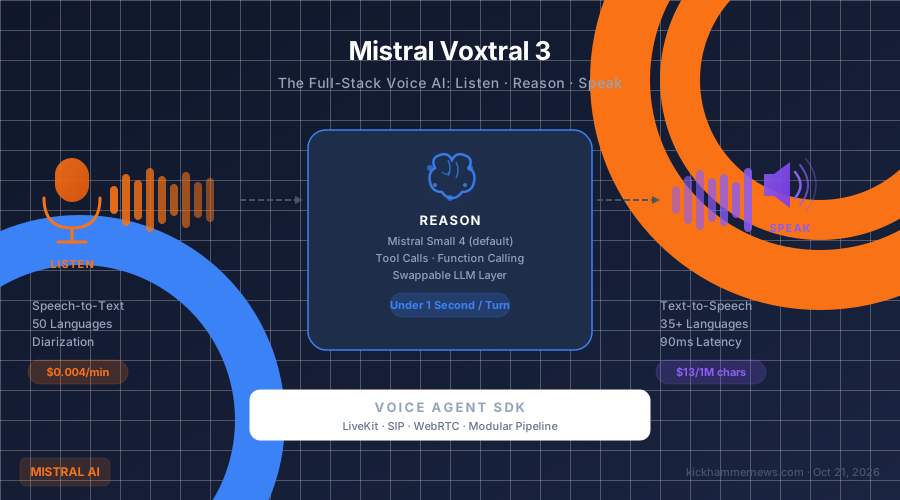
The race to dominate voice AI just got more crowded. On Tuesday, French AI lab Mistral unveiled Voxtral 3, a family of speech models and a developer SDK designed to power real-time voice agents capable of listening to a caller, reasoning through a request, calling external tools, and responding — all in under one second. The launch drops Mistral squarely into a market where OpenAI’s GPT Live, Google’s Gemini Realtime, and ElevenLabs’ Eleven Realtime are already competing hard.
Voxtral 3 isn’t a single model. It’s a complete stack: two batch transcription models, a real-time streaming transcription model, a text-to-speech engine, and a voice agent SDK that wires them together into a single pipeline. Mistral is framing it as “one place for listening, reasoning, tool calls, and speaking” — and the pricing is aggressive enough to make existing voice AI providers sit up.
What’s in the Box
At the transcription layer, Mistral is shipping two options. The flagship Voxtral Small Transcribe 3 targets the highest accuracy scenarios: medical dictation, legal proceedings, enterprise call centers. It covers 50 languages, including all 24 official EU languages, supports speaker diarization (identifying who said what), and offers context biasing — the ability to feed the model a list of product names or technical terms so they’re transcribed correctly without fine-tuning. Pricing comes in at $0.004 per minute.
For teams that need to process large backlogs of audio cheaply, the Voxtral Mini Transcribe 3 is a 4-billion parameter model priced at $0.0035 per minute. Mistral positions it for resource-constrained environments where accuracy can absorb a slight trade-off for cost.
The third transcription model is the one that matters most for real-time applications: Voxtral Mini Transcribe Realtime 3, a streaming speech recognition engine delivered over WebSocket. It includes end-of-turn detection — the model signals when a speaker has finished talking — which is a critical component for building agents that don’t awkwardly cut people off or wait too long before responding. At $0.008 per minute, it costs twice the batch models but is still competitive against real-time offerings from major labs.
Rounding out the family is Voxtral Speech 3 (also marketed as Voxtral Mini TTS 3), Mistral’s text-to-speech engine. It covers 35 languages and 50 dialects, offers explicit controls for emotion, pacing, and emphasis with 34 emotion tags, and claims roughly 90 milliseconds time-to-first-audio. There’s also a Pro Voice feature that can clone a speaker’s voice style from 30 minutes of audio. Pricing lands at $13 per million characters, which Mistral claims undercuts OpenAI TTS-1, Deepgram, ElevenLabs Flash, and Google’s Gemini Flash TTS.
The Voice Agent SDK
The most consequential piece of the Voxtral 3 launch isn’t any individual model — it’s the SDK. Built on LiveKit, the open-source real-time audio framework, the Voxtral Voice Agent SDK assembles the three stages of a voice interaction into a single streaming pipeline: the realtime transcriber detects when a caller stops speaking, a reasoning model (Mistral Small 4 is the suggested default) processes the request and can invoke external tools via function calling, and Voxtral Speech 3 speaks the response back.
Each stage is a separate, swappable component. Teams can replace the language model with a different one, swap in a different voice, or localize each stage for a different region — without rebuilding the agent from scratch. The SDK handles both SIP phone calls and WebRTC sessions in browsers and mobile apps.
Mistral says end-to-end latency from the moment a caller stops speaking to the first audio of a response is under one second. That figure comes from internal testing; real-world SIP deployments often add latency at the network and telecom layers, so enterprise teams should benchmark against their own infrastructure before committing.
How It Stacks Up
On Mistral’s own benchmark charts — and this caveat matters — Voxtral 3 holds up well against the field. On the FLEURS multilingual benchmark across 45 languages, Voxtral Small Transcribe 3 scores a 4.1% word error rate, matching Microsoft’s MAI-Transcribe-2 and beating Google’s Gemini 3.5 Transcribe and ElevenLabs Scribe v2.
On speaker diarization — correctly assigning speech segments to the right speaker — Voxtral Small achieves 18.4% cpWER (character-pair word error rate), better than Pyannote at 19%, MAI-Transcribe-2 at 20.3%, and notably ahead of Gemini 3.5 Transcribe at 38.4%. For multi-speaker scenarios like earnings calls, medical consultations, or legal depositions, that gap is meaningful.
The one place Voxtral clearly trails is raw processing speed. Third-party tests from Artificial Analysis place Voxtral at a 65.8x real-time factor for transcription, while MAI-Transcribe-2 clocks in at 307.5x. For applications processing massive audio archives under time pressure, that gap matters.
On the realtime side, Google’s Gemini 3.5 Realtime Transcribe leads Mistral’s own chart with a 4.2% word error rate, beating Voxtral Mini Realtime 3’s best score of 5.7% at 2,400 ms latency. Mistral beats both OpenAI GPT Live Transcribe (8.4%) and ElevenLabs Scribe v2 Realtime (8.7%), but is not the leader on real-time accuracy.
Why This Moment Matters
2026 has been the year voice AI crossed from experimental to deployable. OpenAI launched its GPT Live voice API for developers in September. Google embedded Gemini Realtime into Android Auto. ElevenLabs introduced Eleven Realtime this very week. The infrastructure is maturing, and enterprise teams are increasingly asking: which vendor do we commit to?
Voxtral 3 gives Mistral a credible answer for European enterprises in particular. All models are available on Mistral’s EU-hosted endpoints with zero data retention, a selling point in industries regulated under GDPR. The 24 EU language coverage addresses the fragmented linguistic reality of European markets that US-focused products often deprioritize.
The open-weight question remains unanswered. Mistral built its early reputation on releasing open-weight models that developers could self-host and study. Voxtral 3 is API-only for public access, with self-hosting available only through enterprise sales. That signals Mistral is treating voice as a commercial product rather than a community asset — a strategic shift that may frustrate the open-source community that championed the company in its early days.
What Comes Next
Voxtral 3 is available in public preview starting today through Mistral’s API. Pricing is live, models are accessible through OpenRouter and Vercel AI Gateway as well, and the voice agent SDK documentation is published.
The company hasn’t announced a Voxtral 3 open-weight release. Whether the competitive pressure from DeepSeek’s DeepInfer framework — also open-sourced this week — or the broader industry push toward open-weight models forces Mistral’s hand remains to be seen.
What’s clear is that the voice AI frontier is moving fast, the pricing is falling quickly, and developers now have a European-headquartered option with a full-stack SDK that handles everything from raw audio to a spoken response. For businesses that have been waiting for voice agents to mature before investing, that moment may have just arrived.


