For years, quantum computing skeptics have pointed to one stubborn obstacle: errors. Quantum bits — qubits — are famously fragile, prone to decoherence from vibrations, stray electromagnetic fields, or even the act of measuring them. Building a computer powerful enough to solve real-world problems means stringing together millions of operations without those errors cascading out of control. On October 19, 2026, Cambridge-based Quantinuum announced results that may have finally turned that corner.
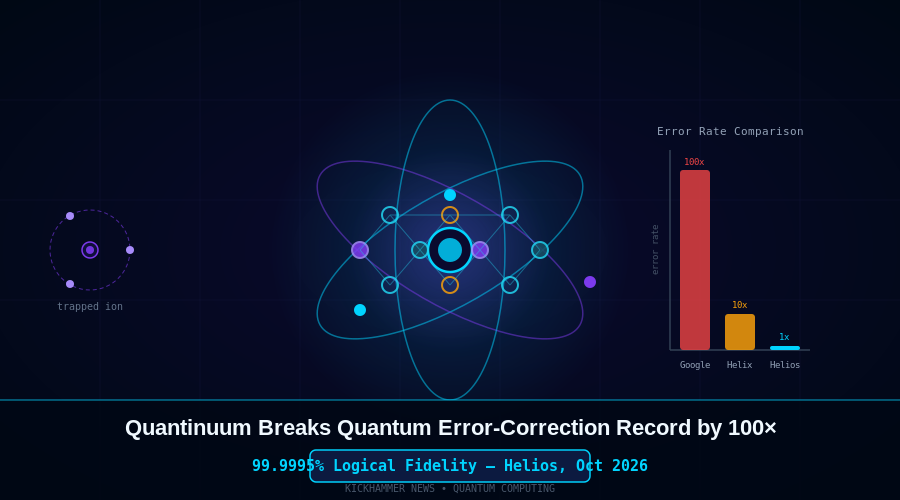
The company’s Helios quantum processor achieved a logical fidelity of 99.9995% — roughly five errors per million operations. That figure is not just a new record; it is 10 times better than the company’s own record set just weeks earlier using a different error-correction code, and 100 times better than the best-published result on superconducting hardware, including Google’s widely-cited benchmark. In the language of quantum computing, it is the kind of leap that makes the once-theoretical concept of a truly fault-tolerant machine look like a scheduled product launch rather than a distant dream.
What “Logical Fidelity” Actually Means
Before parsing why this matters, it helps to understand what the number represents. A physical qubit is unreliable by nature — a single qubit operation in state-of-the-art systems might fail roughly once every few thousand tries. Quantum error correction works by bundling many physical qubits together to encode a single “logical” qubit, allowing errors on individual physical qubits to be detected and corrected before they corrupt the overall computation.
The trade-off is qubit overhead. Quantinuum’s earlier Helix code required 10 physical qubits per logical qubit. The new approach, based on a “color code” architecture, uses up to 37 physical qubits per logical qubit — more than three times the overhead. Yet the additional investment paid off dramatically: logical errors fell exponentially as the code distance increased, with each step in code distance cutting remaining errors by a factor of 12. No other platform has yet demonstrated that kind of exponential suppression scaling.
The distinction matters enormously. If a system can suppress errors exponentially by adding more qubits, scaling up becomes a straightforward engineering problem. If it cannot — if errors plateau or grow — then no amount of additional hardware will make the machine reliably useful. Quantinuum’s results suggest its trapped-ion architecture sits firmly in the first camp.
Helios: The Hardware Behind the Record
Quantinuum’s Helios computer is built around trapped-ion technology, which confines individual charged atoms — ions — using electromagnetic fields and manipulates them with precisely tuned laser pulses. Trapped ions have a key advantage over superconducting qubits: all-to-all connectivity. Every qubit can directly interact with every other qubit, without the routing constraints that force superconducting systems into nearest-neighbor topologies that balloon error counts during complex operations.
Helios also integrates AI-powered decoders — software that processes syndrome measurements in real time, identifying which physical qubits have erred and which correction operations to apply. The combination of high-fidelity physical operations, flexible connectivity, hardware-level error feedback, and intelligent decoding allowed Quantinuum to test multiple error-correction codes on a single device and even chain between codes, a capability no system has offered before at this fidelity level.
“We have now crossed the threshold required for exponential accuracy gains,” said CEO Rajeeb Hazra in the announcement. Independent experts broadly agreed the results were significant. Robin Blume-Kohout of Sandia National Laboratories, who was not involved in the research, described it as “a serious step,” adding that a scaled-up system achieving comparable results could reach useful, reliable computation with under a million physical qubits — a figure far below older estimates that had put the requirement in the tens of millions.
Why October 2026 Is a Pivotal Moment
Quantinuum’s record lands at a peculiarly charged moment in the quantum computing industry. Just days earlier, the U.S. Congress moved to direct the Treasury Department to scrutinize quantum technology investments — a signal that policymakers are paying close attention to which nations and companies are pulling ahead. SEALSQ announced a $465 million raise for post-quantum semiconductor work. Chalmers University researchers in Sweden separately reported 99.9% accuracy on superconducting qubits using novel control pulses, suggesting multiple hardware paths are converging on the reliability thresholds long considered necessary.
But 99.9% and 99.9995% are separated by more than they appear. The difference in error rate is roughly 200-fold, and for algorithms that require millions of sequential operations — simulating molecular chemistry, cracking RSA encryption, optimizing logistics networks — that gap determines whether results are trustworthy or not. Quantinuum’s result is qualitatively different from near-miss achievements; it enters a regime where meaningful computation on logical qubits begins to look tractable.
The Apollo Roadmap
The immediate context for Quantinuum’s announcement is its internal roadmap. The company’s next planned system, Apollo, is designed to be a universal fault-tolerant quantum computer and is projected to arrive by 2029. Hazra and the company’s researchers now say the fidelity demonstrated on Helios falls within the target range Apollo needs to operate usefully — meaning the company believes it has already validated the physics; the remaining work is engineering scale.
That framing is notable because it shifts the question from “can quantum error correction work?” — still debated as recently as 2024 — to “how quickly can we manufacture enough high-quality trapped-ion qubits?” That is a very different, and much more tractable, engineering question.
It also places Quantinuum in an interesting competitive position relative to Google, IBM, and Microsoft. All three have announced roadmaps toward fault tolerance, but none has demonstrated the same exponential error suppression scaling at equivalent code distances. Google’s superconducting Willow chip showed promising below-threshold error rates in late 2024, but Quantinuum’s new benchmark is two full orders of magnitude better on the metric that most directly predicts how well a system will perform at scale.
Implications for Business and Security
For industries watching quantum computing from the sidelines, the Helios results are a reason to revisit timelines. Pharmaceutical companies hoping to simulate protein folding at quantum speed, financial institutions looking to optimize portfolio risk across millions of correlated assets, and defense agencies tracking quantum threats to public-key cryptography all operate on the assumption that fault-tolerant quantum computing remains at least a decade away. That assumption is now shakier.
The security implications are particularly acute. Current RSA and elliptic-curve encryption underpins the vast majority of secure internet communications. A fault-tolerant quantum computer running Shor’s algorithm can break those schemes. The National Institute of Standards and Technology finalized post-quantum cryptographic standards in 2024, but adoption across legacy infrastructure has been slow. A credible 2029 timeline for Apollo — even allowing for slippage — suggests organizations that have not yet started migrating to post-quantum algorithms are running out of runway.
Caveats and What Comes Next
Quantinuum’s announcement is a company press release, and the work has not yet been peer-reviewed in full. The fidelity figures were achieved in experimental conditions designed to stress-test error correction, not in the middle of a full logical computation. Scaling from demonstrating high-fidelity logical qubits to performing useful algorithms on them involves additional engineering challenges, including managing the overhead of classical decoding in real time as qubit counts rise.
None of that diminishes the significance of what Helios demonstrated. Error suppression that scales exponentially with code distance — confirmed across multiple code families on a single physical device — is the fundamental prerequisite for fault-tolerant computing. Quantinuum has now shown it in the most demanding test conditions the field has yet applied.
The era of dismissing quantum computing as permanently around the corner is becoming harder to sustain. The corner may finally be in the rearview mirror.


