For years, quantum computing’s threat to modern cryptography was theoretical — interesting dinner table conversation for physicists, perhaps, but not something that kept CISOs up at night. That calculus is shifting, and shifting fast.
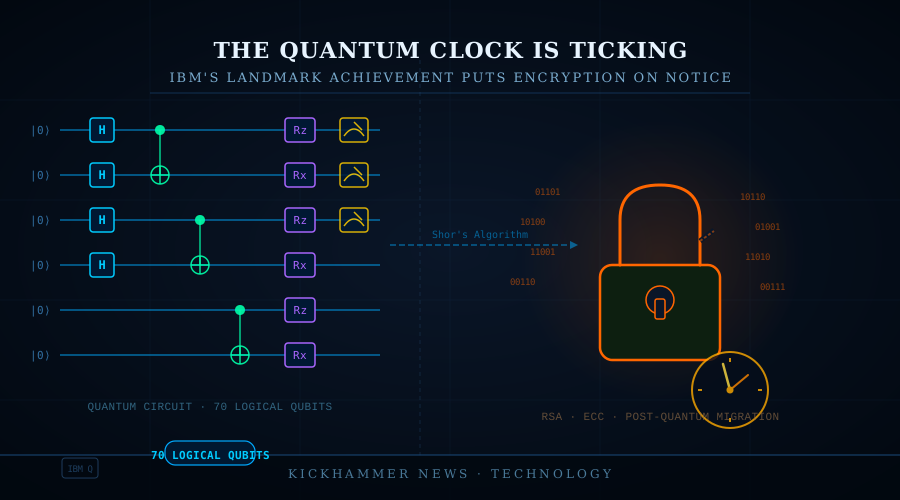
In July 2026, IBM and the University of Chicago jointly announced what researchers are calling a genuinely landmark milestone: a verified demonstration of quantum advantage using 70 logical qubits on IBM’s Heron r2 processor. This wasn’t a marketing claim slapped onto a press release. The demonstration was independently verifiable — classical supercomputers required more than 37 minutes to validate a computation the quantum system performed almost instantaneously. For the first time in the history of the field, the quantum machine’s output could be certified as correct without simply trusting IBM’s word on it.
That last part — the “trusted” part — matters enormously. Prior claims of quantum advantage, including Google’s headline-grabbing Sycamore demonstration in 2019, faced legitimate criticism that the results were difficult to independently verify. IBM’s new framework addresses that head-on, using a technique called logical circuit verification that allows outside parties to confirm the quantum result is genuine. This is a qualitative leap, not just a quantitative one.
What 70 Logical Qubits Actually Means
There’s a distinction worth drawing clearly here: physical qubits versus logical qubits. Physical qubits are the raw computational units — fragile, error-prone, sensitive to the slightest environmental noise. Logical qubits are groups of physical qubits that work together to encode information reliably, using quantum error correction to suppress noise. Getting 70 clean, error-corrected logical qubits working in a circuit that outperforms classical supercomputers is the kind of achievement quantum scientists have been building toward for three decades.
IBM’s Heron r2 processor powered the demonstration, and the University of Chicago team’s theoretical contributions were essential to designing the verification protocol. The result, published in Nature, used a technique involving Floquet dynamics — a form of periodic quantum evolution — to execute circuits that would take classical systems days or longer to simulate, while remaining verifiable by external observers.
The key phrase in IBM’s announcement is “trusted quantum computation on logical circuits.” Trusted. That word is doing a lot of heavy lifting. It means the quantum advantage here is real, reproducible, and independently confirmable — the gold standard the field has been seeking.
Why This Should Matter to People Who Don’t Own a Quantum Computer
Here is the uncomfortable truth: the most consequential applications of quantum computing for ordinary technology users are not about drug discovery or climate modeling. They’re about encryption.
The RSA cryptosystem, which protects the vast majority of internet traffic, relies on the computational difficulty of factoring large numbers. Elliptic curve cryptography, used in everything from TLS connections to Bitcoin wallets, relies on the hardness of the elliptic curve discrete logarithm problem. Both of these problems are vulnerable to Shor’s algorithm, a quantum algorithm that can solve them exponentially faster than any classical computer — once you have enough clean logical qubits.
The question is: how many is “enough”? Current estimates suggest that breaking RSA-2048 would require somewhere between 2,000 and 4,000 error-corrected logical qubits running coherently for hours. IBM’s 70-qubit demonstration is several orders of magnitude away from that threshold. The Bitcoin blockchain, with its reliance on elliptic curve cryptography, faces a similar situation: its core cryptographic assumptions remain intact for now.
But “for now” is not the same as “forever,” and the pace of progress should not be treated as constant or slow.
IBM Opens the Door — and the Timeline Narrows
What happened this November adds a new dimension to the story. IBM recently announced it is making its quantum hardware, including the Heron-class processors behind the July milestone, available to external researchers through its IBM Quantum Network. The intent is to accelerate the development of fault-tolerant algorithms and to push the logical qubit count higher, faster.
This is a smart move for the field, and a quietly alarming one for security planners. When breakthrough hardware becomes widely accessible to researchers, the discovery rate doesn’t just increase linearly — it compounds. The history of classical computing tells that story clearly: once researchers worldwide could access shared infrastructure, the pace of innovation exploded.
NIST finalized its first round of post-quantum cryptography standards in 2024, including CRYSTALS-Kyber for key encapsulation and CRYSTALS-Dilithium for digital signatures. These are algorithms designed to resist attack by both classical and quantum computers. The question the IBM milestone raises is whether the migration timelines organizations are working toward — typically measured in years — remain adequate.
The honest answer is: probably, but not comfortably. And “probably” is not a word that should live in a security strategy document without a contingency plan behind it.
The Hardest Problem Is Not Technical
The cryptographic community broadly understands what needs to happen: retire RSA and ECC, deploy NIST-approved post-quantum algorithms, inventory every system that depends on public-key cryptography. The process is well-understood in theory.
The challenge is execution at scale. Modern internet infrastructure depends on cryptographic primitives embedded everywhere — in firmware, in hardware security modules, in decades-old certificate authorities, in embedded devices that will never receive a software update. The industrial control systems managing power grids, the ATM networks, the satellite communication links — these are not systems that flip to a new cryptographic standard on a quarterly update cycle.
This is what makes the IBM announcement genuinely significant even if it feels distant from everyday life. The 2026 milestone doesn’t break encryption. But it moves the realistic threat timeline from “theoretical and distant” to “engineering problem with a narrowing horizon.”
Security teams should be treating post-quantum migration as infrastructure work that needs to begin now, not as an exotic risk to be revisited in 2030. The quantum computer that breaks encryption won’t announce its arrival in advance.
The window for proactive migration, not emergency response, is still open. The question is whether organizations will use it.