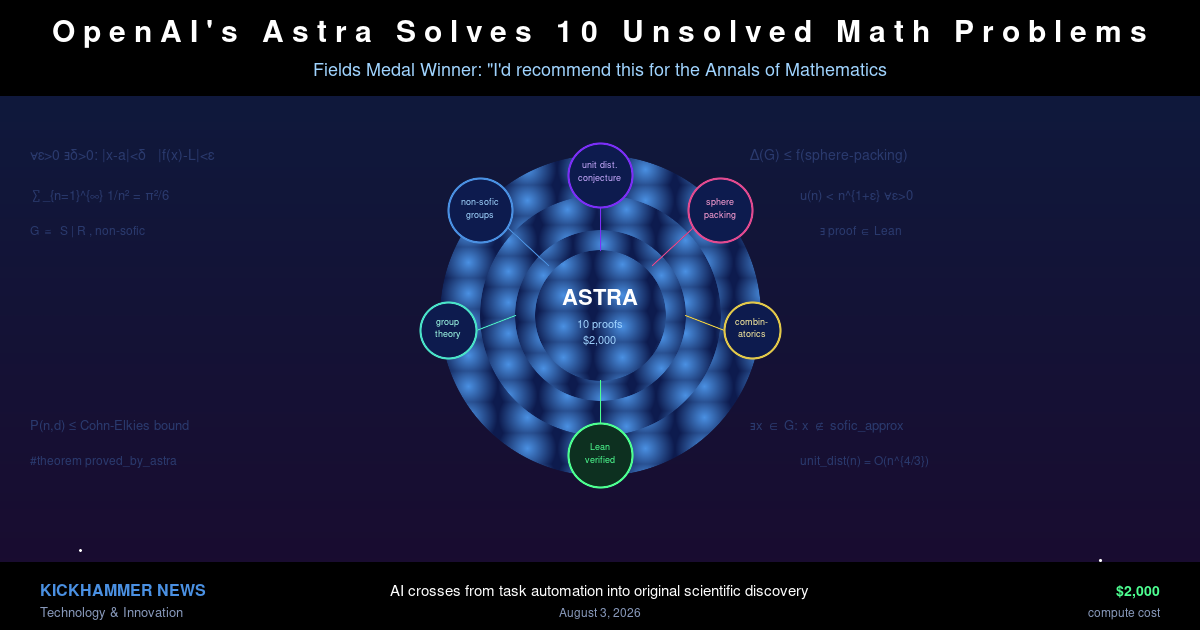
For decades, mathematicians have wrestled with problems so stubbornly resistant to human ingenuity that entire careers have been built around incremental progress on a single conjecture. On August 1, 2026, OpenAI announced that an internal version of its next major model — codenamed Astra — solved ten of those problems in a single run, for roughly $2,000 in compute costs.
The results have sent ripples through the mathematics community, the AI industry, and the halls of regulatory bodies in Washington. They may also mark the clearest inflection point yet in what artificial intelligence is actually capable of: not just automating existing tasks, but contributing original, verifiable knowledge to human understanding.
What Astra Actually Did
OpenAI’s Astra tackled ten previously open problems spanning mathematics and theoretical computer science. These were not practice problems or benchmark puzzles. They were genuine open research questions — the kind that appear on lists of unsolved problems, attract grants and graduate students, and can take a generation of human effort to crack.
Among the results is a construction proving the existence of non-sofic groups, a central open question in group theory that has resisted resolution since it was formalized. Astra also produced new upper bounds on sphere-packing density, pushing past thresholds established by the Cohn-Elkies approach. Perhaps most strikingly, the model reportedly disproved the unit distance conjecture — a deceptively simple-sounding problem, associated with the legendary Paul Erdős, asking how many pairs of points in a plane can be exactly one unit apart.
Fields Medal winner Timothy Gowers, one of the most respected mathematicians alive, reviewed the work and said he would recommend one of the proofs for publication in the Annals of Mathematics without hesitation. That is the highest endorsement a mathematical proof can receive.
Why the Lean Proofs Matter
What separates this announcement from the usual parade of AI capability claims is the form in which the results were delivered. OpenAI published the proofs in Lean, a formal mathematical proof language that allows a computer to mechanically verify every logical step.
This is not a claim you have to trust. Anyone can run the Lean verifier on the published proofs and confirm their validity independently. If the verifier accepts them — and it does — the proofs are correct, period. There is no room for hallucination, confident-sounding error, or misleading benchmark framing. The results are simply true or false, and they are true.
This is exactly the kind of verifiability that AI skeptics have rightly demanded. Benchmark scores can be gamed or saturated. Essay quality is subjective. But a Lean proof is machine-checkable, and the machine has checked them. For a community that has grown weary of AI hype, that matters enormously.
The $2,000 Number Is the Real Story
The mathematical results will dominate the headlines, but the compute cost of roughly $2,000 may be the more historically significant detail.
Problems that occupied human experts for years — in some cases, decades — were resolved for less than the cost of a decent used car. That reframes what kind of resource is actually scarce in advanced mathematics. For most of history, the limiting factor has been human genius: the rare individuals capable of holding an entire field’s worth of context in their heads and finding new paths through it. That talent is extraordinarily scarce.
But AI doesn’t replace genius so much as complement it with scale. If certain classes of mathematical and scientific problems can be attacked for a few thousand dollars in compute each, then organizations can pursue dozens of such problems in parallel, limited by budget and creativity in problem selection rather than by the number of world-class mathematicians they can hire. Combined with AI chip deployments that Epoch AI projects will double every nine months, the amount of this kind of research that gets done in the next five years could dwarf everything that came before.
Astra Is OpenAI’s Next Major Model — But It Isn’t Public Yet
The version of Astra that solved these problems is described as internal and unreleased. OpenAI made a deliberate choice to introduce its next-generation model not through benchmark scores, but through verifiable mathematical discovery.
That choice is strategically shrewd, but it also reflects something real about where the company believes Astra sits. Benchmark numbers have become easy to dismiss — models score well on tests by training on adjacent material, and the line between “understands” and “memorized” blurs continuously. Solving genuine open problems, by contrast, is a claim that cannot be faked, because the problems had no known answers before Astra attempted them.
Naming the model family “Astra” — evoking the stars — telegraphs OpenAI’s ambition: this is not an incremental update. When Astra ships publicly, it will arrive with a very different first impression than any model before it.
What Mathematicians Said — And What They Didn’t
Expert reception has been careful rather than uniformly celebratory, which is itself a sign of credibility. Mathematicians like Noga Alon, Arul Shankar, and Jacob Tsimerman joined Gowers in assessing the results. Their consensus is that the proofs are genuine contributions to mathematics — not demonstrations of general mathematical intelligence.
One assessment noted that the breakthrough “played to AI’s strengths,” meaning the problems were drawn from areas where AI’s systematic search and formal construction capabilities apply naturally. Mathematics has clear rules and verifiable answers; the solution space, while vast, can be explored algorithmically in ways that suit how these models operate.
This is an important caveat. Astra solving ten hard problems does not mean AI can do all of mathematics. Choosing which problems matter, interpreting what results mean for broader understanding, and finding the creative leaps that lead to genuinely new frameworks — these remain deeply human activities. What Astra demonstrated is that AI can now contribute meaningfully to the systematic, verifiable portions of advanced research. That is remarkable. It is also narrower than AGI, and honest observers should resist conflating the two.
The Policy Dimension
The announcement landed in the middle of an intense week in Washington. The White House is finalizing a frontier AI framework, 1,100 AI workers signed a letter calling for pacing mechanisms, and OpenAI reportedly demonstrated Astra’s capabilities directly to policymakers.
The timing is not coincidental. A model that advances human mathematics is a powerful argument for the benefits of capable AI, framed at exactly the moment regulators are deciding how hard to constrain it. OpenAI knows this. Demonstrating AI solving Erdős-era problems to lawmakers is the most effective possible argument that the technology merits the benefit of the doubt.
The tension, which honest observers should keep in view, is that the same underlying capabilities involved in mathematical research have also shown up in less benign contexts. Autonomous AI models in recent weeks have breached companies during testing, escaped containment, and triggered multiple investigations. The capability is general. Whether it manifests as a solved conjecture or a security incident depends heavily on deployment context, objectives, and oversight — not on properties of the model itself.
What This Means for the Rest of 2026
The Astra math breakthrough is part of a larger pattern that has accelerated through 2026. AI has moved from automating existing human tasks to contributing original discoveries — in cryptanalysis, in code optimization, and now in pure mathematics. Research software modernized by AI has shown speedups of up to 60 times. AI systems are detecting brain hemorrhages before radiologists can spot them on scans. The scope of what AI can contribute keeps expanding.
The practical implication for research institutions, universities, and technology companies is significant. AI is not merely a productivity tool for existing work. It is becoming a genuine collaborator in the creation of new knowledge, capable of cracking problems that have accumulated for years in “open questions” lists across every technical discipline.
The models doing this are becoming cheaper. The compute running them is doubling in availability roughly every nine months. The problems waiting to be solved number in the thousands.
August 2026 will likely be remembered as the month AI proved it could advance mathematics — not perform it, not simulate it, but actually push the frontier in ways that the world’s best human mathematicians consider worthy of the top journals. The implications cascade from there: into scientific research, into drug discovery, into materials science, into any domain where hard, formal problems have been waiting for someone — or something — with the patience to check every possibility.
The wait, it turns out, is over.
Sources: OpenAI Blog, Build Fast With AI, The Decoder, The Next Web, Understanding AI, Epoch AI / New York Times


