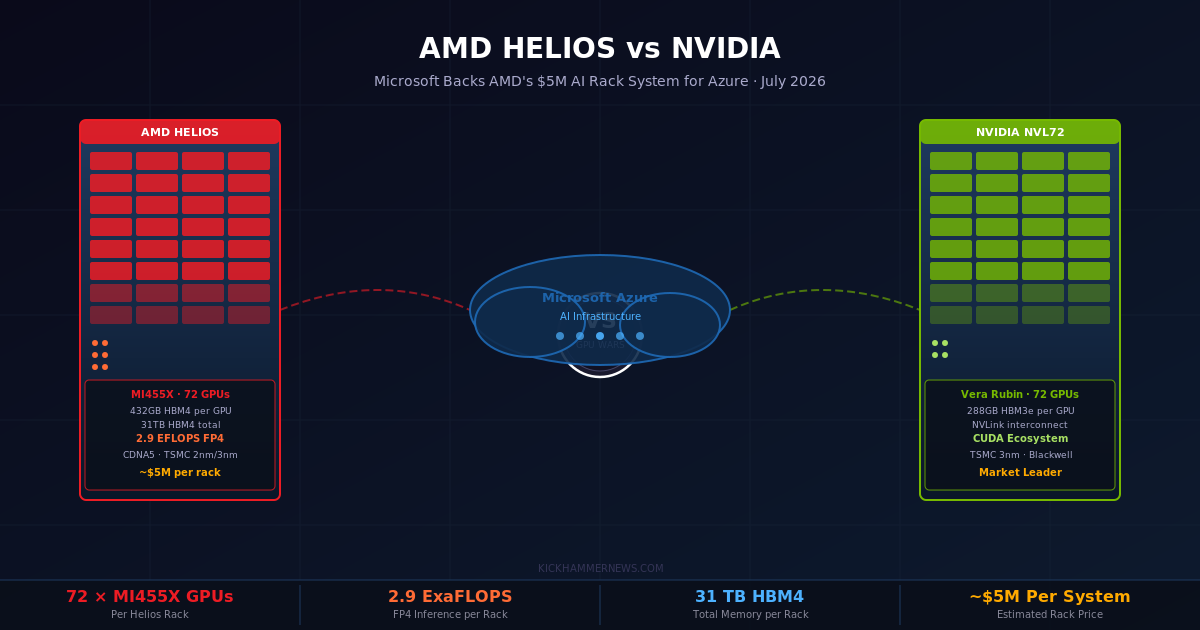
For years, the story of AI infrastructure has been essentially one company: Nvidia. Its H100s and H200s powered the generative AI boom, its Blackwell architecture dominated hyperscaler procurement, and its Vera Rubin systems were shaping up to anchor the next wave of data center buildouts. But on July 20, 2026, AMD drew the clearest battle lines yet — announcing Helios, its first integrated rack-scale AI system, with Microsoft as its inaugural customer.
It’s the most significant challenge to Nvidia’s AI hardware monopoly in years, and the deal signals that the era of single-vendor dominance in AI compute may finally be ending.
What Is AMD Helios?
Helios is AMD’s answer to Nvidia’s NVL72 rack systems — a fully integrated, rack-scale AI solution that packages 72 of AMD’s new Instinct MI455X GPUs alongside sixth-generation EPYC Venice CPUs, Pensando networking silicon, and the ROCm software stack into a single unified system that ships and operates as one cohesive unit.
On paper, the specs are staggering. Each MI455X accelerator carries 432 gigabytes of HBM4 memory — a significant step beyond Nvidia’s Vera Rubin platform — with 19.6 terabits per second of memory bandwidth and roughly 40 petaFLOPS of FP4 compute performance per chip. Multiplied across a full 72-GPU rack, Helios delivers approximately 2.9 exaFLOPS of FP4 inference performance and 1.4 exaFLOPS of FP8 training capability, backed by a combined 31 terabytes of HBM4 memory across the entire system.
The MI455X itself is a marvel of chiplet engineering. AMD built it on a mix of TSMC’s 2nm and 3nm process nodes, packing a transistor count that exceeds 320 billion — a density that enables the dramatic efficiency and performance gains over the prior generation. Each Helios compute tray houses four MI455X accelerators and a single EPYC Venice CPU with up to 256 Zen 6 cores, with 18 such trays making up the full rack.
Microsoft Goes All-In
The headline from AMD’s announcement wasn’t just the hardware — it was the customer. Microsoft will deploy Helios in its Azure data centers later this year, using the systems to power frontier model AI inference for its own services and its AI customers, including the Azure AI platform used by thousands of enterprises worldwide.
The AMD-Microsoft partnership runs deeper than a single purchase order. AMD confirmed an expanded strategic relationship spanning GPUs, CPUs, networking, and software across the Azure platform. That means EPYC Venice processors in Azure virtual machines, Pensando networking in Azure’s data center fabric, and Helios racks underpinning AI inference at scale — a comprehensive stack bet that few would have anticipated even two years ago.
Microsoft joins Meta, OpenAI, Oracle, and Tata Consultancy Services among the first wave of Helios adopters, a customer list that reads like a who’s-who of global AI infrastructure demand. That AMD has landed this cohort before Helios has even reached mass production — full scale ramp is expected by Q2 2027 — speaks to the urgency among hyperscalers to diversify away from Nvidia dependence.
The Nvidia Problem Nobody Talks About
The subtext of the Helios launch is something that has been quietly discussed in data center circles for years: Nvidia’s leverage has become uncomfortable.
With H100 and H200 GPUs commanding prices of $30,000 to $40,000 each and wait times stretching into quarters, hyperscalers found themselves at the mercy of a single supplier for their most critical infrastructure. Nvidia’s pricing power, delivery constraints, and the complexity of its proprietary NVLink interconnect created genuine strategic risk for companies spending tens of billions of dollars on AI compute.
AMD’s pitch with Helios is multipart. The MI455X GPUs are priced competitively, with industry estimates placing them in the $25,000 to $45,000 range per accelerator — but AMD’s willingness to package the whole system at an estimated $5 to $5.5 million per rack, including CPUs and networking, offers hyperscalers a meaningful cost-of-ownership argument. More importantly, AMD’s use of UALink-over-Ethernet as its interconnect — a more open alternative to NVLink — reduces vendor lock-in and integrates more naturally into existing data center networking fabrics.
ROCm, AMD’s software platform, has historically lagged CUDA in ecosystem maturity, and that gap remains the most significant obstacle to widespread adoption. But Microsoft’s commitment to Helios is meaningful precisely because it implies Microsoft is willing to invest in ROCm compatibility for its workloads — a signal that could accelerate third-party software support across the industry.
The Bigger Picture: AI Hardware Is Diversifying
The Helios announcement doesn’t arrive in isolation. In the same week, reports surfaced that Google is developing an internal chip codenamed “Frozen v2” — a purpose-built inference accelerator for Gemini models projected to be six to ten times more efficient than current TPUs, targeted for 2028. Meta has its own custom Iris silicon in development. Amazon has Trainium2. Even startups like Tenstorrent and Groq are carving out inference niches.
What’s emerging is an AI hardware landscape that looks less like Nvidia’s kingdom and more like the server CPU market of the early 2000s — competitive, multi-vendor, and increasingly shaped by specific workload requirements. Inference and training have different optimization targets; frontier model development and edge deployment require different tradeoffs. A single architecture can no longer optimally serve every use case.
Nvidia isn’t going anywhere. Its CUDA ecosystem, installed base, and continued product leadership with Vera Rubin and beyond ensure it will remain the default choice for many workloads for years. But “default” is different from “only option,” and the Helios-Microsoft deal makes clear that hyperscalers are actively building alternatives.
What Comes Next
With mass production targeted for Q2 2027, the real test for Helios will come in deployment. Microsoft’s Azure operations are a crucible that few hardware platforms survive unchanged — the scale, reliability requirements, and software integration demands of running cloud AI at Microsoft’s scope will either validate AMD’s architecture or expose its weaknesses.
For the broader industry, the stakes are high. If Helios performs well at Azure, expect AMD’s customer list to grow significantly. If ROCm compatibility proves smoother than skeptics expect, the case for diversification becomes even more compelling. And if AMD can match Nvidia’s delivery timelines — historically one of AMD’s weak points in the data center market — the competitive dynamics of AI infrastructure could look meaningfully different by 2028.
The GPU wars, long a foregone conclusion, are heating up. And for the first time in years, the outcome is genuinely uncertain.


