For years, Apple has played an unusual role in the artificial intelligence race — a company with unmatched hardware and software integration, a billion-plus user base, and a reputation for obsessive polish, yet conspicuously behind rivals in AI capability. At WWDC 2026, held Monday at Apple Park in Cupertino, the company finally answered its critics. Apple unveiled Siri AI, a ground-up reimagining of its long-struggling voice assistant, alongside iOS 27, macOS Golden Gate, and a sweeping suite of AI features collectively branded as the next generation of Apple Intelligence.
The announcements mark what many analysts are calling Apple’s most consequential developer conference in a decade — not because it introduces any single revolutionary feature, but because it signals Apple’s full commitment to making AI the center of its ecosystem strategy.
Siri AI: From Voice Shortcut to Contextual Intelligence
The centerpiece of WWDC 2026 was unquestionably Siri AI. The original Siri, launched in 2011, was a curiosity that aged into a punchline — capable of setting timers and playing music, but notoriously unreliable for anything more complex. While competitors like Google Assistant, Amazon Alexa, and eventually ChatGPT leapfrogged it in capability, Apple largely tinkered at the margins.
That era appears to be over.
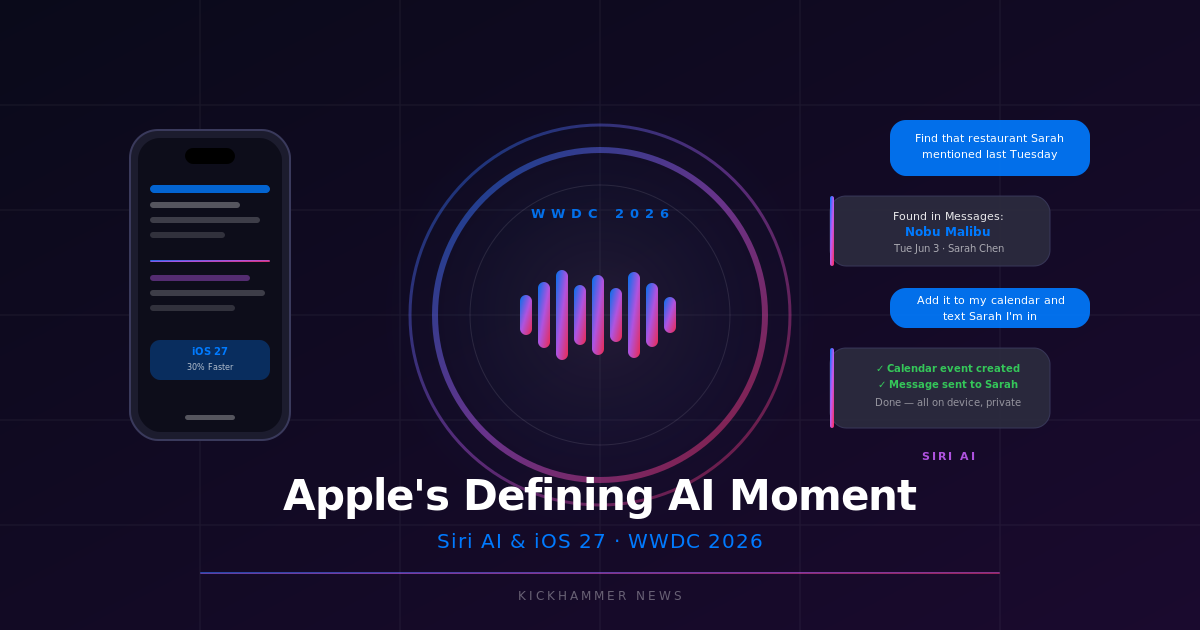
Siri AI is multimodal, context-aware, and deeply integrated across Apple’s operating systems. It can see and understand what is on your screen — whether that’s an email, a photo, a document, or a webpage — and act on it intelligently. Ask Siri AI to “find that address my friend mentioned last week,” and it will search through your Messages history, cross-reference your contacts, and surface the right result without requiring you to know exactly what to search for.
The new Siri can handle multi-step requests that span multiple apps. A user can say “take the flight info from my email and add it to my calendar, then text my wife the arrival time” — and Siri AI will execute the entire chain. This kind of agentic, cross-app orchestration has been the hallmark of newer AI assistants, and Apple has now built it natively into its platform.
Critically, Apple has done this while maintaining its signature emphasis on privacy. Much of the on-device AI processing runs locally on Apple Silicon using the Neural Engine, meaning sensitive data such as messages, emails, and health information never leaves the device. For tasks requiring more powerful cloud computation, Apple uses its Private Cloud Compute infrastructure, which it says prevents server-side access to user data.
iOS 27: Speed, Intelligence, and a New Look
Beyond Siri AI, iOS 27 brings a comprehensive refresh of the iPhone experience. Apple claims app launch times are 30 percent faster, and photos now appear in the Photos library 70 percent faster than in iOS 26. Animations have been tightened, responsiveness improved, and the overall feel of the OS described by early testers as noticeably snappier — a meaningful achievement given the iPhone’s already high baseline performance.
The visual language of iOS 27 has been refined as well. Apple has updated its system-wide typography and spacing, with a greater emphasis on fluid transitions between apps and states. Lock screen customization has been expanded, and the home screen now supports more flexible app arrangement options.
The Camera app receives significant AI enhancements. A new Intelligent Scene Mode uses Apple’s on-device models to detect shooting conditions and optimize settings in real time. Photo editing has been upgraded with AI-powered tools for removing unwanted objects, adjusting lighting after the fact, and generating stylized looks without requiring third-party apps.
The Messages app gains a suite of AI writing assistance tools — not unlike those already present in competitive products, but integrated more tightly with iMessage’s end-to-end encryption model. Users can request Siri AI to draft, revise, or summarize messages while keeping the content private.
macOS Golden Gate and the Apple Intelligence Ecosystem
macOS 27, named Golden Gate in Apple’s continuing tradition of California-themed releases, brings the same Apple Intelligence features to the Mac. The Finder gains AI-powered search that understands natural language queries. Safari integrates Siri AI for research assistance, allowing users to ask questions about pages they’re reading or request summaries of long articles. The Notes app now offers voice-to-structured-document capabilities, where dictated content is automatically organized into headers and bullet points.
The Apple Watch and Apple TV also receive targeted updates, with watchOS 14 adding more health AI features and tvOS 20 gaining personalized content recommendations powered by on-device models.
visionOS 3, the update for Vision Pro, deepens spatial computing integration with Apple Intelligence. Siri AI in visionOS can respond to voice, gaze, and gesture inputs simultaneously — an early indicator of how Apple envisions AI working in a spatial environment where traditional screen interfaces give way to something more ambient.
Child Safety and Developer Changes
Not all of WWDC’s news was purely about AI. Apple announced a substantial expansion of Screen Time and parental controls, responding to months of pressure from governments and advocacy groups — including warnings from UK Prime Minister Keir Starmer, who last week cautioned tech companies to act on child safety or face legal consequences.
New controls let parents set app usage limits with greater granularity, require approval for downloads even from older teenagers, and receive AI-generated summaries of their child’s phone activity without accessing the content of messages directly — a careful balance between oversight and privacy.
Apple also announced changes to App Store rules for developers, expanding sideloading options in Europe further and offering new business models for subscription apps. The moves appear aimed at preempting further regulatory action while maintaining Apple’s core revenue model.
What It Means for the AI Race
Apple’s WWDC 2026 announcements come at a pivotal moment. OpenAI continues to expand ChatGPT into a broad “super app,” Google is embedding Gemini across all of Android and its cloud services, and Microsoft has woven Copilot into every corner of Windows. Each of these companies has a compelling AI story to tell.
Apple’s story is different — and arguably more powerful in the long run. No competitor has Apple’s combination of trusted hardware, OS-level integration, and privacy reputation. Siri AI does not exist as a separate app the user must open; it is woven into every action the device can take. That integration advantage is something competitors cannot easily replicate.
The caveat is execution. Apple’s history with AI features includes notable stumbles — from early Siri embarrassments to overpromised and underdelivered features in Apple Intelligence’s first iteration. The features announced at WWDC 2026 are previews; most will ship in fall software updates, and some are earmarked for later releases. European and Chinese users will face further delays due to regulatory requirements.
But the vision is clearer than it has ever been. Apple wants Siri AI to be the intelligence layer through which users interact with all of their apps, devices, and data. If it can deliver on that promise, the company that was once the laggard in AI may turn its integration advantage into the most formidable AI platform of all.
The AI era on Apple devices is no longer coming. At WWDC 2026, it arrived.
Sources: Apple Newsroom, Bloomberg, TechRadar, Tom’s Guide, TechCabal


