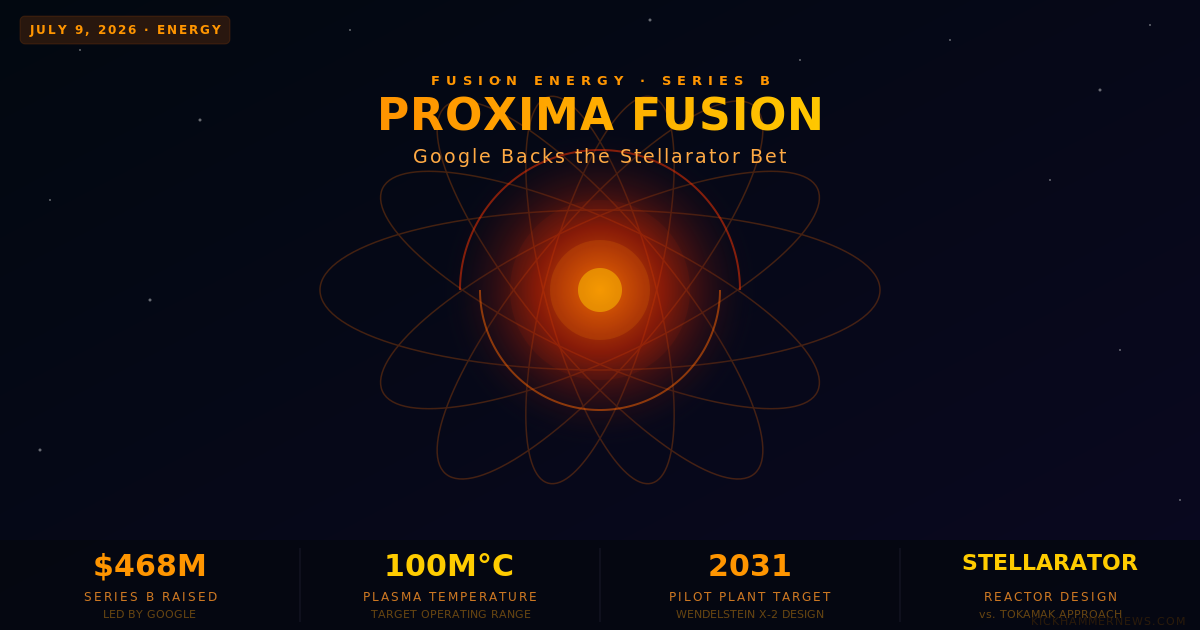
When Proxima Fusion closed its EUR411 million ($468 million) Series B funding round this week, the announcement barely needed a headline. The numbers told the story: Europe’s biggest-ever private fusion investment, a $2.7 billion valuation for a three-year-old startup, and Google — one of the world’s most aggressive energy consumers — putting serious money behind a technology that has tantalized scientists for seventy years without ever delivering commercial power.
This time, the people writing the checks believe it’s different.
Why Google Is Betting Big on Fusion
Google’s motivations are easy to understand. The company’s data centers, which power everything from Search to YouTube to the AI models that now underpin much of its business, consume electricity at a scale that strains regional power grids. The International Energy Agency estimates that global data center electricity consumption could double by 2030, and AI workloads are accelerating that timeline.
Nuclear fusion — the process that powers stars by fusing hydrogen atoms to release enormous energy — holds a simple appeal: it produces no carbon emissions, generates no long-lived radioactive waste, and runs on fuel derived from water. A working fusion plant could theoretically run continuously, unlike wind and solar, which depend on weather conditions. For companies like Google that need guaranteed, carbon-free power around the clock, fusion is worth a long-term bet.
Google has made similar bets before. The company previously invested in Commonwealth Fusion Systems, the MIT spinout building a tokamak-based fusion reactor in Massachusetts, and signed a power purchase agreement with them last year. Now it’s adding Proxima Fusion to its portfolio, diversifying its exposure across different fusion technology approaches.
“Fusion holds huge potential as an energy source of the future: it’s clean, abundant and inherently safe, and it can be built just about anywhere,” Google said in a statement tied to the announcement.
The company didn’t oversell it. “Commercializing fusion remains immensely challenging, and success is not guaranteed,” it added.
The Stellarator Bet
What makes Proxima Fusion unusual isn’t just its European origins — it’s the reactor design it’s pursuing.
Most of the heavily funded fusion startups in the U.S. are building tokamaks: donut-shaped devices that use powerful magnetic fields to contain superhot plasma until fusion reactions occur. Tokamaks have the longest research history, and the massive ITER project in France — a global scientific collaboration involving 35 nations — is the flagship example.
Proxima is building a stellarator instead.
Like a tokamak, a stellarator uses magnetic fields to confine plasma. But where a tokamak’s magnetic configuration requires an electrical current flowing through the plasma itself to help stabilize it, a stellarator relies entirely on the shape of external magnets to do that job. The magnetic coils in a stellarator are twisted into extraordinarily complex three-dimensional geometries — shapes so intricate that designing them wasn’t practical until modern supercomputers could run the necessary simulations.
The payoff for that complexity is stability. Because stellarators don’t depend on plasma current for confinement, they can in theory run continuously without the disruptions that occasionally plague tokamak experiments. That’s a meaningful advantage for a commercial power plant, which needs to operate reliably for decades.
The tradeoff is engineering difficulty. Stellarators are harder to design and more expensive to manufacture, which is why the fusion industry largely sidelined them for decades in favor of tokamaks. Advances in high-temperature superconducting magnets and computational design have changed the calculus — and Proxima was founded specifically to exploit those changes.
The company was spun out of the Max Planck Institute for Plasma Physics in Munich, home to the Wendelstein 7-X — the world’s most advanced stellarator research device. Proxima’s founders include scientists from Max Planck, MIT, and X, Google’s former moonshot laboratory. CEO Francesco Sciortino conducted fusion research at both MIT and Max Planck before co-founding the company in 2023.
“Europe is racing with the United States and China to get to the first fusion power plant,” Sciortino said in a statement this week. “Proxima’s financing demonstrates that Europe can not only invent breakthrough technologies, but also build globally competitive companies around them.”
The Road Ahead
The $468 million round was led by XTX Ventures and East X Ventures, with Google and German energy giant RWE participating as strategic investors. Existing backers Plural, UVC Partners, Balderton Capital, and Cherry Ventures returned to support the round.
RWE’s involvement is particularly significant. The German utility has signed a cooperation agreement with Proxima to build the company’s first commercial stellarator at the site of RWE’s decommissioned Gundremmingen nuclear fission plant in Bavaria. The logic is practical: decommissioned nuclear sites often have grid connections, cooling water access, and communities already accustomed to large energy facilities — the kind of infrastructure that typically takes years and billions of dollars to build from scratch.
The new funding will go toward expanding production of high-temperature superconducting cables and magnets, building out Proxima’s engineering and manufacturing teams, and advancing design work on Alpha, the company’s planned net-energy fusion demonstrator. The company targets Alpha’s completion in the early 2030s, serving as a final proof of concept before construction of Stellaris — the commercial power plant — later that decade.
If that timeline holds, Proxima would be operating commercial fusion capacity by approximately 2040. That’s an ambitious projection in a field famous for sliding timelines.
How Proxima Stacks Up
Even with Europe’s largest-ever fusion fundraise, Proxima remains an underdog by the numbers. Commonwealth Fusion Systems has raised roughly $2.9 billion since its founding, and Sam Altman-backed Helion Energy has collected approximately $1.5 billion. The global fusion investment landscape has grown dramatically over the past five years, with more than $7 billion in private capital flowing into fusion startups since 2021, according to the Fusion Industry Association.
That competition is accelerating Proxima’s urgency. The race isn’t just scientific — it’s commercial. Whoever delivers grid-scale fusion power first will have a decades-long head start in one of the most consequential energy markets of the twenty-first century.
For Google, the $468 million investment is part of a longer-term hedge. The company isn’t betting that Proxima will necessarily win. It’s betting that fusion will eventually power the data centers of the future, and that owning a stake in the companies most likely to get there first is worth the risk.
For Proxima, the funding is an inflection point — validation that a European startup with its roots in academic physics can compete on the same stage as Silicon Valley-backed rivals flush with venture capital.
Whether a twisted magnetic coil in a Munich laboratory eventually lights up European homes is a question only the next decade can answer. For now, the money is in, and the science is finally catching up to the ambition.