Today marks the end of an era for Google’s developer tooling. As of this morning, the Gemini CLI and Gemini Code Assist IDE extensions have officially stopped serving requests for individual users, replaced by Antigravity — Google’s all-in-one, agent-first development platform that the company unveiled at Google I/O last month. The transition has been months in the making, but today’s hard cutoff makes it official: the way Google wants developers to build software has fundamentally changed.
From Chatbot to Co-Pilot to Commander
To understand why Antigravity matters, it helps to trace how developer AI tools have evolved. When GitHub Copilot launched in 2021, the pitch was simple: AI completes your code. Then tools like Cursor and the original Gemini CLI pushed further, enabling back-and-forth conversation about code and limited multi-file edits. Antigravity 2.0 takes a much more ambitious leap: it is not a co-pilot sitting beside you in your IDE — it is an autonomous agent platform that can plan, execute, test, and deploy entire applications while you narrate at a high level.
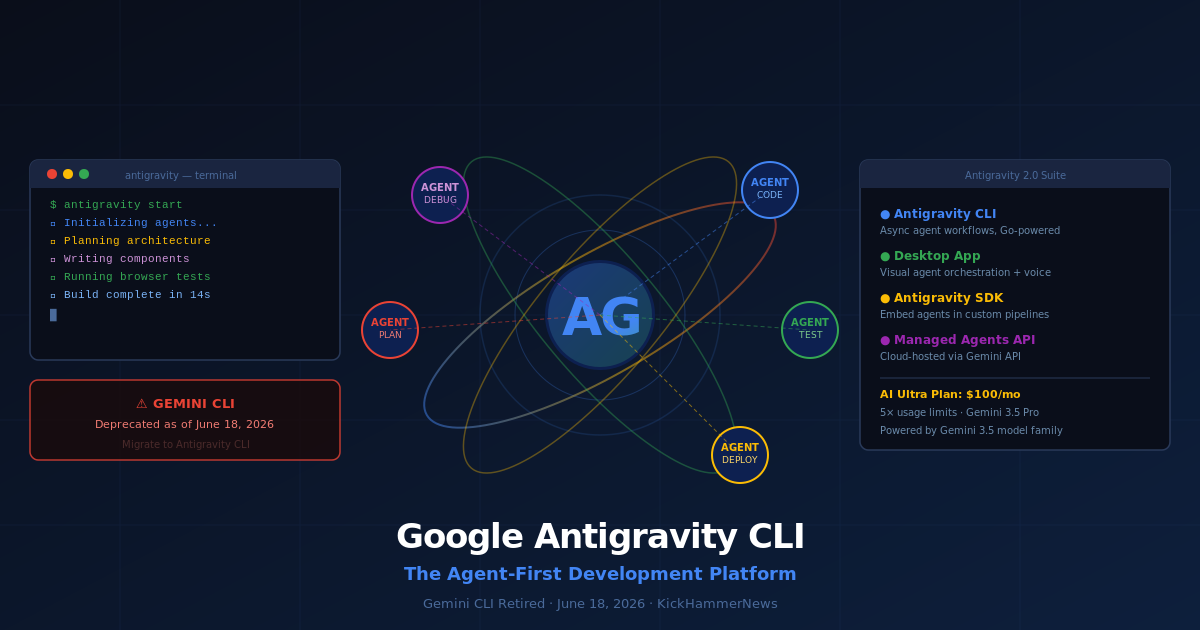
Google describes Antigravity as an “agent-first development platform.” In practice, that means the software spins up multiple specialized AI sub-agents that divide and conquer complex tasks in parallel. One agent handles architecture planning. Another writes code. A third launches a live Chrome browser instance, clicks through the actual running application like a human QA tester, takes screenshots, spots errors, and feeds that feedback back into the loop. The entire build-test-fix cycle runs continuously, without waiting for developer intervention at each step.
What Is Actually Shipping Today
The Antigravity 2.0 suite that went live this week includes four main components:
Antigravity CLI — The terminal-based successor to Gemini CLI, rebuilt in Go for speed. It supports asynchronous workflows, so long-running agent tasks execute in the background while developers continue working. It also introduces “Agent Skills,” modular capabilities that agents can call on — things like web search, database queries, or file system operations. The CLI supports hooks and sub-agents, and existing Gemini CLI extensions can be migrated as Antigravity plugins, though Google has acknowledged that feature parity will not be perfect at launch.
Antigravity Desktop App — A standalone macOS and Windows application that provides a visual interface for the same agent orchestration system. The desktop app shows a live feed of what each sub-agent is doing, making the automated development process more transparent. Voice command support is built in, so developers can direct agents by speaking rather than typing.
Antigravity SDK — An API and library set for embedding Antigravity agent capabilities into custom pipelines, enterprise workflows, or third-party tools. The SDK is tightly integrated with Google AI Studio, Firebase, and Android development tooling.
Managed Agents via Gemini API — For teams that want to deploy agents as cloud-hosted services rather than running them locally, Google offers a managed execution environment through the Gemini API, with enterprise support available through the Gemini Enterprise Agent Platform.
The Open Source Question
Not everyone is celebrating. The Gemini CLI was an open-source project on GitHub, which made it popular among developers who wanted to inspect, fork, or self-host the tool. Antigravity CLI, at least in its current form, is not open source. Google has not published its source code, and the company has not committed to doing so.
Developer forums have lit up with criticism. Posts on Hacker News and Reddit called the shift “a step backward for transparency” and accused Google of locking down tools that were only popular because they were open. Others noted that the commercial incentives are obvious: a closed, subscription-gated tool is easier to monetize than an open-source one.
Google has not directly responded to the open-source criticism beyond confirming that enterprise customers with existing Gemini Code Assist Standard or Enterprise licenses will not see any disruption. Individual free-tier and Google AI Pro users are the ones facing the hardest transition.
Pricing and the New AI Ultra Plan
The full Antigravity experience is not cheap. Google has introduced a new 00 per month AI Ultra plan specifically designed for developers who want frontier access. Ultra subscribers get five times the usage limits in Antigravity compared to the standard Google AI Pro plan, plus priority access to Gemini 3.5 Pro, the model powering Antigravity reasoning and planning capabilities.
For comparison, GitHub Copilot enterprise tier runs around 9 per user per month, and Cursor top tier is 0 per month. At 00, Google is pitching Antigravity Ultra as a premium product — not just a code assistant, but a complete agentic development environment that eliminates entire categories of manual work.
Google AI Pro users at the standard tier will still have access to Antigravity, but with significantly tighter usage caps that may frustrate developers working on intensive projects.
The Bigger Picture: Agentic Development Goes Mainstream
Antigravity launch is not just a Google product story — it signals where the entire software development industry is heading. Every major player in developer tooling is making similar bets: SpaceX June acquisition of Cursor for 0 billion underscored how valuable AI-first coding tools have become. Microsoft has been steadily moving GitHub Copilot toward task-level automation rather than line-level autocomplete. Amazon Q Developer has added agentic features across its AWS toolchain.
The common thread is the shift from AI helps you type faster to AI executes entire workflows autonomously. In this framing, the developer job becomes less about writing individual lines of code and more about setting objectives, reviewing outputs, and making high-level architectural decisions.
Antigravity is Google most fully realized attempt to build for that future. Whether it succeeds will depend on whether developers trust an AI agent enough to hand over the execution — not just the autocomplete.
What Developers Should Do Now
If you have been relying on Gemini CLI, today cutoff means your existing setup no longer works for free-tier or AI Pro users. Google has published a migration guide on the Developers Blog walking through how to translate Gemini CLI configurations, hooks, and extensions into Antigravity equivalents.
Enterprise users on Gemini Code Assist Standard or Enterprise plans have more time and will not see an immediate disruption, but Google has signaled that Antigravity is the long-term direction for all tiers.
For developers evaluating their options, the competitive landscape for agentic coding tools is evolving rapidly. Antigravity browser-native testing loop and parallelized sub-agent architecture are genuinely differentiated. But the loss of open-source access and the 00 per month price tag will push some developers toward Cursor, Claude Code, or self-hosted alternatives.
The AI-assisted development era just got significantly more agentic. Whether you are on board or not, today Gemini CLI sunset is a hard line in the sand — and Antigravity is what Google is betting the future on.