The collapse of a massive cloud capacity deal between two tech giants exposes an uncomfortable truth: in the race to feed AI infrastructure, compliance walls can stop even the biggest checkbooks.
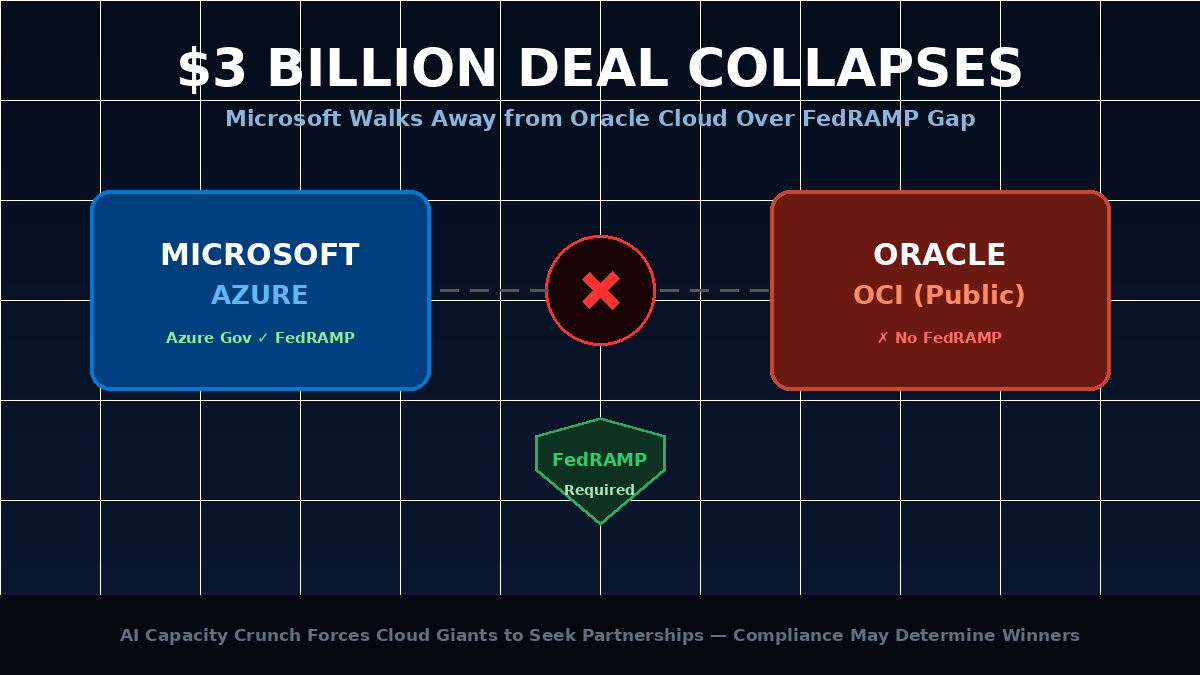
When two of the most powerful technology companies in the world can’t close a $3 billion deal, you take notice. According to a Business Insider report published this week, Microsoft recently walked away from advanced negotiations to lease cloud infrastructure capacity from Oracle after the talks hit an immovable compliance obstacle. The sticking point was FedRAMP — a Federal Risk and Authorization Management Program certification that Oracle’s public cloud does not currently hold, and reportedly was not willing to obtain.
The deal’s collapse is more than a footnote in enterprise tech news. It reflects the acute infrastructure strain underneath the AI boom, the growing strategic importance of government compliance frameworks, and the shifting competitive dynamics between the world’s largest cloud platforms.
The Deal That Almost Was
Microsoft’s AI ambitions have been devouring computing resources at a pace that even its own sprawling data center empire struggles to satisfy. The company recently projected capital expenditures for calendar year 2026 at $190 billion — a staggering figure driven almost entirely by the need to expand AI capacity. Despite that investment, demand continues to outrun supply.
That capacity crunch led Microsoft to Oracle’s door. The proposed arrangement would have seen Microsoft move some of its workloads onto Oracle Cloud Infrastructure (OCI), effectively leasing compute capacity to supplement Azure’s overtaxed systems. According to one source familiar with the matter, “We are shopping for capacity everywhere.” The deal was potentially worth more than $3 billion.
But it never happened.
The FedRAMP Wall
The specific obstacle was FedRAMP certification — a U.S. government compliance framework that standardizes security requirements for cloud services handling federal data. Amazon Web Services and Google Cloud Platform both hold FedRAMP authorization, giving them an edge in bidding for government and regulated workloads. Oracle’s public cloud does not.
For Microsoft, FedRAMP is not optional. Azure is deeply embedded in federal agencies, defense contractors, and regulated industries across the United States. Moving any workload to a third-party cloud that lacks FedRAMP certification would introduce unacceptable compliance risk — not just for government contracts, but for the trust enterprise customers place in Microsoft’s infrastructure assurances.
An Oracle executive acknowledged to Business Insider that obtaining FedRAMP certification for Oracle’s public cloud would be a “massive engineering undertaking.” Oracle’s government cloud does carry the certification, but that product is a separate, isolated environment and was not what was on the table in these negotiations.
Oracle pushed back on the report, with a spokesperson stating: “The details mentioned in the article are inaccurate. Microsoft is both an OCI partner and a customer. We have a tremendously collaborative and fruitful partnership, where we often talk about ways we can expand upon our ongoing work together.” Microsoft declined to comment. The existing Oracle Database@Azure partnership — a separate arrangement that embeds Oracle database services within Azure’s ecosystem — remains unaffected.
AI Is Eating the Cloud
The failed deal sits inside a broader story that is reshaping the entire cloud industry: AI’s voracious appetite for compute is forcing even hyperscalers to seek capacity from competitors.
Microsoft is not alone in this scramble. Google recently disclosed a deal to pay SpaceX $920 million per month for AI compute capacity, running from October 2026 through June 2029. That announcement came just weeks after Google Cloud separately agreed to sell AI compute to Anthropic. OpenAI, meanwhile, signed a landmark $300 billion infrastructure deal with Oracle — a five-year arrangement starting in 2027 that cements Oracle’s role as a central compute provider for the leading AI lab, even as Oracle’s relationship with Microsoft cools.
The irony is notable: Oracle is building out capacity for OpenAI at a scale that would make it one of the world’s most significant AI infrastructure providers, while simultaneously failing to clear the compliance bar needed to serve as a capacity backstop for its own existing partner, Microsoft.
Microsoft has already moved to lease capacity from Amazon Web Services to support GitHub, its developer platform, following outages tied to a surge in AI-driven software development. The GitHub-AWS arrangement was seen as an unusual and somewhat awkward partnership — GitHub is a Microsoft property, and AWS is Azure’s primary competitor — but infrastructure reality has a way of overriding competitive sensitivities.
What This Means for Enterprise Cloud Strategy
The story carries significant implications for CIOs and enterprise architects who are navigating multicloud decisions. FedRAMP certification is not just a checkbox for federal agencies — it has become a de facto signal of infrastructure maturity and security seriousness for a much broader class of enterprise customers in finance, healthcare, defense contracting, and any industry with regulatory exposure.
Oracle’s decision to decline FedRAMP certification for its public cloud while pursuing massive AI infrastructure contracts creates a bifurcated identity for OCI. It is simultaneously one of the most aggressive players in building out AI capacity and one of the few major clouds without a standardized government security certification on its core public platform. That gap may limit its appeal for large enterprises that need workload portability across public cloud and regulated environments.
For Microsoft, the episode underscores just how strained its infrastructure position has become. A company spending $190 billion on capex in a single calendar year and still reaching out to Oracle for overflow capacity is a company whose AI ambitions have genuinely outpaced its build-out timeline. The fact that even that search came up empty suggests that finding compliant third-party capacity at hyperscale is harder than it looks.
The Bigger Picture
The collapse of the Microsoft-Oracle deal is a signal of how compliance requirements are becoming a structural feature — not a footnote — of cloud infrastructure deals at the highest levels. FedRAMP was designed to protect government data, but it has evolved into something closer to a universal security trust mark, one that determines who can partner with whom at scale.
Oracle’s choice to invest its compliance engineering effort in government-specific cloud rather than its public platform reflects a strategic bet: that AI compute customers (like OpenAI) care more about raw capacity and performance than security certifications. That bet may pay off handsomely for its OpenAI infrastructure deal. But it apparently cost the company a $3 billion relationship with one of the tech industry’s most important cloud buyers.
As the AI infrastructure race accelerates, expect compliance architecture to become an increasingly visible fault line between cloud competitors. The winners in the next phase won’t just be those with the most GPUs — they’ll be those who can deliver capacity at scale without creating a security hole in their customers’ compliance posture.
Microsoft is still shopping. The question is who has the infrastructure, the scale, and the certification to answer the call.
*Sources: Business Insider, Techzine Global, Yahoo Finance*