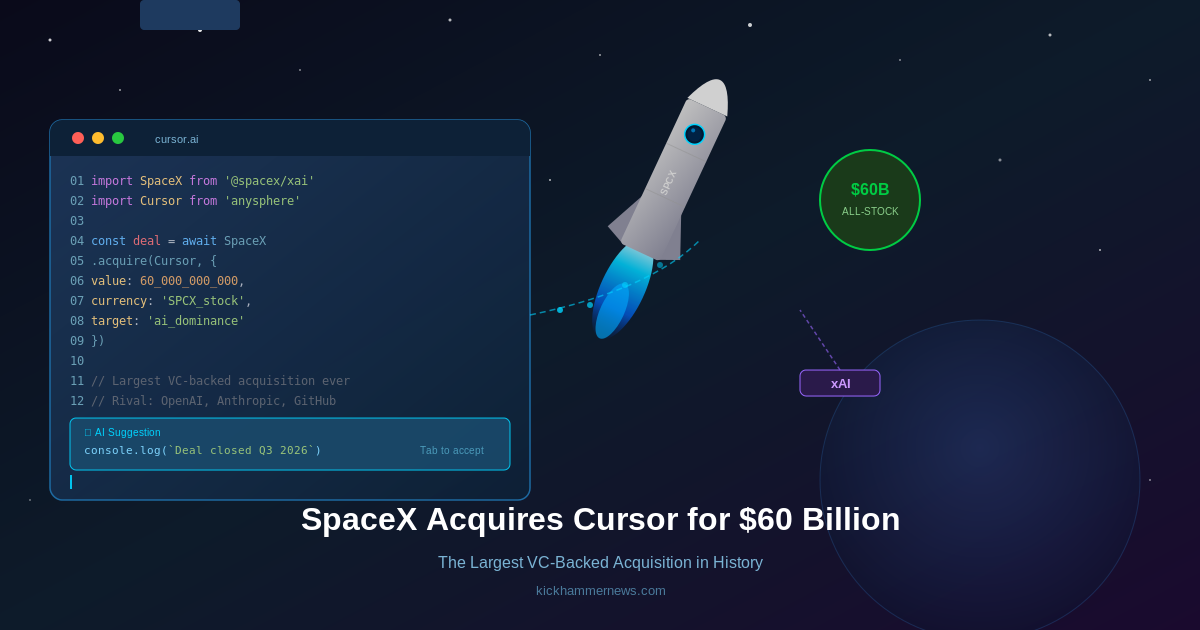
June 17, 2026 — Just days after completing the largest IPO in U.S. history, SpaceX has already spent a significant chunk of its new public-company credibility — not on rockets, not on Starlink satellites, but on a San Francisco AI coding startup. The company announced it will acquire Anysphere, the developer behind the popular AI coding assistant Cursor, in an all-stock deal valued at $60 billion. The move is the largest acquisition of a venture-backed startup on record, and it signals that SpaceX — and Elon Musk — are dead serious about winning the AI software wars.
From Orbit to Codebase
To understand why SpaceX would spend $60 billion on a coding tool, you need to understand what SpaceX told investors during its IPO process. The company pitched itself not merely as a space launch company or satellite internet provider, but as an emerging AI powerhouse with eyes on a $26 trillion total addressable market — a figure roughly equivalent to the entire U.S. GDP. That’s an extraordinary claim for a company best known for reusable rockets. But behind that number was a real, if rocky, bet on AI software products built around xAI, Musk’s artificial intelligence company that SpaceX merged with earlier this year.
The problem: xAI’s track record had been marred by controversies. The platform drew widespread criticism after allowing users to generate non-consensual deepfakes of women and children. An internal restructuring followed. Engineers who had once been energized by the mission to compete with OpenAI and Anthropic were, by many accounts, demoralized. Cursor is SpaceX’s answer to that problem — a shot of credibility, a wave of revenue, and a team of engineers who have already figured out how to build developer AI tools that people actually want to use.
What Is Cursor, Exactly?
Cursor is an AI-powered code editor built by Anysphere, a team of MIT graduates who set out to build the most powerful AI-enhanced IDE on the market. The product works by embedding powerful language models directly into the coding workflow — suggesting code completions, explaining bugs, refactoring functions, and even autonomously implementing features when prompted. It quickly became a favorite among software developers who found that it could dramatically accelerate how fast they could ship code.
The numbers backed up the hype. By November 2025, Cursor had crossed $1 billion in annualized revenue. By the time SpaceX came calling in April 2026, the company was on track to close a $2 billion funding round from major investors including Andreessen Horowitz, Thrive Capital, and Nvidia — at a $50 billion valuation. SpaceX preempted that round with a $60 billion buyout offer, giving Cursor the option to accept the all-stock acquisition or watch SpaceX walk away after paying a $10 billion break-up fee. Cursor’s leadership chose the acquisition.
As of the deal announcement, Cursor reported approximately $2.6 billion in annualized B2B revenue, with enterprise adoption growing sharply. The company’s software is used by engineers at some of the world’s most recognizable companies. However, the competitive landscape had tightened significantly: Cursor’s share of the AI coding tools market had slipped from roughly 41% in June 2025 to approximately 26% by May 2026, as rivals including GitHub Copilot, Anthropic’s Claude Code, and Google’s Gemini coding features intensified the fight.
An All-Stock Deal Built on IPO Momentum
The mechanics of the deal are unusual and revealing. SpaceX completed its IPO on June 12, raising $75 billion and sending its stock to $211 per share by some accounts. Under the acquisition agreement, each Cursor share will convert into SpaceX Class A common stock at the volume-weighted average closing price. No cash changes hands — Cursor shareholders become SpaceX shareholders.
That structure reflects both the strength of SpaceX’s newly public stock and a calculated move to conserve cash while using SPCX shares as acquisition currency. The deal is expected to close in Q3 2026, pending regulatory review. SpaceX filed formal documentation with securities regulators confirming the agreement between the two companies, including a wholly owned subsidiary called X67 Inc. serving as the merger vehicle.
The Competitive Stakes: Taking On Anthropic and OpenAI
The AI coding tools market has become one of the most fiercely contested battlegrounds in the broader AI industry. GitHub Copilot, backed by Microsoft, has the advantage of deep integration with the world’s largest code repository. Anthropic’s Claude Code has earned a reputation for nuanced, thoughtful code generation. OpenAI has integrated coding capabilities directly into ChatGPT. Google’s Gemini is being pushed across Workspace and developer tools.
Into this crowded field, SpaceX is betting that Cursor’s product quality — combined with xAI’s data center infrastructure in Memphis, Tennessee — can power a next-generation coding assistant that beats all comers. When SpaceX first announced the potential partnership in April, Cursor said it envisioned using xAI’s compute resources to build future products that would leapfrog what current AI coding tools could do.
The theory is straightforward, even if the execution is anything but. Cursor brings a battle-tested product with millions of users, enterprise contracts, and a team that understands developer workflows. xAI brings raw compute. SpaceX brings the financial scale and, after its IPO, a stock that can be used as acquisition currency. Together, the bet is that this combination can outcompete the AI labs at their own game.
Why This Deal Changes the Calculus for Developers
For the millions of software engineers who use AI coding tools every day, the acquisition raises genuine questions about Cursor’s future. Will a SpaceX-owned Cursor remain developer-first? Will the product’s pricing change as it gets folded into a larger corporate structure? Will the engineering talent that built Cursor stay, or will they cash out their SpaceX shares and start something new?
These are fair concerns. Large acquisitions of beloved developer tools have a checkered history. The most optimistic read is that SpaceX’s resources will allow Cursor to scale infrastructure and model investment in ways that Anysphere alone could never match. The most pessimistic read is that the product will drift, the team will disperse, and another window will open for a new entrant to capture developer mindshare.
The competitive response from Anthropic, OpenAI, and Microsoft is likely to be swift. GitHub Copilot will face direct pressure. Expect aggressive pricing moves, new feature announcements, and possibly competing acquisitions in the months ahead.
The Broader Picture: Consolidation at the Frontier
The SpaceX-Cursor deal does not exist in a vacuum. It is the latest in a wave of mega-consolidation sweeping the AI industry. Musk already merged SpaceX and xAI. Jeff Bezos’s Prometheus just raised $12 billion to build what it calls an “artificial general engineer.” Goldman Sachs has projected that AI infrastructure investment will reach $76 trillion over the coming decade. China announced a $295 billion national AI infrastructure push just last week.
What is happening is a race to verticalize AI — to own the full stack from chips and compute to models and applications. SpaceX is attempting to become a vertically integrated AI company that happens to also build rockets and run a satellite internet network. Cursor is the missing piece that gives it a foothold in the developer tools market, a segment that sits right at the intersection of where software gets made.
Whether the bet pays off at $60 billion will take years to determine. But in the spring of 2026, with SPCX stock riding high and the AI wars entering a new phase of consolidation, SpaceX made its move — not with a rocket, but with a code editor.


