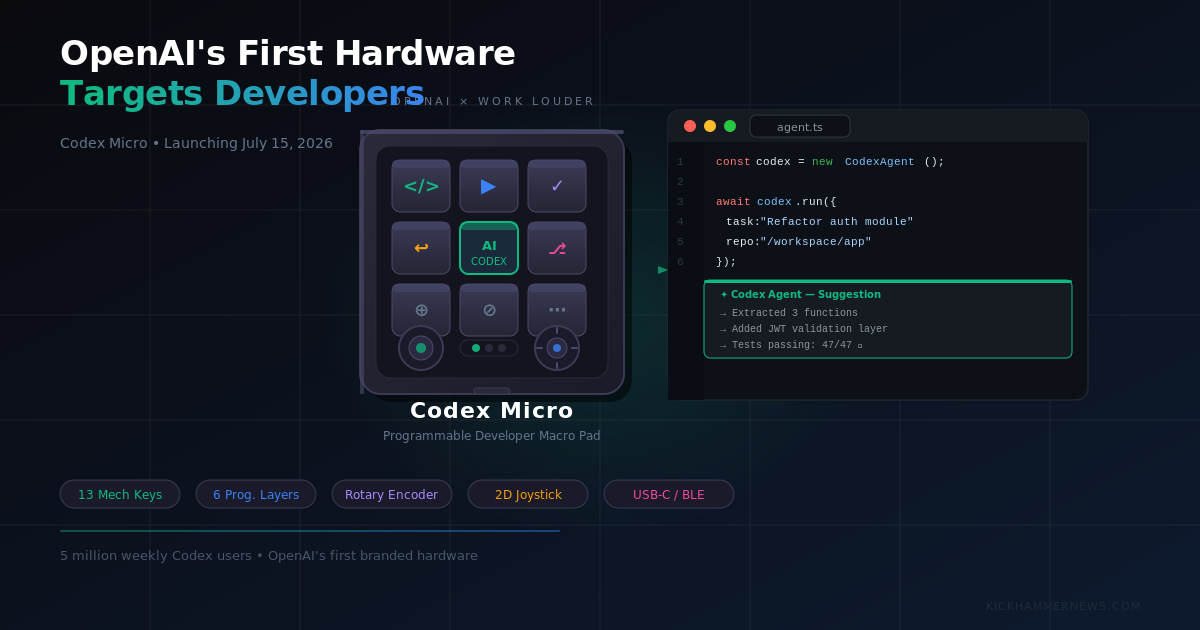
OpenAI just unveiled its first branded physical product, and it has nothing to do with the AI consumer gadget everyone’s been waiting for. Meet the Codex Micro: a compact programmer’s macro pad that puts AI coding shortcuts at your fingertips.
For months, the AI hardware conversation has revolved around one thing: the mysterious consumer device that OpenAI has been developing with former Apple design chief Jony Ive. Speculation about a screenless AI companion, a wearable, a next-generation phone replacement — the rumor cycle has run hot. So when OpenAI quietly teased its first branded hardware on June 29 at the AI Engineer World’s Fair in San Francisco, the announcement caught almost everyone off guard. This wasn’t a glossy consumer device aimed at the mass market. It was a 13-key programmer’s macro pad called the Codex Micro, built in collaboration with boutique keyboard maker Work Louder, targeting the 5 million developers who use OpenAI’s Codex AI coding agent every week.
The July 15 launch date is now just two weeks away, and the Codex Micro is shaping up to be one of the more interesting signals about where AI companies are heading — not just in terms of models, but in terms of how humans physically interface with AI tools.
What the Codex Micro Actually Is
The Codex Micro is not a keyboard in the traditional sense. It’s a programmable macro pad — a compact, standalone input device designed to sit alongside your regular keyboard and provide dedicated, one-press access to frequently used actions.
The hardware is built on Work Louder’s Creator Micro 2 chassis, a platform the company has previously customized for design tool companies including Figma and Framer. The Codex Micro version features 13 low-profile mechanical MX-style switches arranged in a square grid, a clickable rotary encoder for scrolling or adjusting parameters, a capacitive touch sensor for cycling through up to six programmable key layers, and a 2D analog joystick capable of triggering radial menus inside applications. The body is built around a CNC-machined aluminum frame with a polycarbonate shell, giving it a premium feel that matches a professional workstation setup.
Connectivity is expected to match the Creator Micro 2’s options: a USB-C wired Base model and a Bluetooth Low Energy Pro model with a built-in 2,100 mAh battery. The device is cross-platform, supporting Mac, Windows, iOS, Android, and Linux.
OpenAI spokesperson Dominik Kundel described the Codex Micro at the World’s Fair simply as “a keyboard designed to supercharge people’s Codex usage.” Pricing has not been announced, but the Creator Micro 2 that underlies it starts at $144 for the wired model and $174 for the wireless Pro version — making the Codex Micro’s likely price range reasonably predictable.
The Problem It’s Solving
To understand why this product exists, you need to understand how developers actually interact with AI coding agents at scale.
Codex is OpenAI’s autonomous software engineering platform. Unlike a simple autocomplete tool, Codex operates as a full agent: it reads codebases, writes and modifies code, runs tests, proposes pull requests, and can handle multi-hour development tasks in isolated cloud sandboxes. Developers interact with it through a terminal CLI, a desktop app for macOS and Windows, IDE extensions, and a ChatGPT-integrated cloud interface.
When you’re using Codex intensively — spinning up agents, reviewing diffs, accepting or rejecting suggestions, triggering rewrites, managing parallel tasks — you’re performing many of these actions dozens or hundreds of times per session. Each one requires either a keyboard shortcut that must be remembered and typed accurately, or a mouse click that pulls focus away from the code itself. Neither approach is frictionless at high volume.
The standard workaround has been improvised: Elgato Stream Decks repurposed for coding shortcuts, QMK keyboards with custom-built macro layers, AutoHotKey scripts, shell aliases. These solutions work, but they’re idiosyncratic. A developer with their own custom setup has muscle memory that doesn’t transfer to a colleague with a different configuration. Onboarding a new team member into your AI coding workflow means teaching them your personal shortcut system alongside everything else.
A dedicated, purpose-built macro pad with Codex-specific key iconography solves all of that. When every developer on a team has the same physical device with the same layout, shortcut workflows become transferable. The tactile feedback of a physical button is also faster to invoke than a keyboard chord — especially for actions that aren’t performed frequently enough to become truly automatic.
The HID Question That Matters Most
Here’s the technical detail that most coverage has glossed over, but which will determine whether the Codex Micro is a broadly useful tool or a narrow ecosystem play: whether it ships as a standard USB Human Interface Device (HID) or requires a proprietary driver.
A standard HID device is recognized natively by any modern operating system without custom software. It sends keystrokes and input events that the OS treats identically to any other keyboard input. That means a Codex Micro operating as a standard HID device would work with VS Code, Cursor, JetBrains, Neovim, a terminal — anything — because it’s just sending keyboard events that the user maps to application-specific shortcuts.
Work Louder’s Creator Micro 2 supports VIA, a widely used open-source configurator built on QMK firmware that allows real-time key remapping without reflashing device firmware. If the Codex Micro preserves VIA support, it’s a standard HID device with software-enhanced remapping on top — and it’ll work anywhere.
If OpenAI has modified the firmware to require a proprietary Codex driver or app, the device’s usefulness becomes conditional on which integrations OpenAI ships and continues to maintain. Full details won’t be known until July 15.
What This Means for the AI Coding Wars
It would be easy to dismiss the Codex Micro as a niche accessory. In one sense, it is. It’s aimed at a specific segment of a specialist market — power users who interact with an AI coding agent so frequently that optimizing their physical input layer makes a measurable productivity difference.
But the strategic signal is harder to dismiss.
Codex competes directly with Anthropic’s Claude Code, Cursor, GitHub Copilot, and a rapidly expanding field of AI coding tools. The competitive dynamics in this space are brutal: models improve on a monthly cadence, pricing constantly shifts, and developers switch tools based on benchmark results and workflow fit. Differentiation is difficult when the underlying models are rapidly converging.
Physical hardware is a different kind of moat. A developer who builds muscle memory around the Codex Micro’s layout — who reaches for specific buttons without thinking — has created a switching cost that has nothing to do with whether a competing model produces marginally better code. The buttons are on their desk. Their hands know where they are. Switching to a different AI coding tool means unlearning physical habits, not just updating a VS Code extension.
This isn’t a new playbook. Figma’s Work Louder Creator Micro, announced in December 2023, shipped with pre-configured Figma shortcut keys and custom keycap iconography for Figma-specific workflows. Framer followed the same formula. OpenAI’s Codex Micro is applying the same strategy to the AI coding space — and doing so at a moment when Codex has 5 million weekly active users who represent exactly the kind of power-user base that would benefit from dedicated hardware.
The Larger Context: Two Hardware Tracks
It’s worth being precise about what the Codex Micro is not: it’s not the Jony Ive project.
OpenAI has been developing a consumer AI device with former Apple design chief Jony Ive and his design firm io for the better part of a year. That product — which has been described as a screenless, voice-first AI companion in a novel form factor — remains on track for the second half of 2026. The Codex Micro and the Ive device are aimed at entirely different audiences, built by different teams, and positioned in different product categories.
What the Codex Micro does signal is that OpenAI is willing to pursue multiple hardware tracks simultaneously. A precision instrument for developer power users now; a mass-market consumer device later. The Codex Micro required relatively limited investment — it’s a co-branded version of an existing platform from an established keyboard maker. The Ive device represents a much larger bet on consumer hardware from scratch. Both can exist in parallel.
Unconfirmed: What July 15 Must Answer
OpenAI and Work Louder have confirmed the partnership, device name, and launch date. Significant details remain outstanding:
Pricing: The Creator Micro 2’s $144–$174 range is the best available reference, but co-branded devices have shipped at both premiums and discounts relative to the base model.
Key mapping flexibility: Will developers be able to remap keys freely via VIA or Work Louder’s Input software, or will the Codex Micro ship with locked OpenAI presets? The Figma and Framer Creator Micros preserved full remapping capability.
IDE integration: Does the device communicate with VS Code, Cursor, JetBrains, or other editors through a dedicated extension, or does it rely entirely on OS-level shortcut mapping?
API access: Will there be a programmatic interface allowing teams to define custom Codex workflows triggered by specific key combinations?
Global availability: Whether the Codex Micro launches globally or in limited markets on July 15 has not been announced.
The Bottom Line
OpenAI’s first branded hardware product is modest in scope but meaningful in what it signals. A 13-key macro pad is not going to reshape the consumer electronics market. But placing a physical, branded device on the desks of the developers who use your AI coding tools every day is a remarkably efficient way to deepen product loyalty, build switching costs, and establish a presence in the workspace that a browser tab or IDE extension simply cannot replicate.
The Codex Micro won’t ship until July 15, and its full specifications remain under wraps. But the underlying strategy is already clear: OpenAI is thinking about how developers interact with AI tools at a physical level, not just a software level. In an era when AI coding capabilities are becoming table stakes, the company that makes the interaction itself feel most natural might have a bigger advantage than any benchmark suggests.
Watch the July 15 launch closely. The specs will matter — but the HID question will matter most.


