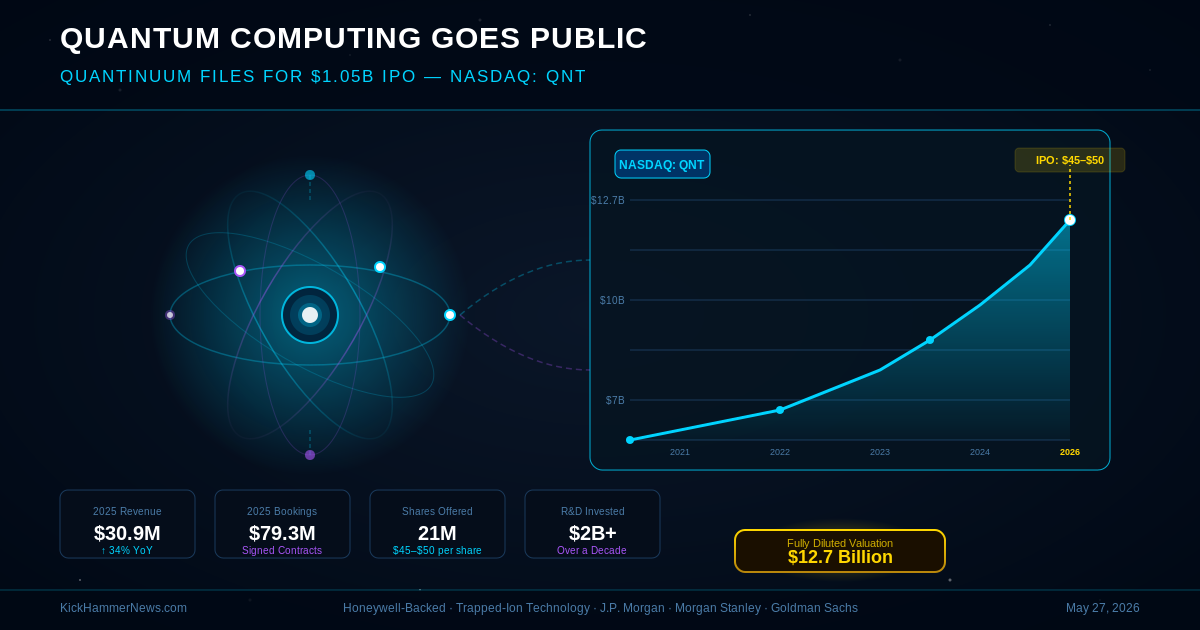
The quantum computing industry just crossed a threshold that no one quite expected to arrive so soon. On May 26, 2026, Quantinuum — the Honeywell-backed quantum computing company — filed for a landmark U.S. initial public offering, targeting a fully diluted valuation of up to $12.7 billion. If the deal prices at the top of its range, it will not only rank as the largest quantum computing IPO in history, but it will stand as the industry’s first-ever traditional IPO — a signal that quantum computing is no longer a science experiment, but a serious commercial enterprise.
The Deal in Numbers
Quantinuum plans to offer approximately 21 million shares priced between $45 and $50 each, listed on the Nasdaq under the ticker “QNT.” At the top of that range, the company would raise up to $1.05 billion in fresh capital — money it intends to funnel into working capital, capital expenditures, and the relentless research-and-development effort required to build fault-tolerant quantum systems at commercial scale.
The financial snapshot the SEC filing reveals is honest in its early-stage nature. Quantinuum reported $30.9 million in revenue for 2025, up from $23 million the prior year, with a net loss of $192.6 million. For Q1 2026, the company generated $5.2 million in revenue. These are not the numbers of a mature technology business. They are the numbers of a company spending aggressively to win a race it believes will reshape computing for the next century.
At $12.7 billion fully diluted, the market is pricing Quantinuum at roughly 400 times revenue — a valuation multiple that reflects not what the company is today, but what it might become. That is either an extraordinary act of faith or a shrewd calculation by institutional investors who believe quantum computing will be as transformative as the internet. Perhaps both.
What Quantinuum Actually Does
Quantinuum was formed in 2021 through the merger of Honeywell Quantum Solutions and Cambridge Quantum, bringing together world-class trapped-ion hardware and quantum software expertise under one roof. The company is led by CEO Rajeeb Hazra, a veteran of Intel, and chaired by Honeywell’s CEO Vimal Kapur.
The company’s quantum systems are built on trapped-ion technology — a hardware approach that uses electrically charged atoms controlled by electromagnetic fields as qubits. This architecture is designed to prioritize computational fidelity, meaning the accuracy of quantum operations, which is the defining challenge for any quantum hardware platform as systems scale up.
Revenue today comes from several streams: cloud-based access to quantum computing systems, cybersecurity products, quantum software platforms, and professional services. Notably, quantum-resistant encryption and security tools represent a significant portion of current revenue. With conventional public-key cryptography expected to become vulnerable to sufficiently powerful quantum computers within this decade, Quantinuum is already selling the antidote to the problem it is helping to create.
The company’s customer list reads like a who’s who of global enterprise: Airbus, BMW Group, JPMorganChase, Mitsui & Co., Amgen, and the UK’s National Quantum Computing Centre are among those the company identifies as customers and collaborators. These are not research partnerships for show — they represent real commercial deployments across finance, pharmaceuticals, energy, aerospace, and defense.
The Ownership Structure After the IPO
Following the offering, Honeywell will retain approximately 49.1% of Quantinuum’s voting power, while Cambridge Quantum Holdings will hold around 32.5%. Together, the founding shareholders will control roughly 82% of the company’s equity — a structure that ensures Quantinuum can take the long view without being subject to quarterly earnings pressure from public markets.
Founder Ilyas Khan, who played a central role in building Cambridge Quantum into one of the world’s leading quantum software companies before the merger, remains the largest individual shareholder, with a personal stake worth over $2 billion at the IPO price. Khan’s continued involvement underscores that the company’s scientific founding vision has not been diluted by commercialization.
Honeywell will also remain a customer and strategic partner post-IPO, which provides Quantinuum with a significant anchor customer relationship as it scales toward broader commercial adoption.
Why This IPO Matters Beyond Quantinuum
The significance of this offering extends well beyond a single company’s balance sheet. For the quantum computing industry, a traditional IPO — not a SPAC, not a reverse merger, not a strategic acquisition — is a credibility marker. Traditional IPOs require rigorous SEC disclosure, attract long-only institutional investors who do sustained due diligence, and create lasting price discovery mechanisms. The fact that Quantinuum chose this route signals that its leadership and investors believe the company can withstand that level of scrutiny.
It also matters for the broader quantum ecosystem. For years, the standard story about quantum computing was that commercial relevance was perpetually five to ten years away. That narrative is now shifting. IBM predicted 2026 would mark the year a quantum computer first meaningfully outperforms a classical computer on a commercially relevant problem. Government investment has accelerated globally, with the U.S. CHIPS Act-era initiatives, UK National Quantum Strategy, and Chinese state-backed programs all treating quantum as strategic infrastructure.
Quantinuum’s IPO adds a new dimension: public market capital. If the offering is received well — and sources close to the deal suggest pricing and final terms are expected around June 3-4 — it could open the door for other quantum companies to access public markets, further accelerating the pace of investment and development.
The Competitive Landscape Is Fierce
Quantinuum acknowledges in its SEC filing that it faces competition from companies pursuing very different quantum computing architectures: superconducting approaches championed by IBM and Google, neutral atom systems from companies like QuEra and Atom Computing, photonic approaches, and silicon-based platforms. Each architecture has its advocates and its technical trade-offs, and the industry has not yet converged on a single winning approach.
That plurality is actually healthy at this stage — it means the quantum computing race is not winner-take-all, and that breakthroughs in one approach often transfer knowledge to others. But for investors, it also means that betting on any single company involves real technical risk. Quantinuum’s trapped-ion approach has demonstrated some of the highest qubit fidelity rates in the industry, which is why partners and customers have bet on its platform. Whether that advantage compounds into dominance at scale remains the central question.
The company has invested roughly $2 billion in R&D through its predecessor organizations over the past decade, and has accumulated a deficit of approximately $1.5 billion since inception. The path to profitability runs through fault-tolerant quantum computing at scale — systems capable of running commercially useful algorithms with error rates low enough to produce reliable results on real-world problems.
A Race With Global Stakes
The backdrop to Quantinuum’s IPO is a global quantum race with significant geopolitical dimensions. China’s Huawei made headlines just this week with its proposal for a new domestic chip development approach — the Tau Scaling Law — designed to help Chinese companies close performance gaps despite U.S. export controls on advanced chipmaking tools. Quantum computing is very much part of that same strategic competition: whoever achieves fault-tolerant quantum computing first will hold asymmetric advantages in cryptography, drug discovery, materials science, financial optimization, and military simulations.
The U.S. government has made clear it views quantum as a national security priority. Quantinuum works with defense and aerospace customers, and its cybersecurity product line is explicitly designed around quantum-resistant encryption — protecting critical infrastructure against the threat that future quantum computers pose to today’s encryption standards.
What Happens Next
The final IPO pricing is expected around June 3-4, 2026, when shares of Quantinuum (QNT) will begin trading on the Nasdaq. The reception will be closely watched not just by quantum industry insiders, but by the broader technology investment community as a barometer of institutional appetite for deep-tech, long-horizon bets.
For founders and investors in the quantum ecosystem, the message is clear: the window for quantum computing to attract public market capital has arrived. The question is no longer whether quantum computing will matter commercially — it’s who will lead when the technology reaches the scale needed to transform industries.
Quantinuum’s $12.7 billion bet on itself may be the opening chapter of the quantum decade.
Sources: The Quantum Insider, Reuters, Bloomberg, Yahoo Finance, TechStartups.com


