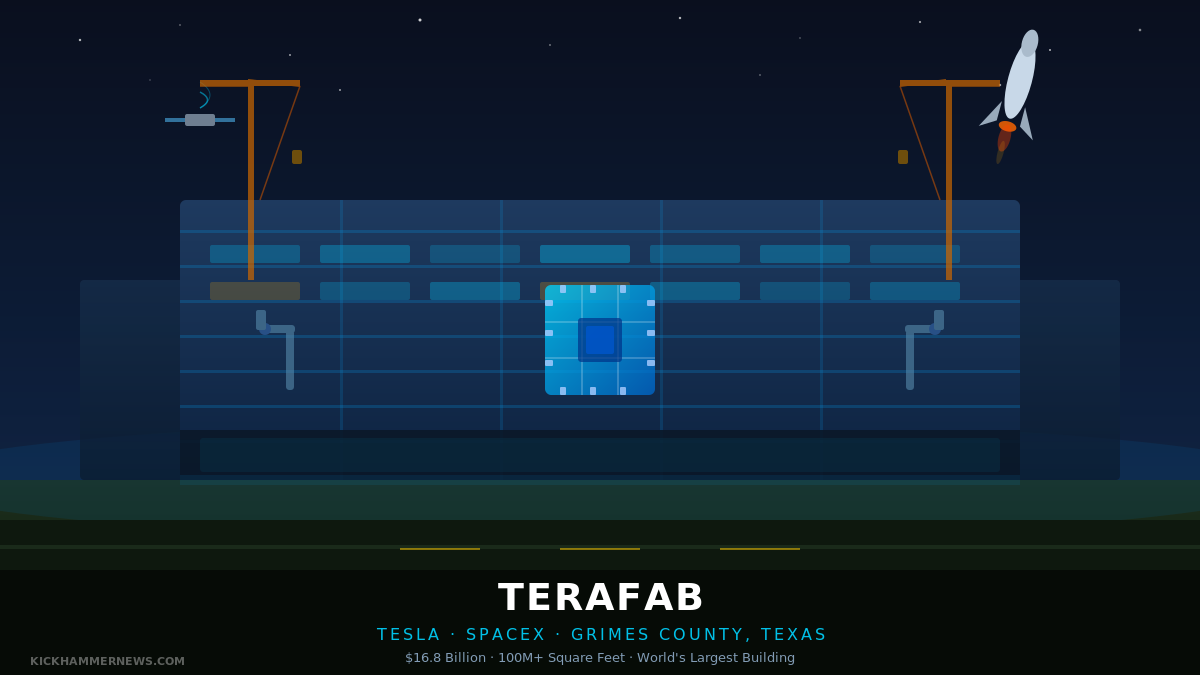
It started as a whisper in regulatory filings and anonymous sourcing. Now it’s a confirmed $16.8 billion reality: Tesla and SpaceX are building “Terafab,” a semiconductor manufacturing campus in Grimes County, Texas, that will span more than 100 million square feet and – if Elon Musk’s vision holds – become the largest and most valuable building ever constructed on Earth.
The formal announcement, made last week, marks one of the most audacious industrial projects in American history. It is also a window into how Musk sees the future: robots everywhere, autonomous vehicles ubiquitous on city streets, satellites doubling as orbital data centers – all of it running on a volume of silicon that the current global chip supply simply cannot provide.
Why Terafab, and Why Now?
The logic behind Terafab is almost blunt in its directness. Tesla’s Optimus humanoid robots and self-driving Cybercabs are not science fiction anymore – they are products moving toward mass deployment. SpaceX’s ambitions for space-based AI inference infrastructure push the demand curve even further. Together, these two companies are staring down a compute gap so wide that no existing foundry relationship could plausibly close it in time.
“The facility will be an advanced semiconductor fab that will bridge the divide between current global chip supply and the compute demand of the future,” SpaceX wrote on its website following the announcement.
Musk has been more colorful. “The largest and most valuable building on Earth by far,” he posted on X. That is not merely a boast about square footage – it reflects a belief that whoever controls leading-edge semiconductor production in the coming decade controls the commanding heights of the AI economy.
SpaceX filings have suggested the multi-phase construction plan could ultimately cost as much as $119 billion, making the $16.8 billion initial commitment a down payment rather than a ceiling. That figure alone would rank among the largest private infrastructure investments ever undertaken in the United States.
What Terafab Will Make
The facility is conceived as a vertically integrated campus, housing manufacturing, packaging, and testing for both logic and memory chips under one roof. That integration is deliberate. By shortening the distance between design iterations and physical production, Musk’s engineers believe they can achieve faster recursive improvements – a lesson drawn from how SpaceX compressed the development cycle for Starship by manufacturing almost everything in-house at its South Texas facility.
Terafab’s output will be divided between two broad categories. Edge and inference chips will go into Tesla hardware: Optimus robots, Cybercabs, and other consumer and commercial products that require low-latency, energy-efficient processing at scale. High-power chips designed for the harsh thermal and radiation environment of orbit will supply SpaceX’s emerging space-based data centers, part of the company’s long-range plan to provide AI training and inference compute from constellations of satellites.
Intel has been named as a contributing partner to Terafab, though the company has been deliberately vague about the precise nature of its involvement. Given Intel’s ongoing push to rebuild its foundry credibility, an association with a project of Terafab’s scale carries obvious strategic appeal – even if the details remain confidential.
Choosing Texas
Grimes County, situated just north of Houston, emerged as the site after a selection process that reportedly considered locations across several states. Texas offered a compelling package: an established Musk-company footprint, favorable tax climate, available land at the required scale, and access to state economic development programs.
The Texas Enterprise Fund extended a $30 million grant to SpaceX as part of the deal, and the project qualifies under Texas’s Jobs, Energy, Technology, and Innovation program. Officials estimate Terafab will employ at least 3,000 workers directly from Grimes and neighboring Brazos County, with downstream employment effects expected to run considerably higher.
Water supply was a pointed concern. SpaceX moved to address it preemptively, committing to source water from the local Gibbons Creek Reservoir rather than drawing on regional groundwater – a gesture toward local communities already watching large-scale industrial projects arrive with skepticism about resource consumption.
That skepticism was on display at a packed county meeting last Wednesday, where hundreds of residents raised objections about the scale of tax abatements and what they described as a lack of transparency in negotiations. The local school district superintendent struck a more optimistic note, framing the project as a generational opportunity while pledging to manage the resulting resources with students’ interests at the center.
The Geopolitical Subtext
Terafab exists within a broader American industrial anxiety: the recognition that advanced semiconductor manufacturing is dangerously concentrated in Taiwan and, to a lesser extent, South Korea. The CHIPS and Science Act was Congress’s legislative answer to that vulnerability. Terafab is a private-sector answer, driven not by subsidy-seeking but by operational necessity.
Tesla and SpaceX’s future products require chips at a volume and specification that cannot be fully outsourced to TSMC or Samsung without strategic exposure. Building Terafab is, in part, an act of vertical integration that doubles as an act of supply-chain sovereignty. Whether that framing resonates in Washington – or generates friction with existing foundry partners – remains to be seen.
TSMC itself has not been quiet about its own American ambitions. The Taiwanese foundry just reported July 2026 revenue of $14.5 billion, up 44.7% year over year, with demand from AI hyperscalers showing no sign of cooling. Its Arizona fabs continue to scale. But Terafab is not positioned as a TSMC competitor – at least not initially. The two projects serve different customers with different timelines.
What Comes Next
Ground has not yet broken. The $16.8 billion commitment covers the first phase, and the full project will likely take the better part of a decade to reach design capacity. Supply-chain buildout, regulatory approvals, and workforce development at the required scale are all non-trivial challenges.
Still, the announcement is significant as a statement of intent. The same company that built a rocket capable of carrying more mass to orbit than any vehicle in history, and the same company that made electric vehicles mainstream, are now betting that they can apply their model of hardware-driven, vertically integrated innovation to semiconductor manufacturing – one of the most technically demanding industries on the planet.
Whether Terafab delivers on its extraordinary premise will depend on execution over years, not announcements over days. But in a world where AI compute demand is doubling faster than global fab capacity can expand, the ambition behind the project is not hard to understand. The future Musk envisions requires silicon at a scale the world has never produced. Terafab is his answer.
Sources: TechCrunch, Interesting Engineering, Fox Business, Yahoo Finance


