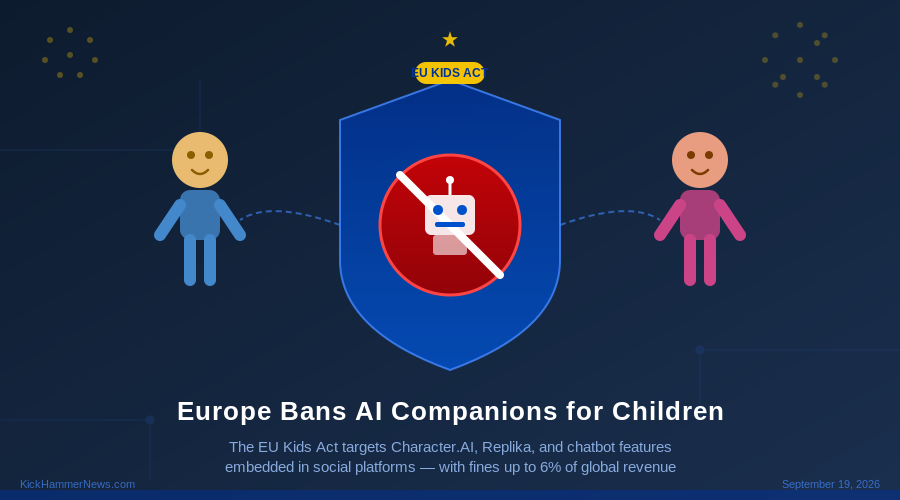
The European Commission dropped its most consequential tech-regulation proposal of the year this week, and Silicon Valley’s AI companion industry is bracing for impact. The EU Kids Act, unveiled on September 17, 2026, would ban social media for children under 13, cap teen usage at an hour a day, and — most controversially — require AI chatbots and companion apps to switch themselves off by default for anyone under 18. Companies like Character.AI and Replika, which have built entire business models around emotionally bonded AI friends, could be forced to redesign their products from the ground up or exit Europe’s children’s market entirely.
What the EU Kids Act Actually Says
The proposal is sweeping in scope but surgical in its targets. Here is the framework as the Commission presented it:
Under the new age-based access framework, children under 3 would be prohibited from accessing any “high-risk” digital service — a category that includes social media feeds, open-ended AI chatbots, and video games with social components. Children between ages 3 and 12 may use services specifically designed for their age group but only under active parental supervision. Those aged 13 and 14 can hold limited, “introductory” accounts on social platforms — with restricted contact lists and enforced daily time limits — but only with explicit parental consent. At 15, teenagers gain full independent access, though platform-level safety features remain mandatory until adulthood.
For AI companions specifically, the rules are even tighter than those governing social media. The Commission’s proposal would:
– Require all AI companion and chatbot services to be switched off by default for minors, with explicit opt-in required from a parent or guardian. – Ban any AI chatbot from retaining memory between sessions for users under 18, short-circuiting the long-term relationship dynamics that make companion apps sticky and, critics argue, emotionally manipulative. – Prohibit AI systems from simulating interpersonal relationships in ways designed to create emotional dependency in users under 18. – Bar children under 13 entirely from chatbot access even with parental consent.
The enforcement teeth are substantial. Companies that fail to comply face fines of up to 6% of global annual turnover — a figure calibrated to hurt even the largest platforms. For context, that would expose Meta to potential fines in the billions for a single violation cycle.
Why Now?
European regulators did not arrive at this proposal in a vacuum. The past two years have seen a cascade of incidents — some tragic, many troubling — involving children and AI companions. Several high-profile cases across member states documented teenagers forming parasocial bonds with AI chatbots, disclosing mental health crises to them instead of parents or counselors, and in a small number of cases, acting on AI-generated advice with harmful consequences.
The Commission’s impact assessment, published alongside the proposal, cites a 2025 study by the European Centre for Digital Rights finding that 34% of 12-to-17-year-olds in the EU had used an AI companion app in the previous six months, and that 19% of those users described the AI as their primary confidant. Regulators view that number not as a usage statistic but as a warning signal.
The proposal also lands after the United Kingdom enacted its own Online Safety Act amendments in spring 2026, which imposed similar but narrower age-verification requirements on generative AI services. Brussels is watching London’s early implementation closely, treating it as something of a pilot program for what stricter enforcement actually looks like in practice.
The Industry Response
The platforms named by the Commission — Character.AI, Replika, and chatbot features embedded in TikTok and Instagram — have offered responses ranging from measured cooperation to quiet alarm.
Character.AI issued a statement on September 18 saying it “supports age-appropriate safeguards” and already operates a separate, filtered experience for users who identify as under 18. But the company did not commit to the memory-erasure requirement, which would fundamentally break the continuity that defines its product. The ability for an AI to remember a user’s name, personality, and previous conversations across weeks and months is core to the emotional hook — and losing it would make the product substantially less engaging for the users it is trying to protect.
Replika’s European team declined to comment officially but acknowledged to reporters that the default-off requirement would “significantly impact” its European user base among minors.
On the social media side, Meta and TikTok’s parent company ByteDance — which has been grappling with regulatory scrutiny in Europe throughout 2026 — both said they were reviewing the proposal’s text. TikTok has already rolled out a default one-hour daily limit for users under 16 in several EU markets following earlier DSA enforcement actions, and executives privately told reporters they view the Kids Act’s social media provisions as largely compatible with what they have already built.
The Hard Questions the Act Doesn’t Answer
The Kids Act proposal is ambitious, but critics — including some who support its goals — point out several gaps that will shape its real-world effectiveness.
Verification is the elephant in the room. The Act mandates that platforms prevent underage access, but it does not prescribe a specific age-verification mechanism. Age-gating has a poor track record online. Children routinely enter false birthdates, use parent accounts, or find workarounds within hours of a new restriction launching. Without a mandatory, privacy-respecting identity-verification standard — something Europe has so far been unable to agree on — the Act could become a compliance exercise rather than a meaningful barrier.
The memory rule is technically complex. Prohibiting AI systems from retaining conversation history for minors sounds simple but is architecturally significant. Many AI companions store personality data, emotional context, and preference histories in ways that are entangled with the model’s broader training pipeline. Cleanly segregating minor users’ data and erasing it reliably between sessions requires re-engineering backend systems that were not designed with this constraint in mind.
The definition of “emotional dependency” is legally fuzzy. The proposal prohibits AI chatbots from interacting in ways that “create emotional dependency,” but it does not define the term technically or clinically. That ambiguity will almost certainly spawn years of litigation as companies argue their products fall outside the prohibition and regulators argue they fall inside it.
Jurisdictional reach is uncertain. Many AI companion services operate from servers outside the EU and have thin legal presences within it. The GDPR has demonstrated both the power and the limits of the EU’s extraterritorial claims. Getting companies headquartered in San Francisco or Seoul to comply with session-memory rules enforced by Brussels requires either credible DMA-style gating at app stores — Apple and Google controlling platform access — or a level of international regulatory coordination that has not existed to date.
What This Means for the AI Companion Market
For the AI companion industry, the EU Kids Act represents a forced pivot — toward either product redesign for compliance, explicit adult-only positioning, or withdrawal from the European minor market entirely.
The business case for serving minors is actually relatively narrow for most companion AI companies. Adults drive most of the revenue through premium subscriptions. The concern is not revenue loss from the under-18 segment so much as the precedent it sets: if Europe’s framework proves workable and becomes a global template — which EU regulation has a historical tendency to do — companies will face the same requirements in a growing number of markets.
That precedent effect is exactly what consumer advocacy groups are counting on. Organizations including Fairplay, the 5Rights Foundation, and the European Consumer Organisation BEUC have spent years advocating for children’s online safety frameworks modeled on the precautionary principle — proof of safety before deployment, rather than proof of harm after the fact. The Kids Act, for AI companions at least, flips the burden of proof.
What Happens Next
The Kids Act is a proposal — it must now navigate the standard EU legislative process, meaning approval from both the European Parliament and the Council of the European Union. That process typically takes one to two years, and the Parliament has historically amended Commission proposals significantly. Expect lobbying battles over the age thresholds, the definition of “AI companion,” and the memory-retention rules in particular.
If it passes in something close to its current form, the Act would give companies a two-year implementation runway before enforcement begins. That clock would likely start in 2028 at the earliest — giving the industry time to adapt, but not as much time as some would prefer.
For parents, children’s advocates, and child psychologists watching these developments, the EU Kids Act represents the clearest signal yet that a major regulatory bloc is willing to treat AI-driven emotional engagement as a category of risk, not merely a category of content. That shift in framing may prove to be as significant as the legislation itself.
KickHammer News covers technology, policy, and the future of digital life. Follow us at kickhammernews.com.