A Bet on the Post-Smartphone Era
Snap has officially entered the consumer augmented reality race. After years of developer-only iterations, limited drops, and tantalizing teasers, the company shipped its long-awaited Specs AR glasses to the general public this week — priced at a steep $2,195 and packed with technology that rivals anything Apple, Meta, or Google has shown to date. The question now isn’t whether the hardware can dazzle. It can. The real debate is whether enough people will open their wallets for a device that sits at the bleeding edge of a category still searching for its mass-market moment.
CEO Evan Spiegel has staked Snap’s next chapter on a simple thesis: the smartphone is not the last great personal computing platform, and whoever builds the successor will define the next decade of tech. Spiegel first signaled this pivot publicly at TC Disrupt in 2025, pledging to ship lightweight, immersive consumer AR glasses the following year. Snap delivered, launching the Specs at an event in June 2026 and beginning broader consumer shipments in September.
The timing is deliberate. Meta’s Ray-Ban smart glasses have sold millions of units, but those devices are fundamentally cameras and speakers with AI assistants — they don’t project anything onto the real world. Snap is betting that consumers are ready to level up, trading passive capture for true spatial computing.
Dual Snapdragon Chips, Waveguide Optics, and a Feature Set That Means Business
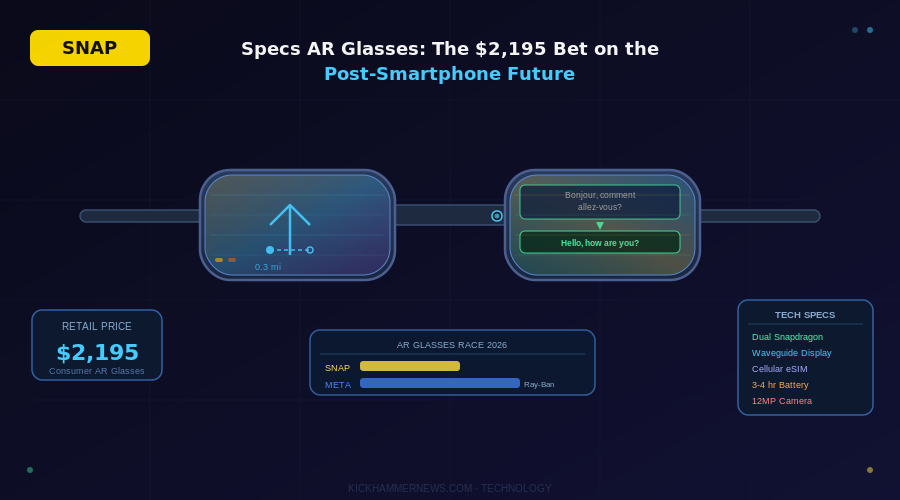
Under the hood, the Specs are among the most powerful wearables ever built. Qualcomm supplied dual Snapdragon processors — one handling real-time spatial computing and display rendering, one dedicated to AI and connectivity — a configuration that Notebookcheck called “a genuine technical feat crammed into a frame you’d actually wear in public.”
The display system relies on optical waveguide technology. Unlike the bulky prism-based optics in many enterprise AR headsets, waveguides allow thin lenses that look close to ordinary eyeglasses. The result is a field of view wide enough for navigation overlays, real-time translated captions, and contextual AR widgets — all without the “scuba mask” aesthetic that has haunted enterprise headsets since the days of Google Glass.
Feature highlights include:
- Real-time translation overlays: Spoken foreign language is transcribed and displayed as floating captions in the wearer’s field of view, powered by an on-device AI model with cellular fallback.
- Navigation: Turn-by-turn directions appear as semi-transparent arrows in the visual field — no phone required.
- Snap AI integration: The glasses surface contextual Snapchat Lens effects, object recognition, and a conversational AI assistant activated by voice or the temple button.
- Cellular connectivity: An eSIM allows the Specs to function independently of a paired phone, a first for consumer AR glasses at this price point.
- Camera: A 12MP camera captures photos and video, with automatic privacy indicator lighting when recording is active.
The $2,195 Problem
Here is where the conversation gets complicated. At over two thousand dollars, the Snap Specs are priced above the iPad Pro, above the MacBook Air, and within a few hundred dollars of the Vision Pro’s base configuration when it launched. Snap has argued the pricing reflects “component reality” — the waveguide lenses, dual processors, and cellular modem don’t come cheap — but analysts have been blunt: the addressable market at this price tier is thin.
A September 2026 piece from Geeky Gadgets flagged a separate hurdle: the battery delivers just three to four hours of active mixed-reality use. For commuters, travelers, and creatives who might build workflows around the glasses, that ceiling is a genuine limitation. Snap says a companion battery case extends daily use, but the case adds weight and the additional cost of the accessory ecosystem compounds the sticker-price concern.
Reviews have been sharply divided. Trusted Reviews called the Specs “the best look at AR’s future yet,” praising the display quality and translation features. Android Authority was more measured, noting that while the technology is impressive, the use cases feel “exciting in demo, uncertain in daily life.” Tom’s Guide flagged the 3–4 hour battery prominently in its live coverage.
The Competitive Chessboard
Snap is not operating in a vacuum. Meta’s Ray-Ban glasses have built enormous brand awareness in the “smart glasses” category, even without true AR displays. Meta is widely expected to ship its own waveguide-equipped glasses — the rumored Orion successor — in 2027. Apple shelved the Vision Pro’s mass-market follow-up amid manufacturing difficulties and is believed to be pivoting toward a lighter form factor. Samsung and Google are collaborating on Android XR-powered glasses. The window for Snap to establish itself as the category leader is narrow.
The bull case is that Snap’s head start in hardware, its massive existing Snapchat creator and filter ecosystem, and its focus on social and real-world AI use cases give it a differentiated platform. No one knows AR glasses better than Snap, which has shipped developer-facing Spectacles hardware since 2016. The accumulated learning — optics, software, battery management, creator tools — is substantial.
The bear case is that Snap lacks the balance sheet to sustain a multi-year hardware ramp against Apple, Meta, and Google. The company has burned cash heavily, and if the Specs generate lukewarm early adoption, maintaining the R&D investment required to iterate quickly will be difficult.
What Comes Next
Snap has confirmed that the Specs are not a limited developer edition — they are a full consumer product available through Snap’s website and select retail partners. The company has also announced a creator program to incentivize developers and Lens creators to build AR experiences specifically for the Specs’ display, recognizing that the hardware alone is not a product: it is a platform that depends on an ecosystem to thrive.
For now, the most candid assessment is this: the Snap Specs are the most technically impressive consumer AR glasses ever shipped, and they exist at a price point that will limit their immediate reach. Whether Snap can drive the software ecosystem, negotiate component prices down, extend battery life, and get to a $999 version of this hardware before its larger competitors arrive with similar technology — that is the race that matters. September 2026 is not the finish line. It’s the starting gun.