September 26, 2026 | By KickHammer Technology
Microsoft dropped a bombshell on the enterprise AI world this week, unveiling a sweeping redesign of its flagship Copilot platform. The new Microsoft Copilot is no longer a chat box bolted onto Office — it is a trio of persistent, autonomous agents that can work while you sleep, build apps without developers, and draft complex business documents without lifting a finger. The announcement, made on September 25, 2026, marks what may be the most significant rethinking of Microsoft’s productivity suite since the original launch of Microsoft 365.
Chat Is Dead — Long Live Agents
For most of its existence, Copilot was essentially a smart chatbot: you asked a question, it answered. You wrote a prompt, it returned a draft. Each session started from scratch. The new Copilot breaks that model entirely.
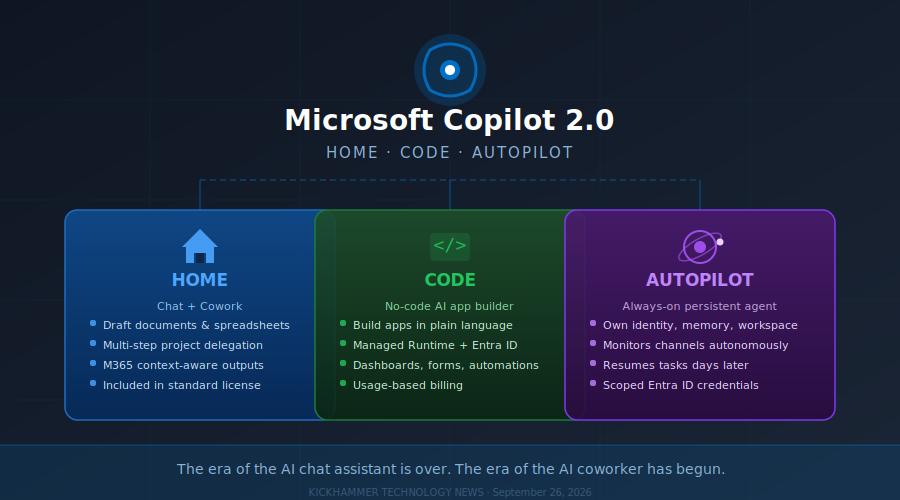
Microsoft is organizing Copilot around three distinct modes: Home, Code, and Autopilot. Each serves a fundamentally different kind of work — and together, they represent a bet that enterprise AI has graduated from question-and-answer to full-scale autonomous collaboration.
“What we’re building is not a better search box,” one Microsoft engineer said in a technical briefing. “These are workers that live in your organization.”
Home: Where Work Begins
Home is the new default Copilot experience and the entry point for most users. It combines two functions that were previously separate: Chat and Cowork.
Chat handles familiar tasks — drafting emails, summarizing documents, answering research questions, generating short content. But Cowork is where things get interesting. When you hand a multi-step project to Cowork — say, assembling a 40-page RFP response, or generating a quarterly financial close document from multiple data sources — it takes the job, works through it autonomously, and returns a finished result. You come back to a completed Word document, a populated Excel workbook, or a polished PowerPoint deck, not a half-baked draft that needs extensive cleanup.
Home also integrates directly with Microsoft 365 applications, pulling context from your calendar, email threads, and SharePoint documents to produce outputs that reflect your actual business environment rather than generic AI responses.
Code: Anyone Can Build Now
The Code mode may be the most disruptive element of the new Copilot for businesses that have historically depended on developer teams to build internal tools.
Built on the technology underpinning GitHub Copilot, Code allows users with no traditional programming background to describe what they want in plain language and receive a working application in return. Need a dashboard that tracks regional sales data from Fabric? A customer intake form that feeds into SharePoint? An automation that routes expense approvals through Teams? Describe it, and Code builds it.
The critical difference from consumer AI coding tools is the governance layer: Code runs inside Copilot Managed Runtime, which hosts generated applications entirely within Microsoft 365 tenant boundaries. Every app created through Code is subject to unified identity management via Microsoft Entra, Git-based source control, deployment versioning, and admin visibility through the Microsoft 365 admin center. IT teams can see who built what, who is using it, how it performs, and what policies apply.
This means the productivity gains of no-code AI development don’t come at the expense of enterprise security — a trade-off that has historically made IT departments deeply cautious about AI-generated tooling.
Autopilot: The Always-On Worker
Autopilot is where Microsoft makes its boldest claim. These are persistent agents — each with its own identity, memory, compute allocation, and dedicated workspace — that don’t stop working when you close your browser.
An Autopilot agent can monitor a Slack or Teams channel for messages meeting specific criteria, handle recurring tasks on a schedule, pull data from external APIs, coordinate with other agents, and resume complex multi-day projects autonomously. It is, in Microsoft’s framing, an always-on worker that operates within whatever permissions your organization assigns.
Autopilot is the renamed evolution of Scout, a feature Microsoft quietly tested in limited preview earlier this year. The rename signals a broader vision: these aren’t cute helper bots. They’re organizational infrastructure.
Each Autopilot agent receives scoped credentials through Microsoft Entra, meaning it can only access the systems and data it is explicitly authorized to touch. Sensitive operations — such as sending external communications or making changes to production systems — require explicit human approval before execution. Administrators can set budgets, usage caps, and define which AI model families individual agents are permitted to use.
Usage-Based Billing: The New Economics of AI Work
Perhaps as consequential as the features themselves is the pricing model. Standard Microsoft 365 seats cover everyday Chat use and Office document work through Home. But Code and Autopilot operate on usage-based billing tied to execution volume — not seat count.
This is a meaningful structural shift. Rather than paying a fixed monthly fee per employee regardless of how much AI work they do, organizations will pay based on the compute and actions their agents actually consume. Users can monitor remaining balance and review usage history, and administrators can impose hard caps.
For large organizations, this creates both opportunity and complexity. Heavy AI adoption could unlock productivity gains that dwarf the incremental cost. But it also means that AI spending is suddenly variable and tied to behavior — a new line item that finance teams will need to learn to forecast.
What This Means for the Workplace
The rollout of Home is happening in stages through Microsoft’s Frontier program starting this week. Code is rolling out to Frontier users in late September, with broader availability expected within weeks. Autopilot is entering private preview at the end of September before a wider release.
The timing is no accident. Microsoft is racing against a rapidly evolving competitive field. OpenAI has its own agent platform. Google is pushing Workspace AI deeper into enterprise workflows. Salesforce is positioning Agentforce as the backbone of customer-facing business operations. Every major technology platform is betting that agents — not chatbots — are the future of enterprise software.
What distinguishes Microsoft’s play is scale. Copilot lives inside the productivity suite that most of the corporate world already uses daily. Word, Excel, Outlook, Teams — these tools don’t need to be replaced. They need to be animated. Microsoft is betting that persistent, capable agents running inside tools people already trust is the fastest path to AI that actually transforms how organizations operate.
The era of the AI chat assistant is over. The era of the AI coworker has begun — and Microsoft just opened for business.
KickHammer Technology covers enterprise software, artificial intelligence, and the future of work. All information sourced from Microsoft’s official announcements and independent technical analysis.


