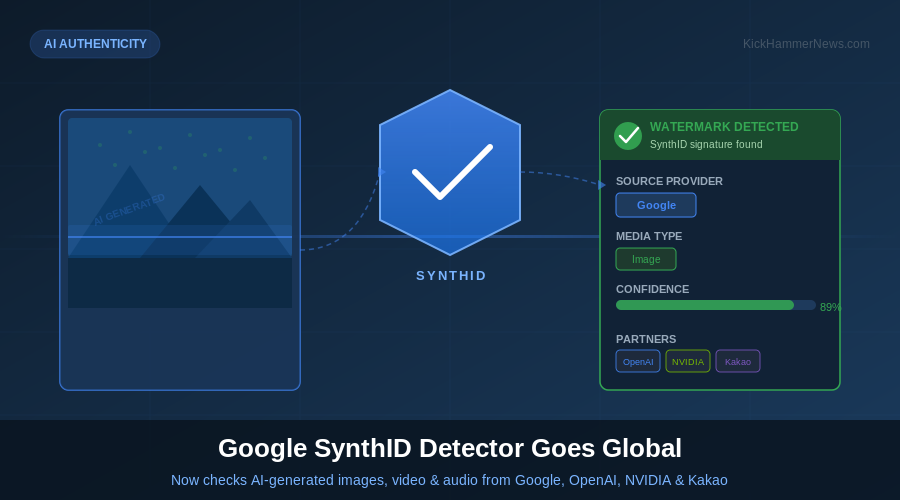
For the past three years, the internet has been quietly filling with AI-generated content — images, videos, and audio clips that look and sound increasingly indistinguishable from the real thing. Now Google is handing ordinary users a flashlight. On October 7, 2026, the company opened its SynthID Detector to anyone with an internet connection, marking one of the most significant steps yet in the race to establish authenticity in the age of artificial intelligence.
The public release of SynthID Detector arrives at a moment when the question “Is this real?” has never felt more urgent. AI-generated deepfakes have reshaped political advertising, flooded social media with synthetic celebrity endorsements, and raised the stakes of almost every photograph or video clip that crosses a news editor’s desk. The ability to verify provenance — to know where a piece of media actually came from — has become a foundational concern for journalists, lawmakers, and ordinary people alike.
What SynthID Is — and What It Isn’t
To understand why this release matters, it helps to understand what SynthID actually does. At its core, SynthID is a watermarking technology that Google introduced in 2023. When AI models under Google’s umbrella — or those of partnering companies — generate an image, encode a video, or synthesize audio, an imperceptible digital signature is woven into the content itself. Unlike traditional metadata stamps, which can be stripped simply by screenshotting or re-exporting a file, the SynthID watermark is embedded within the pixel data and waveform of the content in a way designed to survive casual manipulation.
The new public tool, hosted at SynthID.com, lets anyone upload a file and check whether it carries that hidden signature. Users log in with a Google, OpenAI, or Apple account and receive a verdict: SynthID watermark detected, or not. The system currently checks images, video, and audio, and it covers content generated not only by Google’s own tools but also by OpenAI, NVIDIA, and Kakao — with Apple listed as “coming soon.”
That cross-provider scope is the headline feature. A tool that only detected Google-generated content would have limited utility in a media landscape where ChatGPT’s image generation, NVIDIA’s audio synthesis tools, and countless other platforms compete for market share. By partnering with OpenAI in particular — its most prominent competitor — Google has signaled an intention to position SynthID as something closer to an industry standard than a proprietary feature.
The Numbers Behind the Ambition
The scale figures Google has released are staggering. Since 2023, the company says it has watermarked over 180 billion images and videos — a number that gives some sense of the volume at which AI-generated media is being produced — and approximately 240,000 years worth of audio. The verification infrastructure already built into Google Search, the Gemini app, and Chrome handles more than one million watermark-check requests daily.
Opening that infrastructure to the public is a deliberate gesture. Where previously only users within Google’s trusted-tester program could run a SynthID check outside of Gemini, now anyone can. The practical rate limit — approximately 10 checks per day per user, according to reporting by Ars Technica — is modest by design. Google engineers have indicated the cap is intended to prevent bad actors from using the tool to systematically test whether AI outputs are detectable, potentially building removal tools that strip or corrupt the watermarks.
The Limits Are Real
For all its ambition, SynthID Detector is not a general-purpose AI-detection system, and Google has been careful not to oversell it as one. The tool identifies only content that carries a SynthID watermark. Media generated by AI systems that do not use SynthID — a wide universe of open-source image generators, voice cloning tools, and video synthesis platforms — will receive no signal from the detector. The site will carry a disclaimer acknowledging this gap.
This limitation is important to name clearly. Critics of AI watermarking have long argued that any voluntary or ecosystem-dependent system leaves enormous blind spots. An authoritarian government producing deepfake propaganda, a commercial outfit pushing synthetic review content, or a lone bad actor using an open-source model on their laptop will not necessarily be caught by a tool like SynthID, because they have no incentive to apply the watermark in the first place.
Research has also raised questions about watermark robustness. Academic studies published in the past two years have demonstrated that some watermarking schemes can be disrupted by adversarial transformations — resizing, adding noise, JPEG recompression — that fall short of obvious manipulation. Google has not published a public accuracy or false-positive rate for SynthID detection, which makes independent verification of its reliability difficult.
Why This Still Matters
Despite those caveats, the public launch of SynthID Detector represents genuine progress. Authentication technology has to start somewhere, and the fact that three of the largest players in AI-generated content — Google, OpenAI, and NVIDIA — are now coordinating around a shared detection layer is meaningful. It suggests that the major commercial producers of synthetic media are at least willing to leave a verifiable trail.
The move also mirrors a broader regulatory and legislative push. The European Union’s AI Act, which came into force in stages during 2025 and 2026, includes provisions requiring that AI-generated content be labeled. In the United States, several states have passed laws targeting AI-generated political content and deepfake pornography. The EU’s approach, in particular, creates liability pressure on AI companies to ensure their content is identifiable — pressure that watermarking programs like SynthID are partly designed to satisfy.
For individual users, the practical value of SynthID Detector may be modest today. Most viral AI-generated content circulating on social media has already had its metadata stripped; it will not carry a SynthID watermark. But the trajectory is what matters. As watermarking becomes more embedded in the generation pipeline — as it becomes the default, rather than the exception — tools like SynthID become more powerful.
A Necessary Step in a Longer Journey
The authenticity crisis provoked by the rise of generative AI is not one that technology alone will solve. It will require a combination of technical standards, legal frameworks, platform policies, and, ultimately, cultural habits around verification that society has not yet developed. SynthID Detector is a single instrument in what will need to become a much larger orchestra.
But Google has just handed that instrument to the public. Whether journalists, educators, researchers, and ordinary users reach for it — and whether the broader industry aligns behind the same standard — will determine whether watermarking becomes a genuine accountability mechanism or simply a reassuring-sounding feature that never quite catches up to the problem it is trying to solve.
The stakes are high enough that the attempt is worth watching closely.


